

Are you frustrated with solving math problems? Don’t worry, solving math problems is now easier with simpler yet powerful math solver tools.
Students can now get instant answers along with clear and logical explanations. Whether you’re stuck on algebra, calculus, trigonometry, or basic arithmetic, using a maths solver with steps will help you to solve math problems step-by-step, with not just the final answer.
In this rapidly evolving era, advanced math solvers are more than simple calculators. A good math solver calculator with steps breaks down each solution step by step, helping students learn math concepts, check their work, and build confidence.
Many tools are available as free math solvers, making learning support accessible to students, parents, and teachers worldwide.
In this blog, let us learn how math solvers work, which free tools are worth using, how to use them smartly to improve learning, without depending on shortcuts, and how Vedic Maths reduces dependency on the math solver.
Key Takeaways
- Math solvers are learning tools, not shortcuts. When used correctly, a math solver or maths solver with steps helps students understand methods, verify answers, and clear doubts—without replacing thinking.
- Step-by-step solutions matter more than final answers. A good math solver calculator with steps builds conceptual clarity, supports method marks in exams, and prevents repeated mistakes.
- Not all math solvers are the same. Different tools serve different needs. Arithmetic, algebra, calculus, geometry, or word problems should be chosen based on syllabus and level (CBSE, GCSE, IB, Edexcel).
- Free math solvers are helpful, but limited. A math solver free version works well for quick checks and basic problems, while paid tools offer deeper explanations for advanced learning and exam preparation.
- Accuracy has limits. Math solvers may struggle with complex reasoning, proofs, multi-step logic, and exam-style interpretation—so don’t trust them blindly.
- Over-dependence weakens core skills. Excessive use of math solvers reduces calculation speed, number sense, confidence, and exam readiness.
- Strong calculation skills are non-negotiable. Don’t allow math solvers; make mental maths, algebraic fluency, and speed essential for success.
- Vedic Maths reduces solver dependency. By improving mental calculation speed, clarity, and accuracy, Vedic Maths helps students solve problems independently and confidently.
- The smartest approach is: Learn concepts first, practise independently, use mental maths for speed, and use a math solver only for verification.
- Long-term success comes from mastery, not tools. Math solvers support math-solving technology, but true mathematical confidence is built through practise, reasoning, and strong fundamentals.
1. Introduction: What Is a Math Solver & Why Students Depend on It
A Math solver is a digital tool that helps students solve mathematical problems by providing accurate results with step-by-step explanations.
Unlike traditional calculators that only give final answers, a math question solver can handle many math topics, such as algebra, geometry, trigonometry, calculus, and statistics, and explain the logic behind each step.
Students are rapidly depending on math solvers due to academic pressure, tough syllabuses, and limited revision time.
Students are not only taking their academic tests but also preparing for competitive exams, while managing multiple subjects. For these reasons, students often seek immediate clarification when they get stuck on a math problem.
This is where the rise of AI-based math solvers and smart calculator tools transformed how students learn mathematics. These tools can now interpret typed math equations, scanned questions, and even handwritten inputs, such as handwritten equations — making them more accessible than ever.
However, it's important to view math solvers as educational tools, not shortcuts. When used correctly, they support conceptual understanding, improve problem analysis, reduce confusion, and improve learning, rather than replacing genuine problem-solving skills.
These math solver calculators with steps can help build students' confidence, clarity, and math thinking abilities, and have no dependency on a math tutor.
2. How a Math Question Solver Actually Works (Behind the Screen)
Firstly, a math question solver may look like magic — as soon as you enter a problem, a correct answer is given instantly.
But do you know what happens behind the screen?
Math solvers rely on mathematical logic, algorithms, and computational rules, not guesswork or shortcuts.
Let's see what happens behind the screen of math calculators:
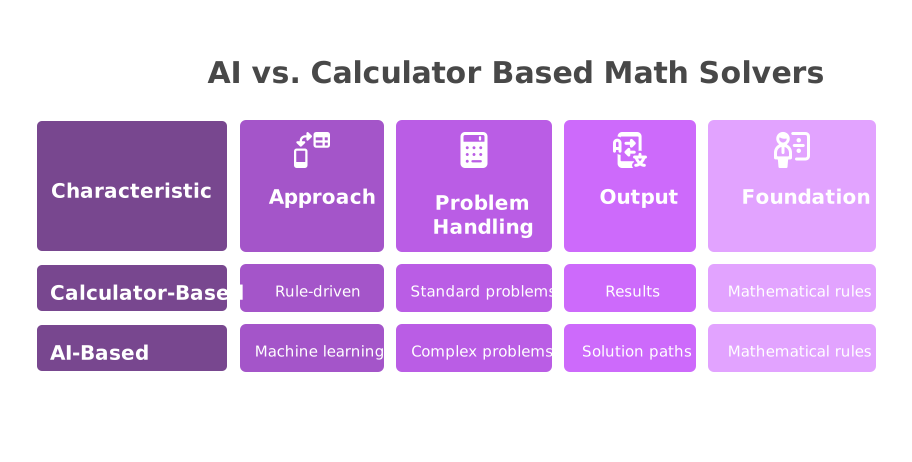
1. Understanding a Question - Input Processing
Every math solver begins by recognising the input. This can happen in three ways:
- Typed equations (e.g., 2x + 5 = 15)
- Scanned or photographed handwritten problems (using optical character recognition – OCR)
- Handwritten input (on tablets or using some writing apps)
The Math solver converts this input into a symbolic mathematical form that a computer can process. Numbers, variables, operators, and math notations are identified and structured correctly before solving begins.
2. Recognising and Processing the Math Symbols - Parsing
Once the input is recognised, the solver parses the equation:
- It identifies the type of problem (algebra, calculus, trigonometry, statistics, etc.)
- It determines relationships between symbols (e.g., which terms are grouped, powers, fractions, functions)
AI-based math solvers use trained models to interpret complex or unclear inputs, while rule-based solvers follow strict mathematical grammar. This is why clear input often leads to more accurate results.
3. Applying Mathematical Rules - Core Logic
This step is the heart of the math solver. Here, the actual math solver work begins.
Math solvers do not "think" like humans. Instead, they apply:
- Predefined mathematical rules.
- Logical transformation steps.
- Verified formulas and identities.
For example:
- Solving equations → isolate variables using inverse operations.
- Differentiation → apply calculus rules (product rule, chain rule, etc.).
- Integration → match patterns to known integrals.
- Simplification → follows algebraic identities step by step.
This is why reliable solvers can also show step-by-step solutions, and each step follows a valid mathematical rule.
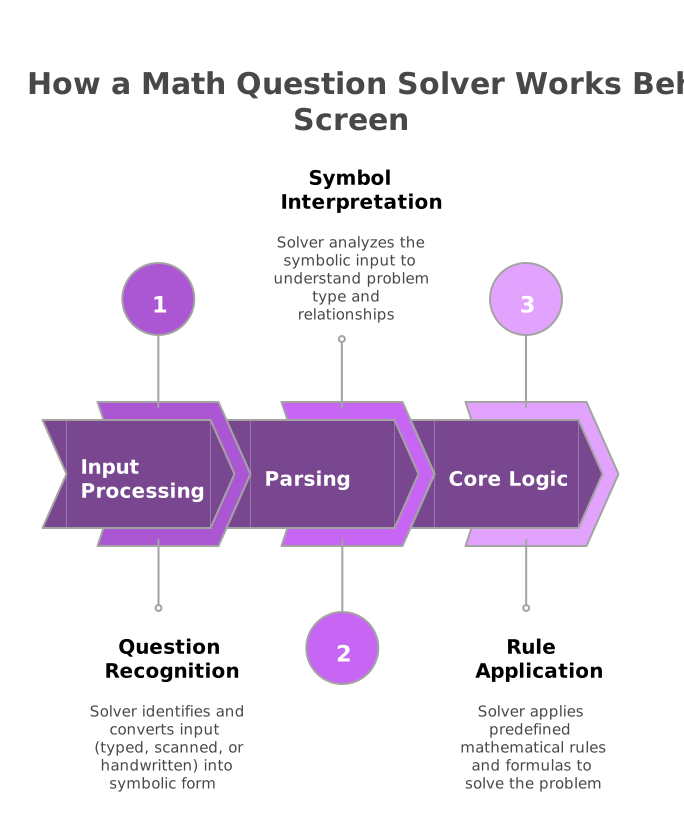
Now, let's see the differences between AI-Based Solvers and Calculator-Based Solvers.
Understanding this difference helps students use tools correctly.
Calculator-Based Math Solvers
- Rule-driven and deterministic.
- Follow fixed math formulas and procedures.
- Excellent for accuracy in standard problems.
- Limited flexibility with complex math word problems.
AI-Based Math Solvers
- AI math solving uses machine learning to interpret various inputs, such as differential equations and visual aids.
- Better at handling word problems and scanned questions.
- Can suggest solution paths, not just results.
- Still grounded in mathematical rules (not guesses).
Both types rely on logic, not guesswork or shortcuts.
Clearing a Common Misconception: It's Not "Magic."
A math question solver does not understand mathematics the way a student does. It doesn't doubt or explore alternatives.
Math solvers simply:
- Recognises symbols,
- Classifies the problem,
- Applies correct rules in sequence, and
- Produces a valid output.
When students view math solvers as logic engines rather than answer machines, they begin using them more effectively and consciously for verification, to learn steps, and to correct misunderstandings.
Math solvers become powerful learning tools and create personalized learning paths when used effectively to improve mathematical thinking.
3. Types of Math Solver Calculators Available Today
Not all math solvers are the same. A math solver calculator with steps is usually designed for a specific level, topic, or syllabus.
Understanding the different types helps students choose the right tool for learning rather than getting confused.
Below are the main categories of math solver calculators used by students today, aligned with school and global curriculums.
1. Arithmetic Math Solvers (Foundational Level)
What they solve
- Addition, subtraction, multiplication, division
- Fractions, decimals, percentages
- Ratios, averages, basic number operations
Who should use them
- Primary and middle school students
- Learners building number sense
- CBSE (Grades 3–6), UK KS2, early IB PYP
Why do they matter?
Arithmetic solvers focus on step-by-step breakdowns, helping students understand how numbers are manipulated, not just the final answer. These tools are ideal for strengthening fundamentals.
2. Algebra Math Solvers (Core School Maths)
What they solve
- Linear and quadratic equations
- Simultaneous equations
- Factorisation and simplification
- Inequalities and functions
Who should use them
- Secondary school students
- CBSE (Grades 7–10), GCSE Maths, IGCSE
- Foundation for Edexcel and IB MYP
A good math solver calculator with steps shows:
- How equations are rearranged
- Why each algebraic step is valid
- How to prevent common mistakes (sign errors, skipped steps)
These solvers are extremely useful for exam-aligned practise.
3. Calculus Math Solvers (Advanced Level)
What they solve
- Differentiation and integration
- Limits and continuity
- Applications of calculus (maxima/minima, area under curves)
Who should use them
- Senior secondary students
- CBSE Class 11–12
- Edexcel A Level Maths, IB DP, AP Calculus
Calculus solvers must match the exam specification. A solver aligned with Edexcel or IB explains steps differently from one designed for competitive exams.
4. Word Problem Math Solvers (Conceptual + Applied Maths)
What they solve
- Real-life application problems
- Ratio, speed–distance–time
- Probability and statistics-based questions
- Multi-step reasoning problems
Who should use them
- Students preparing for competitive exams
- Higher-level school learners
- CBSE, GCSE, IB, Edexcel students need application clarity
These solvers use AI-based parsing to:
- Translate words into equations
- Identify known and unknown variables
- Solve step-by-step logically
They are especially useful when students struggle to form equations from text.
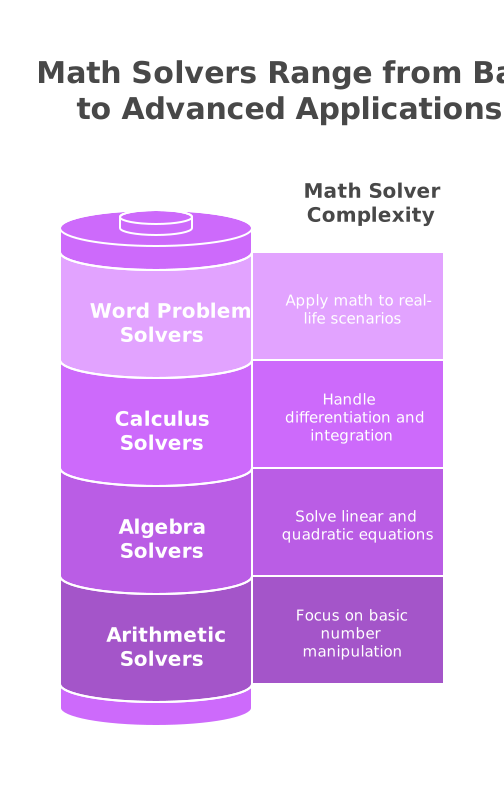
Not every solver suits every student. Choose the right math solver that:
- Matches your syllabus
- Explains steps clearly, not just answers
- Reinforces conceptual learning
When used correctly, math solvers support learning across CBSE, GCSE, IB, and Edexcel, helping students move from confusion to clarity—one logical step at a time.
4. Math Solver with Steps: Why Step-by-Step Solutions Matter
A math solver with steps is far better than a tool that shows only the final answer.
In mathematics, how you get the right answer matters just as much as the answer itself. Especially in exams where method marks, logical flow, and reasoning are essential.
Let's see why answers alone don't build real understanding
When students rely only on final answers:
- They don't know why a method works
- Mistakes go unnoticed and get repeated
- Learning becomes short-term and exam-dependent
This often leads to rote memorisation rather than genuine problem-solving ability.
Importance of reasoning and method clarity
Step-by-step math solvers break a problem into clear, logical stages:
- Each transformation is explained
- Rules and formulas are applied visibly
- Students learn when and why to use a method
This works exactly like how teachers award marks in CBSE, GCSE, IB, and Edexcel exams, where method marks are crucial, even if the final answer is incorrect.
How step-by-step solvers support concept retention
Many studies state that conceptual learning beats memorisation. A math solver with steps supports this by:
- Reinforcing logical thinking
- Strengthening long-term memory through structured reasoning
- Helping students connect new problems to known concepts
Teachers often recommend step-based solvers as guided learning tools, similar to worked examples in textbooks. Because they promote active learning rather than copying.
Teacher-recommended way to use a math solver with steps to maximise learning:
- Try solving the problem yourself first
- Use the solver only to check the method, not to copy the answer
- Compare your steps with the solver's explanation
- Re-solve the problem without help
Used this way, a math solver with steps becomes a powerful learning companion, building clarity, confidence, and mathematical understanding rather than shortcut-based dependency.
5. Free Math Solvers vs Paid Tools: What’s the Real Difference?
When students search for a free math solver, they will have a question about whether paid tools are actually worth it or not.
The truth is,
Both free and paid math solvers have their place. But they serve different learning needs. Understanding the real differences helps students and parents choose wisely.
1. Feature Comparison: Free vs Paid Math Solvers
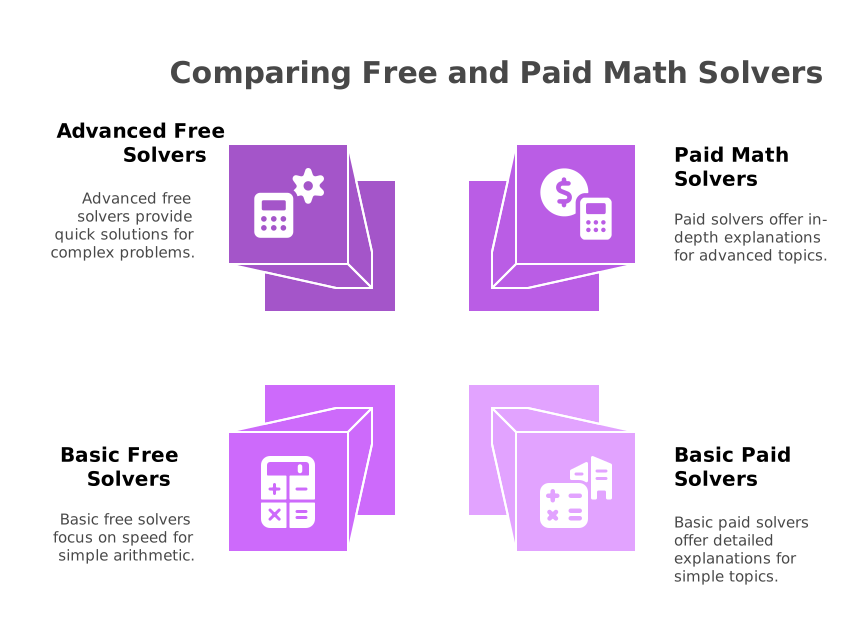
Free math solvers usually offer:
- Quick final answers
- Limited step-by-step guidance explanations
- Basic coverage of arithmetic and simple algebra
- Daily usage limits
Paid math solvers typically include:
- Full step-by-step solutions
- Detailed explanations with reasoning
- Support for advanced topics (calculus, matrices, statistics)
- Word problem breakdowns and multiple solving methods
Free tools focus on speed, while paid tools focus on depth.
2. Step visibility limits: Where free tools have a limit
Many free math solvers show:
- Only partial steps
- Blurred or locked explanations
- "Upgrade to view full solution" prompts
This can be frustrating for students who want to understand the logic, not just the answer.
Paid tools remove these limits and show a maths solver with steps clearly, similar to how a teacher would explain on the board.
3. Accuracy vs depth: What really matters for learning
Most modern math solvers are free or paid, but are accurate for standard problems.
But the real difference is in:
- Depth of explanation
- Alternative solution methods
- Error handling
Free solvers are suitable for:
- Quick checks
- Homework verification
- Simple revision
Paid solvers are better for:
- Concept-building
- Exam preparation
- Advanced or multi-step problems
Now the choice is yours to choose the best suitable one for you.
Choose a free math solver if you need fast answers or basic help.
Choose a paid solver if you want structured learning, deeper understanding, and exam-level clarity.
By default, neither option is "better".
The right choice depends on how the tool is being used. When used as a learning tool, not as shortcuts, both free and paid math solvers can support strong mathematical understanding.
6. Accuracy & Limitations of Online Math Solvers
A math solver can be a powerful learning tool, but it is not flawless.
While most modern math solvers are highly accurate for standard problems, students must understand where these tools work well and where they fail.
Knowing these limits is essential for safe and effective learning, especially for exams.
Let us see where Math Solvers fail:
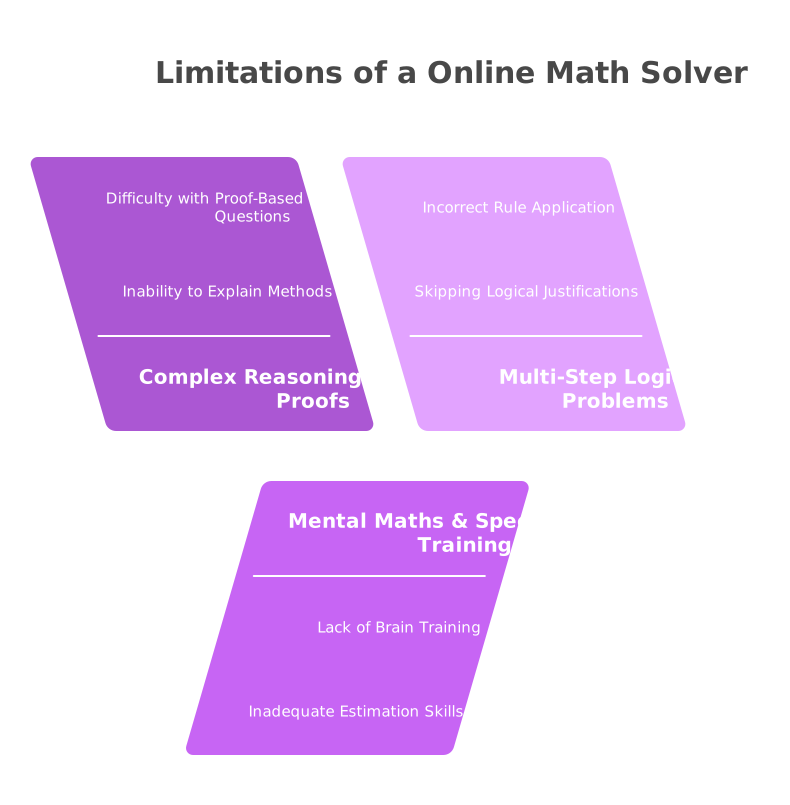
Due to advanced algorithms and AI, math solvers struggle in several key areas:
1. Complex reasoning & proofs
Solvers can compute results, but they often fail to explain why a method works, especially in proof-based questions, modelling tasks, or reasoning-heavy exam problems.
2. Mental maths & speed training
A math solver gives answers, but it does not train the brain for fast calculations. In strictly time-bound exams, students need mental agility, estimation skills, and number sense—something no solver can replace.
3. Multi-step logic problems
In long questions, solvers may:
- Skip logical justifications
- Apply an incorrect rule at an early step
- Write a correct-looking final answer using the wrong process
This is risky because exams award marks for method, not just the final result.
Now, let's look at the risks of over-dependency on math solvers.
- Overusing a math solver can create hidden learning gaps
- Students recognise answers but cannot reproduce steps independently
- Confidence drops in exams and tests when tools are unavailable
- Weak problem-solving stamina develops over time
Teachers frequently observe that students who rely too heavily on solvers:
- Freeze on unfamiliar questions
- Struggle with time management
- Make avoidable calculation errors under pressure
Accuracy is high with the use of the Math solver, but not absolute.
For routine arithmetic, algebra, and standard calculus, most math solvers are accurate 80–95% of the time.
However, accuracy drops when:
- The question requires interpretation or assumptions
- Multiple methods are possible
- The problem mixes concepts (e.g., algebra + mechanics)
This is why you don't blindly trust the math solver.
Then, how to use math solvers safely?
Based on real classroom and exam observations, the safest method to use Math Solvers is:
- Use a math solver to check, not to learn first
- Compare the solver's steps with your own method
- Re-solve the problem without looking at the solution
- Treat errors as learning signals, not failures
When a math solver is used correctly, it supports learning. If used blindly, it can weaken your math skills and thinking capability.
Remember, mathematical strength comes from practise, reasoning, and speed skills, and no online tool can fully replace all of these.
7. Best Use of a Math Solver for Learning (Not Copying Answers)
A math question solver is most powerful when it supports math thinking, not when it replaces it. When used correctly, it becomes a learning companion; when misused, it becomes a shortcut that weakens understanding.
The key part is how and when students use it.
Let's see when to use and when not to use the Math solver.
When should you use a math question solver?
A math solver is appropriate when:
- Checking homework or self-practise answers
- Reviewing mistakes after tests or mock exams
- Learning alternative methods for the same problem
- Clarifying a specific step you don't understand
- Practising independently without a teacher available
In these situations, Math solvers support understanding and correct thinking of math problems.
When should you not use a solver?
Avoid using a math solver:
- During exams, tests, or graded assignments
- Before attempting the problem yourself
- As a replacement for concept learning
- To memorise steps without understanding
- For mental maths or speed-building practise
Using solvers in these cases leads to dependency on math solvers and affects exam performance.
Then, how to use a math solver the right way?
Follow this approach to use the math solver the right way:
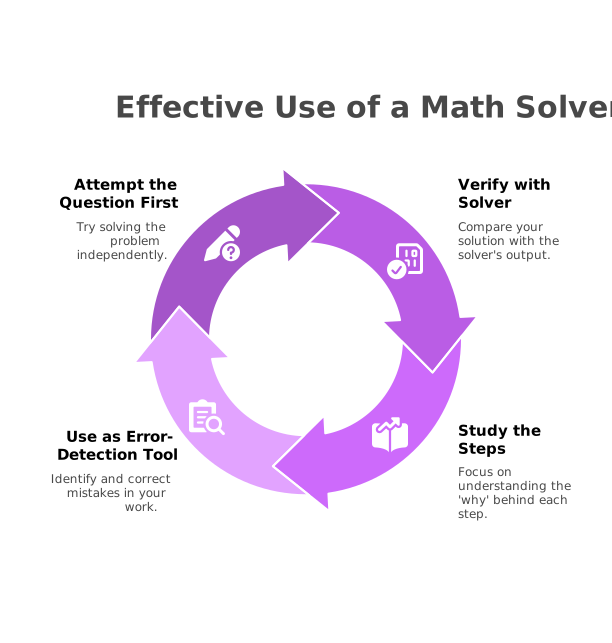
1. Attempt the question first
Always try solving the problem on your own before opening a math solver.
Even partial attempts activate recall and reasoning, which is essential for long-term learning.
2. Use the solver to verify, not generate answers
Compare your solution with the solver's output.
Check:
- Did you choose the correct method?
- Where did your steps differ?
- Was the final answer or the method incorrect?
3. Study the steps, not just the result
Focus on why each step works. Rewrite the solution in your own words or re-solve the problem without looking. This builds method clarity—what examiners actually expect and reward.
4. Use it as an error-detection tool
A math solver is excellent for spotting algebraic slips, sign errors, and calculation mistakes, which are common issues on exams.
Academic integrity & ethical learning
Educational institutions expect students to:
- Use tools for learning support, not copying the answer
- Build independent problem-solving skills
- Submit original work based on personal understanding
When a math solver is used correctly, it aligns with academic integrity standards and modern learning practises. It helps students learn smarter.
8. Why Math Solvers Fail Without Strong Calculation Skills
A math solver with steps can explain what to do, but it cannot replace the calculation skills students must develop on their own.
In real classrooms and exams, we consistently see that students who rely heavily on Math solvers struggle the most with weak basic arithmetic, number sense, and mental calculation skills.
When students lack fluency in:
- Basic arithmetic
- Fractions, ratios, and percentages
- Algebraic manipulation
- Sign and simplification accuracy
They start to depend on a math solver for every single step. Over time, this dependency grows.
Instead of understanding the logic, students wait for the math solver with steps to tell them what to do next. This creates chaos in learning, where the brain follows instructions given by a math solver rather than thinking independently.
From my teaching experience, I can say that students who overuse solvers often:
- Know the "steps" but not the reasoning
- Panic when numbers change slightly
- Freeze when a problem is framed differently
- Struggle to continue if one step looks unfamiliar
What students need to understand here is that speed and number sense cannot be developed by relying on a Math solver.
Math solvers are not designed to build:
- calculation speed
- mental maths ability
- estimation skills
- numerical intuition
These are the essential skills needed in the exams.
In time-bound tests, students need to quickly:
- simplify mathematical expressions
- spot calculation shortcuts
- estimate answers
- avoid careless arithmetic errors
Students with weak foundations in calculation take longer to understand even the solver-generated steps. They copy procedures without understanding why they work—leading to repeated mistakes when working independently.
Why don't exams allow math solvers?
Exams deliberately prohibit calculators with symbolic solvers and AI assistant tools because:
- Exams assess thinking under pressure, not tool usage
- Method marks reward reasoning, not final answers
- Real understanding shows in step selection and flow
- Solvers hide mistakes; students must learn to avoid them.
In real exam scripts, most marks are lost due to:
- algebraic slips
- sign errors
- incomplete working
- slow calculations under time pressure
A math solver with steps cannot help at that moment.
Usually, students with strong calculation skills use solvers occasionally, but Students with weak fundamentals use solvers constantly and fall behind.
It's all about math fluency, especially the foundation.
Math solvers work best after students build:
- Solid arithmetic and algebra basics
- Mental calculation speed
- Confidence in manual problem-solving
Once students are masters of these, then a math solver becomes a support tool.
9. Using Vedic Maths to Reduce Dependency on Math Solvers
Overdependency on a math solver often begins when students feel calculations are slow, confusing, or mentally exhausting. This is exactly where Vedic Maths makes a powerful difference.
Instead of replacing thinking with tools, Vedic Maths strengthens the brain's ability to calculate faster, think clearly, and solve problems independently.
How does Vedic Maths build speed and clarity?
Vedic Maths focuses on mental calculation techniques that simplify arithmetic into fewer, smarter steps.
Students learn to:
- Perform fast multiplication and division mentally
- Handle fractions, partial fractions, ratios, and percentages with ease
- Estimate answers instantly to check correctness
Read our blog, "Vedic Maths for Multiplication," to learn easy and smart multiplication techniques using Vedic Maths.
When calculations become faster, students stop reaching for a math solver for every step. The brain stays engaged and confident.
Where does Vedic maths replace Math solver usage?
In real learning situations, Vedic Maths replaces math solvers in areas such as:
- Long arithmetic calculations that slow students down
- Checking answers quickly without re-solving
- Spotting shortcuts in multi-step problems
- Reducing careless errors
For example,
Problems that generally require a math solver calculator with steps can often be completed mentally in seconds using Vedic Maths techniques, which boost students' confidence and reduce their dependence on math solvers.
Read our blog "Vedic Maths Tricks with PDF" to learn smart Vedic Maths techniques.
When students master these Vedic Maths techniques, while solving any math problem, instead of thinking
"Which math solver should I use?"
They will begin to think,
"What's the fastest way to solve this?"
Math solvers explain steps, but they don't build:
- number sense
- mental agility
- calculation confidence
- exam readiness
Vedic Maths fills this exact gap using Vedic Math techniques, mental math shortcuts, and its 16 sutras and 13 sub-sutras. It makes them solver-independent, especially in exams where math solvers are not allowed.
Learn these Vedic Maths tricks in just 40 days with our Live Vedic Maths Class Program, designed and taught by Mamta Rupesh, a certified Vedic Maths teacher with over 8 years of experience, who has trained 15,000 students, 5,000 parents, and 5,000 teachers to date, and continues to train across the globe.

Live Vedic Maths Classes Best Selling
Its a 40 day live Classes thought only for children from Grade 3 to 12 covers from Basics to Advance.
- 40 Day Live Program
- Get Individual Attention
- Certification & Lifetime Access
You can also learn Vedic Maths at your own pace using our Vedic Maths Bundle Kit—a pre-recorded course with 25 hours of video tutorials suitable for students, parents, and teachers.

Vedic Maths Bundle Kit Best Selling
Perfect program designed for students from grade 3 - 12, teachers & parents aspiring to grow their career & upskill their children.
- Bundle Offer
- Worksheets & Exercise Problems
- Certification & Lifetime Access
Also, access free downloadable Vedic Maths worksheets to practise the techniques and shortcuts learned during the course.
Download the free worksheets today with a simple sign up and practise Vedic Maths techniques in different question formats, screen-free.
The courses provide lifetime access, and you can clear all your doubts with an expert like Mamta Rupesh by joining our Vedic Maths WhatsApp community today. You will also get the latest updates on upcoming classes and courses.
Visit www.thevedicmaths.com or contact us at +91-866-056-2614 or info@thevedicmaths.com to learn more.
Don’t wait any longer.
Book a free 45-minute personalized demo class today to know more about our Vedic Maths course.
Why learn Vedic Maths from Mamta Rupesh?
Listen to what our students, parents, and teachers say about why they chose Mamta Rupesh to learn Vedic Maths.


Testimonials from Students
Here are a few reviews from Parents


It has been wonderful experience for my granddaughter. Our brain is nothing but a number crunching machine. Vedic Maths sharpens the brain and improves this number crunching ability.
Madam Mamata has been very good and her teaching was nice. She is sincere and caring towards students.
Please continue the good work and I wish you best luck for the future journey.

Mukund Oke
Happy Grandfather, India
The most interesting and helpful class in the world,
The teacher always clears our doubts until we are clear about the concepts.
Her teaching style is very interactive. she keeps the class more fun also .Thank you mam for giving us a wonderful opportunity to learn with you.

Sengamala Priya
Happy Mother, UAE
I had enrolled my daughter for vedic math class with Miss Mamta and it was a good experience for her to learn the math concepts. Miss Mamta was patiently guiding through the course, helping out in case of doubts and flexible with kids. Thanks for sessions, it was really helpful.
Thivya Nagarajan
Happy Mother, Singapore
Thank you for your wonderful sessions. My daughter really enjoyed throughout this course. No fear of Maths which she had experienced before with abacus.
You will be greatly missed!
Looking for some advanced classes for kids soon!
Geethu Sajad
Happy Mother, UAE
Ms Mamta is very warm and jovial. She made my child feel very comfortable. By sharing her own challenges in math in her early years and how she overcame these challenges she makes everything seem possible. During this short duration of the demo she showed atleast 5 tricks to solving problems there by piquing my daughter’s interest. We are very much looking forward to the classes with Ms Mamta.
Veena Krishnamurthy
Happy Mother, Malaysia
She is an amazing teacher. She has a “no frills, student centered” teaching approach. The personal attention towards every learner in a virtual environment is indeed praiseworthy. The illustrations and practice exercises are perfect to overcome mathematics phobia. As a teacher, I can safely say, she is a wonderful person to teach Maths to the kids of all age groups.
Dr. Manishankar Chakraborty
Happy Father, UAE
10. Smart Study Strategy: Math Solver + Concept Mastery
A math solver calculator with steps works best when used for learning, not to replace thinking. High-performing students follow a balanced study routine that combines concept mastery, consistent practise, mental math techniques, and smart use of solvers for verification. This approach builds long-term skills, exam readiness, and confidence.
10.1 Balanced learning framework
Here is a balanced learning framework
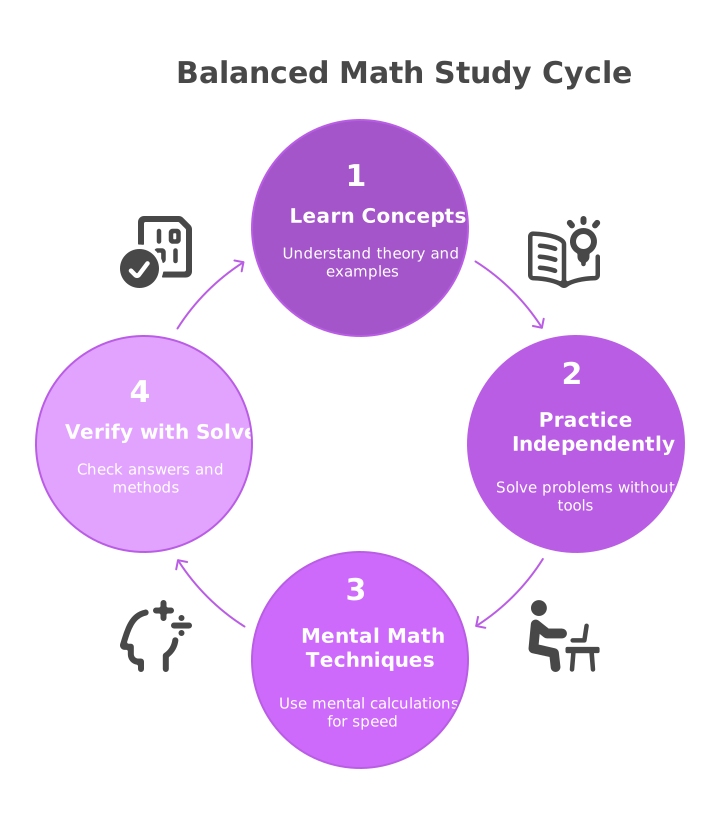
1. Learn the concept first
Start with theory and worked examples from textbooks or class notes.
Focus on why a method works before how to apply it. This establishes strong mental models that are essential for applying to new problems.
2. Practise to mastery
Solve problems independently without tools initially. Aim for accuracy and clear reasoning. Repetition across varied questions builds fluency and pattern recognition.
3. Mental math for speed
Use mental calculation techniques (estimation, simplification, shortcuts) to handle arithmetic and algebra quickly.
Speed reduces cognitive load and prevents careless errors—especially in timed exams.
Read our blog, "Mental Maths - An Ultimate Guide to Fast and Fear-free Calculations," to know how mental maths helps with exams.
4. Use the math solver for verification
Now use a math solver calculator with steps to:
- Check final answers
- Compare methods and spot missed steps
- Find out where an error occurred
- Learn alternate solution paths
This way, students can use the math solver for feedback and validation, not for dependency.
Here is a simple weekly structure
- Daily (20–30 min): Concept review + independent practise
- Daily (10 min): Mental math drills (estimation, simplification)
- 2–3 times/week: Mixed practise sets - interleaving topics improves retention
- After practise: Verify selected problems using a math solver with steps
- Weekly: Error log review - rewrite incorrect solutions correctly
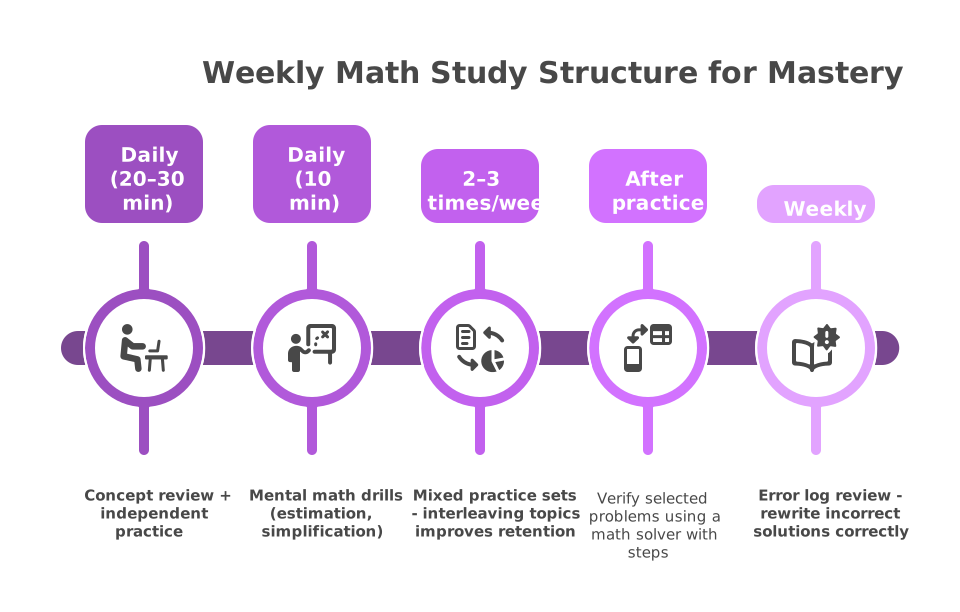
This structure includes active recall, spaced repetition, and retrieval practise—all proven to improve long-term learning.
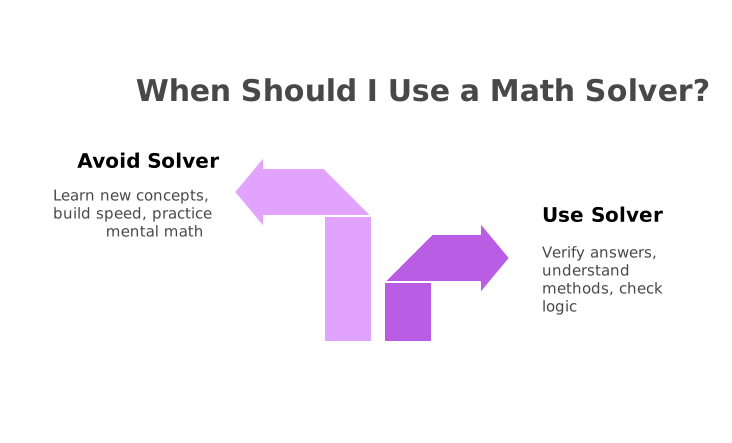
10.2 When to use a solver and when not to
Use a solver when you want to:
- Verify answers after attempting on your own
- Understand an unfamiliar method after trying
- Check the multi-step algebra or calculus logic
Avoid a solver when you should be:
- Learning a new concept for the first time
- Building speed and exam stamina
- Practising mental math and estimation
10.3 Long-Term Skill Development
A student's real goal is to develop long-term skills.
Students who follow these strategies:
- Retain concepts longer
- Become faster without compromising on accuracy
- Rely less on tools over time
Perform better in exams where solvers aren’t allowed
When a math solver calculator with steps is used wisely, it becomes a powerful coach. Combining concepts with mental math techniques helps students learn and practise them independently and effectively.
11. Trusted Math Solver Tools & Resources
Choosing the right math solver free tools is important. Not all solvers are equally accurate, educational, or exam-aligned.
Trusted math solvers should explain the process, follow standard mathematical conventions, and support learning rather than promote shortcut dependency.
11.1 Authoritative Math Solvers Platforms — Globally Trusted
- Best for: Algebra, calculus, linear algebra, statistics
- Strength: Strong symbolic engine with logical step breakdowns
- Limitation: Some detailed steps require paid access
2. Symbolab
- Best for: Algebra, calculus, trigonometry
- Strength: Clear, beginner-friendly step-by-step solutions
- Limitation: Advanced steps may be locked in the free version
3. Desmos (Graphing Calculator)
- Best for: Functions, graphs, visual understanding
- Strength: Excellent conceptual clarity through visualisation
- Limitation: Not a complete step-by-step algebra solver
4. GeoGebra
- Best for: Geometry, algebra, calculus, coordinate geometry
- Strength: Curriculum-aligned for GCSE, IB, CBSE, Edexcel
- Limitation: Requires conceptual understanding to use effectively
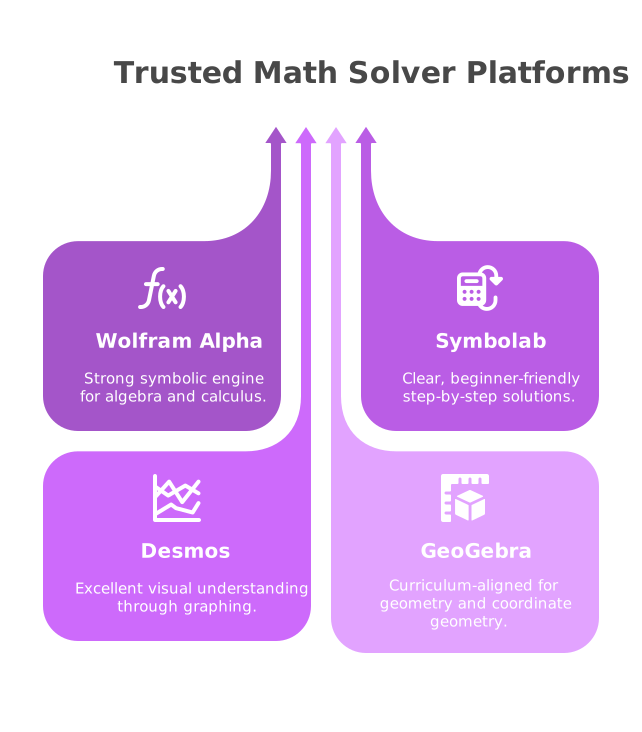
These tools are considered educationally safe and are often recommended by teachers for checking work and understanding methods.
11.2 Educational Calculator-Based Solvers (Exam-Oriented)
1. Scientific & Graphing Calculators (Casio / TI)
- Allowed in many exams (GCSE, A Level, IB – model dependent)
- Useful for:
- Equation solving
- Numerical approximations
- Statistical calculations
Important note: Calculators cannot replace the method marks awarded in exams
2. Online Calculator Simulators
- Help students practise calculator skills legally and ethically
- Useful for exam familiarity, not concept learning
While many math solver free tools are helpful, students should be cautious that :
- Some tools show answers without logic
- Some skip steps or use non-standard methods
- Overuse can weaken reasoning and speed
Always use math solvers only after attempting the problem independently.
11.3 Structured Learning Programs (Internal Authoritative Resources)
To reduce long-term dependence on solvers and build real mathematical confidence, structured learning is essential.
1. Live Vedic Maths Classes (Grades 3–12)
- Focus: Speed, clarity, mental calculation
- Helps students to:
- Solve faster without calculators
- Reduce algebraic and arithmetic errors
- Handle exams confidently where solvers are not allowed
2. Vedic Maths Bundle Kit (Self-Paced Learning)
- Ideal for: Students, parents, teachers, competitive exam aspirants
- Includes:
- 25+ hours of structured lessons
- Worksheets
- Lifetime access
Using these programs, students gradually stop depending on a math solver.
These programs are designed by Mamta Rupesh, a Vedic Maths expert with 8+ years of teaching experience, and she has trained 15,000+ students, 5,000+ parents, and teachers to date.
12. Conclusion
Math solvers have completely changed the way students approach problem-solving. When used correctly, a math solver or maths solver with steps becomes a powerful learning support that helps students understand methods, verify answers, and gain clarity when they feel stuck.
From algebra and calculus to basic arithmetic, these tools make learning more accessible — especially when time pressure and academic load are high.
However, true mathematical confidence does not come from depending on a math solver calculator with steps for every problem.
Real progress happens when students first build strong concepts, practise independently, and develop calculation speed and number sense.
This is why combining smart solver usage with mental maths techniques and structured practise is essential.
Tools can support learning, but they cannot replace thinking, reasoning, and exam readiness.
By following a balanced study strategy such as learning concepts first, practising actively, using solvers only for verification, and strengthening calculation skills through Vedic Maths, students gradually reduce dependency on tools and become confident, independent problem solvers.
13. FAQs on Math Solvers
1What is a math solver, and how does it help students?
A math solver is a digital tool that solves math problems and explains the solution step by step. It helps students understand methods, verify answers, and reduce confusion while learning topics like algebra, calculus, geometry, and arithmetic.
2How to use a math solver tool for geometry homework?
Start by attempting the geometry problem yourself. Then use a maths solver with steps to:
- Verify constructions, angles, or equations
- Understand geometric reasoning and formulas
- Check where a mistake occurred
- Avoid copying answers directly—focus on understanding the logic behind each step.
3Best maths solver apps with step-by-step solutions?
Some widely used and teacher-recommended maths solver apps with step-by-step explanations include:
- Symbolab – clear steps for algebra, calculus, and trigonometry
- Wolfram Alpha – strong symbolic and calculus solving
- GeoGebra – excellent for geometry and visual learning
- Microsoft Math Solver – beginner-friendly explanations
4Free math problem solver with step-by-step breakdowns – does it exist?
Yes. Several platforms offer a math solver free version with partial or complete steps:
- Symbolab (limited steps in free version)
- Microsoft Math Solver
- GeoGebra
Free tools are best for basic verification; advanced steps may require paid access.
5Best apps for solving algebra problems step-by-step?
For algebra-focused learning, the best options are:
- Symbolab – detailed algebraic steps
- Microsoft Math Solver – good for school-level algebra
- Wolfram Alpha – powerful for higher algebra and equations
These apps act as reliable math solver calculators with steps when used correctly.
6Top online services that solve calculus questions instantly?
Popular calculus solvers include:
- Wolfram Alpha – differentiation, integration, limits
- Symbolab – beginner-friendly calculus steps
- Desmos – visual understanding of functions (not complete steps)
They help check work, not replacing concept learning.
7Best websites offering free math problem solutions and explanations?
Some trusted platforms are:
- Wolfram Alpha (limited free access)
- Symbolab
- GeoGebra
- Microsoft Math Solver
These sites are widely used across CBSE, GCSE, IB, and Edexcel curriculums.
8Which math solver apps support Arabic and English interfaces?
Several global math solver apps support both Arabic and English:
Language support makes these tools accessible to students worldwide.
9Can I get a maths problem solver with voice input and step explanations?
Yes. Some modern math solvers offer voice or camera-based input:
- Microsoft Math Solver supports voice and image input
- Google-based tools allow speech-to-text equations
However, step-by-step clarity still depends on the tool and problem type.
10Is using a math question solver considered cheating?
No—if used correctly. A math question solver is ethical when used to:
- Check answers
- Understand steps
- Learn alternative methods
It becomes problematic only when used to copy answers without understanding.
11Are math solvers allowed in exams?
No. Exams do not allow AI math solvers or symbolic math solvers. This is why students must build strong calculation skills, reasoning ability, and speed through practise and mental maths.
12Why do teachers recommend limiting dependence on math solvers?
Because overuse can weaken:
- Mental calculation speed
- Conceptual understanding
- Exam performance under time pressure
Teachers recommend solvers only as verification tools, not learning replacements.
13How can students reduce dependency on math solvers?
Students can reduce dependency by:
- Practising problems independently
- Building mental calculation skills
- Using techniques like Vedic Maths for speed and clarity
- Using solvers only after attempting problems themselves
14Are math solvers useful for parents and teachers, too?
Yes. Parents and teachers use math solvers to:
- Check homework accuracy
- Understand solution methods
- Support children without memorising math formulas
15What is the best long-term approach: math solvers or concept mastery?
The best approach is balance.
Math solvers support learning, but concept mastery, practise, and mental maths create confident, independent problem solvers who succeed without tools.

