

The Edexcel A Level Maths Specification 2026 is one of the most trusted frameworks to help students prepare for advanced mathematics. Whether students are planning a career in engineering, economics, data science, or any STEM field, understanding the Edexcel A Level Mathematics Specification is the first step to strategic planning and exam success.
The official Edexcel A Level specification provides everything you need to know — from core syllabus topics to assessment structure, unit breakdown, and mathematical skills required. It also includes the complete Edexcel A Level Maths syllabus, helping learners and teachers stay aligned with Pearson’s academic standards.
Students choosing advanced math modules: the Edexcel A Level Further Maths spec provides additional depth through topics such as Further Pure Mathematics, Mechanics, and Statistics.
In this blog, let’s explore the Edexcel A Level Maths Specification, download links, a complete syllabus breakdown, the assessment structure, the Further Maths spec for strategic exam preparation, and much more.
Key Takeaways
- The Edexcel A Level Maths Specification is the ultimate preparation road map. It outlines every topic, unit, skill, and exam requirement students need to score confidently in Pure Maths, Statistics, and Mechanics.
- Pure Mathematics forms the core of the syllabus. Two-thirds of the A Level Maths assessment focuses on Pure Maths topics, including calculus, trigonometry, logarithms, integration, functions, and vectors.
- Applied Maths (Mechanics + Statistics) builds real-world problem-solving skills. Students learn motion, forces, probability, distributions, and hypothesis testing — essential for engineering, physics, economics, psychology, and data science.
- Further Maths offers deeper mathematical mastery. The Edexcel A Level Further Maths spec (9FM0) includes Core Pure content and flexible optional modules such as Further Mechanics, Further Statistics, and Decision Maths.
- All exams follow a linear structure with a 100% written assessment
A Level Maths (9MA0):
- Paper 1 – Pure
- Paper 2 – Pure
- Paper 3 – Statistics & Mechanics
Further Maths (9FM0):
- 4 papers (Core Pure + optional modules)
- Official Pearson resources are essential for accurate preparation
Students must rely on:
- Pearson textbooks
- Past papers
- Mark schemes
- Examiner reports
- Pearson training materials
These ensure perfect alignment with the specification.
- A structured, specification-based study plan improves exam performance. Students should follow a 12-month, 6-month, or 3-month revision cycle using concepts like:
- Spaced repetition
- Interleaving
- Active recall
- Timed past-paper practice
- Vedic Maths boosts speed and accuracy. Vedic Maths techniques help with fast calculations in:
- Algebra
- Binomial expansion
- Differentiation
- Integration
- Probability
- Mechanics modelling
This reduces exam stress and improves performance.
- Understanding the specification reduces confusion and builds confidence. Knowing the syllabus early helps students focus on high-weightage topics, reduce uncertainty, and revise strategically.
- Mastering the Edexcel A Level Maths Specification sets a strong foundation for STEM pathways. This qualification supports careers in engineering, computer science, data analytics, physics, economics, architecture, and other competitive fields.
1. Introduction: Why Understanding the Edexcel A-Level Maths Specification Matters
The Edexcel A Level Maths Specification is more than just a syllabus. It is the complete roadmap that guides students on what to study and how to prepare.
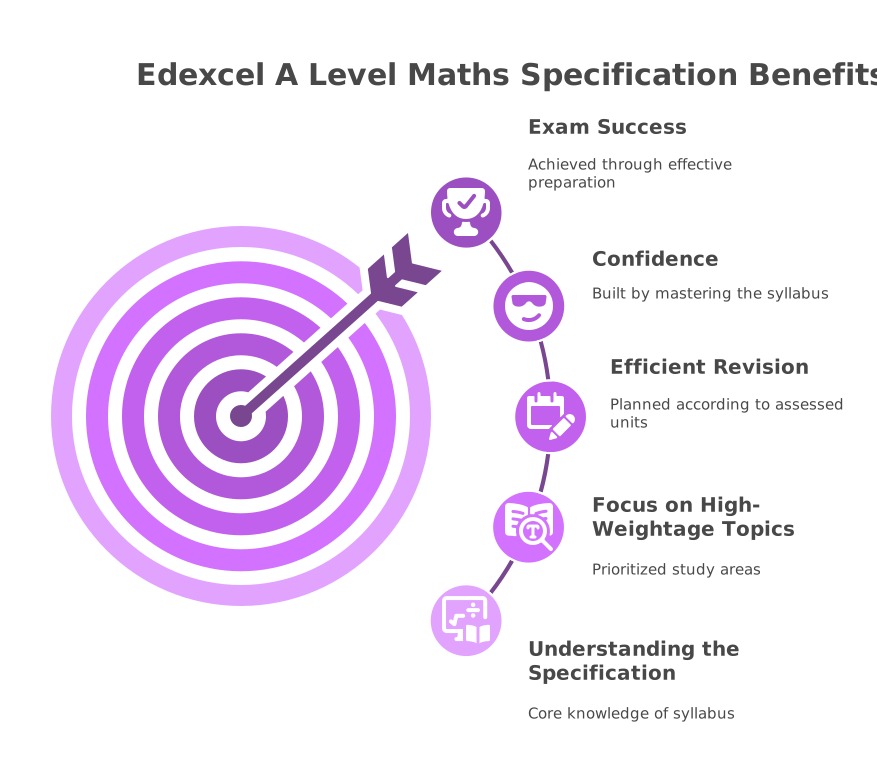
When learners clearly understand the topics, assessment structure, and skills required in the Edexcel A Level specification, they can plan their revision more efficiently, avoid confusion in the final exams, and build confidence throughout the preparation.
By knowing the specification early, students can:
- Structure their revision according to the assessed units
- Focus on high-weightage topics
- Understand the balance between Pure Maths, Mechanics, and Statistics
- Practise exactly what the exam requires instead of guessing
Since the specification is officially published and regulated by Pearson Edexcel, one of the world’s most trusted bodies, it ensures transparency, reliability, and global academic standards.
For any student aiming for strong grades in 2026, understanding the specification is the first and most important step.
2. Overview of the Pearson Edexcel A Level Maths Qualification
The Edexcel A Level Mathematics Specification provides a well-structured pathway for students who want to build strong analytical, numerical, and problem-solving skills.
It is designed by Pearson Edexcel — one of the world’s most trusted awarding bodies. The qualification is followed by millions of learners globally and is highly valued by universities and employers.
The A Level Maths course includes a combination of:
- Pure Mathematics
- Mechanics
- Statistics
This is suitable for students who want to build careers in STEM fields, engineering, economics, finance, data science, architecture, computer science, and research-based fields. It strengthens mathematical reasoning and advanced application skills required at a university level.
Although the course is two years, it follows a linear assessment model, meaning students sit for all final exams at the end of the programme rather than in separate AS and A2 stages. This structure allows learners to build depth, continuity, and mastery over time.
With Pearson supporting over 3 million learners worldwide, the Edexcel A Level Maths qualification remains one of the most internationally respected pathways for advanced mathematics study.
3. Official Edexcel A Level Maths Specification – Download Links
To prepare accurately for A Level Mathematics, students must follow only the official Edexcel A Level specification published by Pearson. This specification outlines everything from unit content and assessment structure to formula sheets and learning objectives, ensuring your revision matches the exact exam requirements.
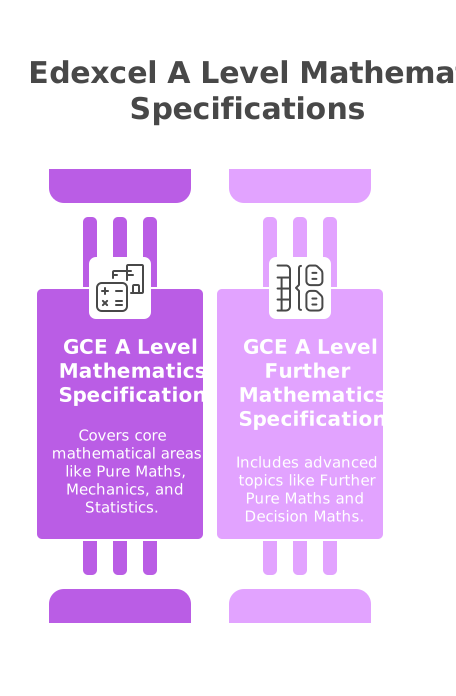
Pearson provides two key specifications.
1. GCE A Level Mathematics Specification (9MA0)
This is the complete syllabus for A Level Maths, covering:
- Pure Mathematics
- Mechanics
- Statistics
- Assessment objectives
- Exam structure and weightage
2. GCE A Level Further Mathematics Specification (9FM0)
Students who wish to pursue advanced mathematical pathways can refer to the Edexcel A Level Further Maths spec, which includes:
- Further Pure Mathematics
- Decision Maths
- Further Statistics
- Further Mechanics modules
Both documents are available on the official Pearson Edexcel website under the GCE Mathematics section. Students, parents, and teachers should always download the latest version directly from Pearson to ensure accuracy, as it will update every year.
The official Pearson specifications are the most reliable source for anyone preparing to use the Edexcel A Level specification, ensuring complete alignment with the 2026 exam requirements.
Download the GCE A Level Mathematics Specification (9MA0) PDF here.
Download the GCE A Level Further Mathematics Specification (9FM0) PDF here.
4. Full Syllabus Breakdown: Pure Mathematics
Pure mathematics forms the foundation of the Edexcel A Level Maths Syllabus. Mastering Pure Maths is essential because it builds the core algebraic, geometric, and calculus skills applied across Mechanics and Statistics.
Below is a clear breakdown of every major topic area included in the Edexcel A Level Maths specification (9MA0), along with the skills students must develop and sample-style questions similar to those found in real Edexcel past papers.
1. Algebra & Functions
Covers:
- Manipulating algebraic expressions
- Solving equations & inequalities
- Polynomial graphs
- Composite and inverse functions
- Modulus functions
Sample Exam-Style Question:
Solve the inequality |2x – 5| < 7 and represent the solution on a number line.
2. Coordinate Geometry
Covers:
- Equations of straight lines
- Circles and geometric properties
- Using coordinate geometry to prove identities
Sample Exam-Style Question:
Find the equation of the circle with centre (–3, 2) that passes through the point (1, 6).
3. Sequences & Series
Covers:
- Arithmetic progressions (AP)
- Geometric progressions (GP)
- Sigma notation
- Proofs using mathematical induction
Sample Exam-Style Question:
Show that the sum of the first n terms of a GP is Sn = a(1−rⁿ) / (1−r) for r ≠ 1.
4. Trigonometry
Covers:
- Trigonometric identities
- Radian measure
- Sine, cosine, tangent rules
- Sketching graphs and solving equations
Sample Exam-Style Question:
Prove that sin(2x) + cos(2x) = √2sin(2x + 45∘)
5. Exponentials & Logarithms
Covers:
- Laws of logarithms
- Natural logs (ln)
- Exponential models
- Growth & decay applications
Sample Exam-Style Question:
Solve the equation 3^2x = 7. 3^x
6. Differentiation
Covers:
- Rules of differentiation
- Chain, product, quotient rules
- Stationary points
- Differentiation of exponentials, trigonometric & logarithmic functions
Sample Exam-Style Question:
Find the turning points of the curve y = x³ - 6x²+ 9x
7. Integration
Covers:
- Basic integration rules
- Integration by substitution & by parts
- Definite integrals
- Area under curves
- Differential equations
Sample Exam-Style Question:
Evaluate ∫(4x² - 3x + 1) dx.
8. Numerical Methods
Covers:
- Iteration methods
- Finding roots of equations
- Error bounds and approximations
Sample Exam-Style Question:
Use iteration to find an approximate root of the equation
x³ - 6x - 5 = 0
9. Vectors
Covers:
- Vector equations of lines
- Magnitude & direction
- Scalar and vector products
- Application in 3D geometry
Sample Exam-Style Question:
Given vectors a = (2, -1, 3) and b = (1, 4, 2), find a x b and the angle between them.
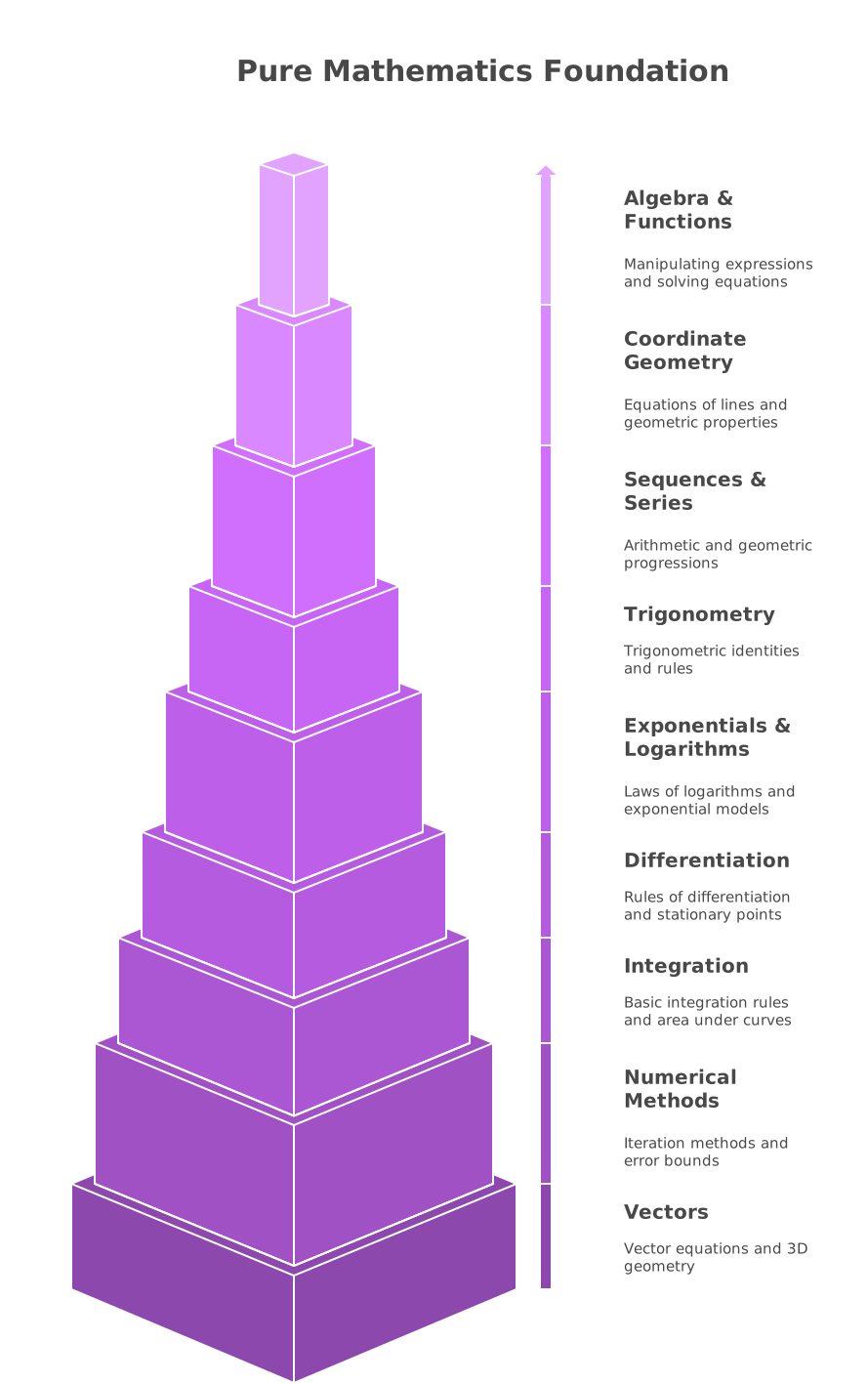
Understanding the Edexcel A Level Maths syllabus thoroughly helps students plan revision smartly and helps them score highly in exams.
5. Applied Mathematics: Mechanics
The mechanics of the Edexcel A Level Mathematics Specification focus on applying mathematical methods to real-world situations. It teaches students how objects move, how forces act on bodies, and how momentum, motion, and equilibrium are related.
Mechanics is important for students planning careers, especially in engineering, physics, architecture, computer science, and aviation. It builds analytical and problem-solving skills used in STEM fields.
Below is the complete topic overview aligned with the Pearson Edexcel A Level Mathematics Specification.
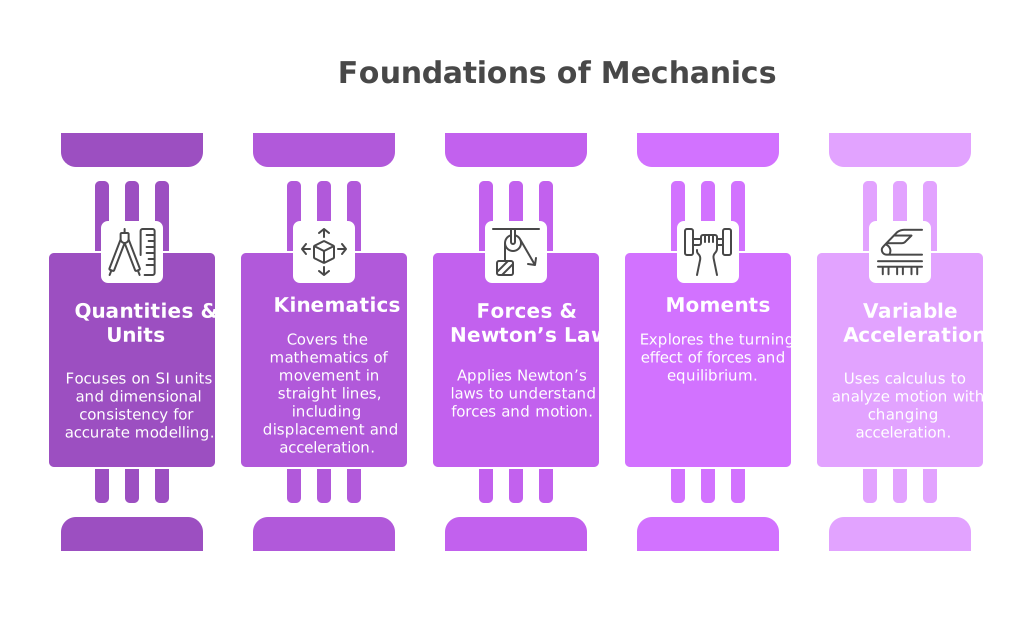
1. Quantities & Units
Students learn:
- SI units (metre, kilogram, second)
- Derived units (m/s, m/s², Newtons)
- Dimensional consistency in equations
Why it matters:
Mechanics uses a physics-style approach. Ensuring units are consistent is essential for accurate modelling.
Exam-style sample:
A particle travels 10m in 2 seconds. Express its average speed with correct SI units.
2. Kinematics
Covers the mathematics of movement in straight lines:
- Displacement, velocity, acceleration
- Constant acceleration equations
- Velocity–time and displacement–time graphs
Exam-style sample:
A particle starts from rest and accelerates at 3 m/s² for 5 seconds. Find its displacement.
3. Forces & Newton’s Laws
Students apply:
- Newton’s First, Second, and Third Laws
- Weight, normal reaction, tension, friction
- Connected particles
- Motion on inclined planes
Exam-style sample:
Two particles are connected by a light, inextensible string over a smooth pulley. Find the acceleration of the system using Newton’s 2nd Law.
4. Moments
Topics include:
- Turning effect of forces
- Centre of mass
- Equilibrium of rigid bodies
Exam-style sample:
A uniform rod is pivoted at one end. A 5N force acts at the other end. If the rod is 2 m long, find its moment about the pivot.
5. Variable acceleration
Focuses on:
- Calculus in motion
- Using differentiation to find velocity & acceleration
- Integrating acceleration to find displacement
Exam-style sample:
The acceleration of a particle is a=6ta = 6t a = 6t. If the initial velocity is 4 m/s, find the velocity after 3 seconds.
Every student wonders why Mechanics is like Physics?
Mechanics integrates physics-style reasoning by:
- Using real-life motion and force models
- Combining mathematical calculation with conceptual interpretation
- Requiring assumptions (smooth surface, negligible air resistance)
- Modelling real systems mathematically, just like in physics
This makes the Mechanics section a hybrid of physics and maths — perfect for students entering scientific and technical fields.
6. Applied Mathematics: Statistics
The Statistics section of the Edexcel A Level Maths syllabus teaches students how to analyse data, interpret probabilities, and make evidence-based conclusions. This part of the course develops essential skills used in economics, business, psychology, research fields, and data-based careers.
Statistics appear alongside Mechanics in Paper 3, making it one of the core components of the Edexcel A Level Maths specification.
Below is the complete topic breakdown:
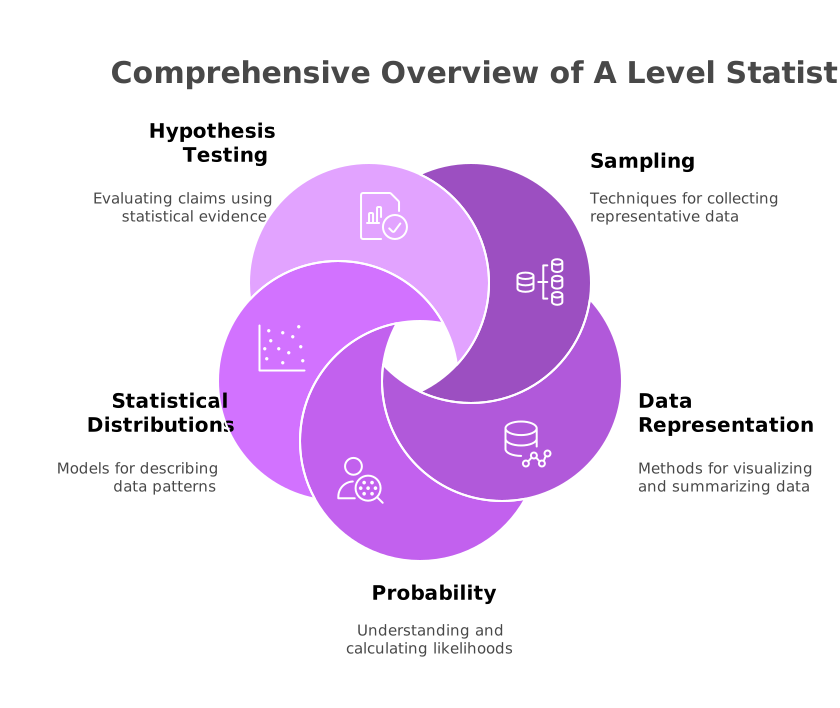
1) Sampling
Students learn:
- Random sampling
- Stratified sampling
- Systematic sampling
- Advantages and disadvantages of each method
Exam-style example:
Explain why stratified sampling gives more accurate estimates than simple random sampling when populations vary significantly.
Sampling ensures data is collected fairly and represents the population, a key principle in scientific research and real-world analytics.
2) Data representation
Includes:
- Histograms
- Box plots
- Cumulative frequency curves
- Calculate mean, median, mode, IQR, variance, and standard deviation
Exam-style example:
A set of data is shown on a cumulative frequency curve. Estimate the median and interquartile range.
3) Probability
Focuses on:
- Conditional probability
- Venn diagrams
- Probability rules (addition, multiplication)
- Independent and mutually exclusive events
Exam-style example:
If P(A) = 0.4 and P(B|A) = 0.6, find P(A ∩ B).
4) Statistical distributions (Binomial, Normal)
Students study two main distributions:
a) Binomial Distribution
Used for discrete, success/failure events (e.g., flipping coins).
b) Normal Distribution
Continuous distributions are widely used in real-world modelling.
Includes standardisation using z-scores.
Exam-style example:
A machine produces components with normally distributed weights.
Given mean μ = 50g and SD = 4g, find P(X > 58).
5) Hypothesis testing
Covers:
- Writing null and alternative hypotheses
- One-tailed and two-tailed tests
- Using binomial and normal distributions in tests
- Interpreting p-values and significance levels
Exam-style example:
A manufacturer claims the bulb failure rate is 3%. Using a sample of 20 bulbs, test if the claim is valid at the 5% significance level.
Statistics teaches learners how to:
- Evaluate data critically
- Understand uncertainty
- Make informed decisions
- Apply maths to real-life situations (economics, medicine, psychology, AI, finance)
Statistics is an essential preparation step for modern data-based university courses.
7. Edexcel A Level Further Maths Specification
The Edexcel A Level Further Maths Specification is designed for students who want to study advanced-level mathematics beyond the standard A Level Maths course. It is especially ideal for learners aiming for degrees in engineering, physics, computer science, mathematics, economics, and other quantitatively demanding fields.
The Further Maths specification includes both mandatory core content and a range of optional applied modules, giving students flexibility to learn the qualification based on their subject strengths and career goals.
7.1 Mandatory Content: Core Pure Mathematics (Core Pure 1 & Core Pure 2)
Every student taking Further Maths must complete the Core Pure modules. These form the foundation of the qualification and appear in all exam routes.
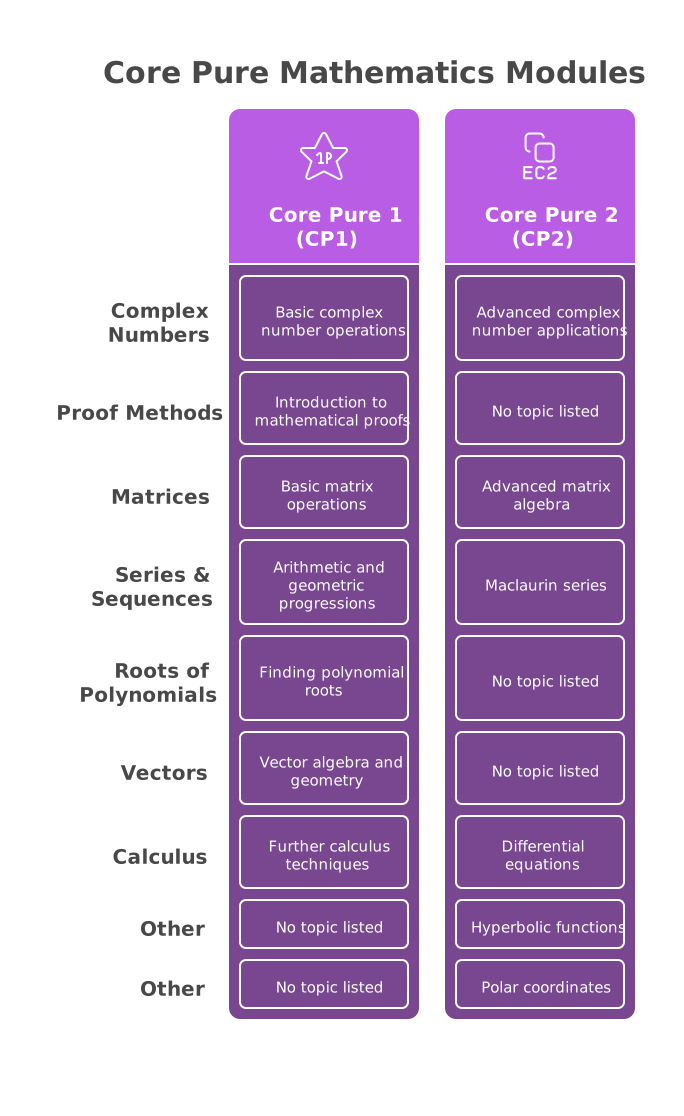
Core Pure 1 (CP1) topics include:
- Complex numbers
- Proof methods
- Matrices
- Series & sequences
- Roots of polynomials
- Vectors
- Further calculus techniques
Core Pure 2 (CP2) topics include:
- Further complex numbers
- Hyperbolic functions
- Differential equations
- Maclaurin series
- Polar coordinates
- Advanced matrix algebra
These advanced topics build the analytical thinking required for university-level mathematics.
7.2 Optional Modules (Choose Based on Exam Route)
According to the official Edexcel Further Maths specification (9FM0), students must complete a combination of optional applied modules. Schools choose the available pathways, but most include:
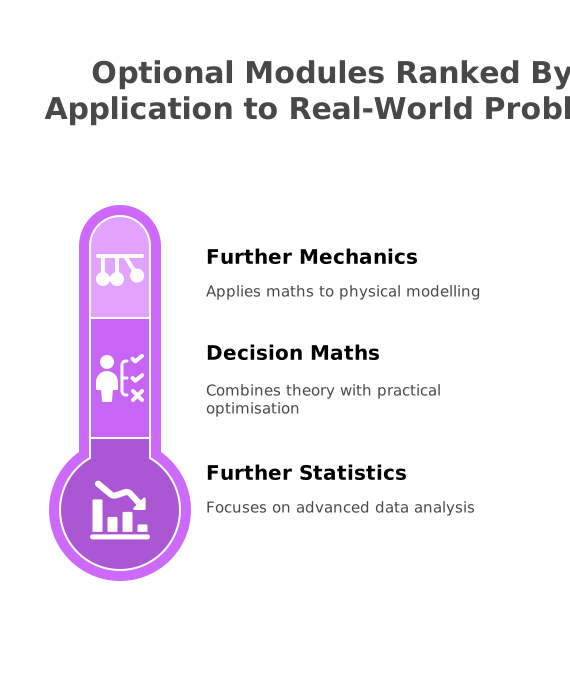
1. Further Mechanics
This module is perfect for students pursuing physics or engineering.
Covers:
- Work, energy, and power
- Momentum & impulse
- Circular motion
- Centres of mass
- Elastic collisions
- Variable acceleration
Further Mechanics applies pure mathematics to real-world physical modelling, making it essential preparation for STEM careers.
2. Further Statistics
Focused on advanced data and probability skills.
Topics include:
- Continuous and discrete distributions
- Chi-squared tests
- Probability generating functions
- Correlation & regression
- Multivariate data analysis
Further Statistics prepares students for data science, machine learning, economics, and research fields.
3. Decision Maths (Discrete Maths)
Ideal for students interested in computer science, AI, logistics, or business modelling.
Topics:
- Graph theory
- Algorithms
- Linear programming
- Network flows
- Critical path analysis
- Matching algorithms
Decision Maths is used in real-world optimisation — transport networks, operations research, and computational algorithms.
The final assessment for Further Maths typically includes:
- Two Core Pure papers (mandatory)
- Two optional applied papers (chosen from Further Mechanics, Further Statistics, or Decision Maths)
This structure allows flexibility and maintains mathematical depth.
8. Assessment Structure & Exam Pattern
Understanding the exam pattern is a crucial part of the Edexcel A Level Maths Specification, as it helps students plan revision strategically and prepare with clarity.
Pearson Edexcel follows a fully linear assessment structure, meaning all exams are taken at the end of the two-year course.
Here is the complete breakdown for both A Level Maths (9MA0) and A Level Further Maths (9FM0).
1. A Level Maths (9MA0) – Assessment Breakdown
The Edexcel A Level Mathematics qualification includes three written papers, each assessing different parts of the specification.
Paper 1: Pure Mathematics
- Total Marks: 100
- Duration: 2 hours
- Weighting: 33.33%
- Covers core Pure Maths topics: algebra, functions, sequences, calculus, vectors, and more.
Paper 2: Pure Mathematics
- Total Marks: 100
- Duration: 2 hours
- Weighting: 33.33%
- Assesses the remaining Pure Maths units in the Edexcel A Level Maths specification.
Together, Papers 1 and 2 account for two-thirds of the overall grade, reflecting conceptual mathematical fluency.
Paper 3: Statistics & Mechanics
- Total Marks: 100
- Duration: 2 hours
- Weighting: 33.33%
- Section A: Statistics (sampling, probability, distributions, hypothesis testing)
- Section B: Mechanics (kinematics, forces, Newton’s laws, moments)
This combined paper evaluates applied mathematical reasoning across real-world contexts.
2. A Level Further Maths (9FM0) – Assessment Breakdown
Further Maths is assessed through four separate papers, chosen from both mandatory and optional content.
Mandatory Core Papers
- Core Pure 1
- Core Pure 2
Optional Papers (Choose Based on School Pathway)
Students complete two additional units from:
- Further Mechanics
- Further Statistics
- Decision Maths (Discrete Mathematics)
- Further Pure Mathematics (optional pathways)
Each paper:
- Duration: 1 hour 30 minutes
- Equal weighting
- Assesses advanced Pure or Applied content, depending on the module choice
According to Pearson’s official exam framework, Further Maths allows flexible pathways to support different university or career goals.
3. Assessment Features (Common to Both Qualifications)
- 100% Exam-Based
There is no coursework in A Level Maths or Further Maths. All marks come from final written examinations.
- Structured Mathematical Questions
Questions progress in difficulty:
- Short, direct questions
- Multi-step reasoning questions
- Proof-style tasks
- Real-world modelling problems
- Problem-Solving & Mathematical Modelling
Pearson’s specification emphasises:
- Mathematical modelling
- Interpretation of solutions
- Logical method-based reasoning
- Calculator Use
A calculator with advanced statistical functions is required, especially for Statistics assessments.
9. Internal & External Resources to Master the Specification
To master the Edexcel A Level Mathematics Specification, students must use the right mix of official Pearson resources and efficient tools such as Vedic Maths. These resources help students to strengthen conceptual clarity and improve speed, especially for time-pressured papers like Further Maths.
Here are authoritative Pearson Edexcel Resources (Highly Recommended)
These are the most reliable and exam-aligned materials, directly from the awarding body.
1. Pearson Edexcel Textbooks (Official)
Pearson publishes textbooks mapped exactly to:
- A Level Mathematics (9MA0)
- A Level Further Mathematics (9FM0)
These books include exam-style questions, worked examples, and topic summaries aligned with the official specification.
2. Past Papers
Past papers are one of the most powerful tools for exam preparation. They help students:
- Understand question patterns
- Practice real exam difficulty
- Track improvement in time management
Includes:
- A Level Maths past papers
- Further Maths module past papers
3. Mark Schemes
Knowing mark schemes teaches students how examiners will follow marking methods and accuracy marks, helping improve written responses and step-by-step reasoning.
4. Examiner Reports
These reports provide insights such as:
- Common student mistakes
- Expected reasoning quality
- What earns full marks vs partial marks
This is one of the most valuable resources for the Edexcel A Level mathematics specification.
5. Pearson Training Materials
Pearson offers:
- Teacher guides
- Topic tests
- Practice booklets
- Guided revision notes
These materials reflect the board's exact structure and expectations.
6. Additional Learning Resources for Faster Problem-Solving
To complement the specification and enhance exam performance, students can use additional tools that improve speed, accuracy, and confidence, such as Vedic Maths. (Details given in section 11).
Download Free Vedic Maths worksheets that help students to practice Vedic Maths Sutras and shortcuts to perform math operations quickly.
Each worksheet contains 20 questions in various formats, including multiple-choice, fill-in-the-blank, true-or-false, and real-world word problems.
7. Mock Tests, Topic Tests & Timed Papers
Practicing under strict timed conditions ensures:
- Better exam performance
- Improved speed in long papers
- Familiarity with the question structure
Pearson Edexcel resources help students understand the syllabus, structure, concepts, and exam expectations.
Adding Vedic Maths and mock test practice helps students to improve speed, accuracy, and application, making them exam-ready.
When used together, students get:
- Strong conceptual clarity
- Faster calculation skills
- Better performance under exam pressure
- Higher accuracy in Pure Maths, Statistics & Mechanics
10. Study Plan Based on the Specification
A well-designed study plan aligned with the Edexcel A Level Maths syllabus helps students build a strong foundation in Pure Mathematics, mechanics, and statistics. With quick recall methods and consistent practice, long-term retention and exam performance can be boosted.
Below is a structured revision strategy for 12, 6, and 3 months.
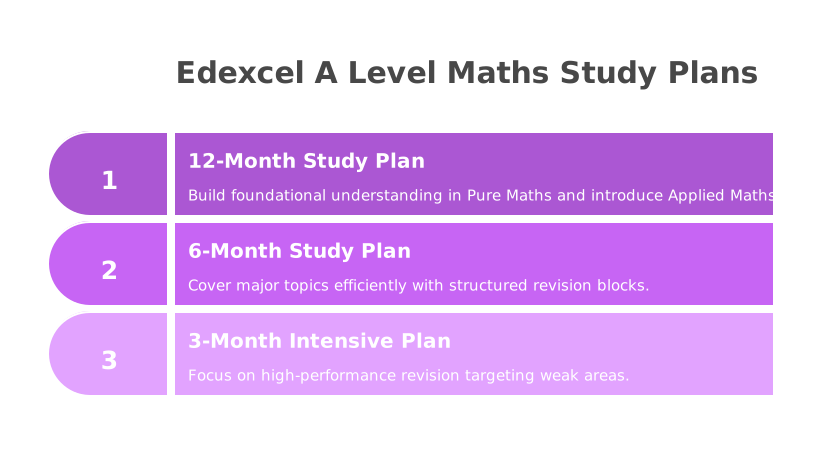
1. 12 Month Study Plan
Build the foundational understanding in Pure Maths and begin light exposure to Applied Maths.
a) Months 1–3: Pure Maths Foundation
- Algebra & Functions
- Coordinate Geometry
- Sequences & Series
- Trigonometry
Tip: Use spaced repetition and solve related topical question papers every 2 weeks.
b) Months 4–6: Applied Maths Introduction
- Statistics → Sampling, data representation, probability
- Mechanics → Quantities, units, basic kinematics
Tip: Interleave Pure + Applied weekly.
c) Months 7–9: Deeper Pure Maths
- Exponentials and logarithms
- Differentiation (core + applications)
- Integration (basic + advanced techniques)
Tip: Start combining Pure topics in mixed problem sets.
d) Months 10–12: Exam-Oriented Learning
- Numerical methods
- Vectors
- Mixed Pure + Applied questions
Tip: Begin solving past papers by topic.
2. 6-Month Study Plan
Cover all major topics efficiently with structured revision blocks.
a) Months 1 – 2: Pure Maths Core
- Algebra, functions, geometry, sequences, trig
- Start short daily active-recall quizzes
b) Months 3 – 4: Applied + Advanced Pure
- Mechanics: Forces, acceleration, Newton’s Laws
- Statistics: Distributions, hypothesis testing
- Pure: Differentiation + integration methods
c) Months 5 – 6: Exam Practice
- 2 past papers per week (Paper 1, Paper 2, Paper 3)
- Review examiner reports
- Timed assessments under real exam conditions
3. 3-Month Intensive Plan (Final Exam Preparation)
Need High-performance revision targeting weak areas.
a) Month 1: Subject Consolidation
- Pure Maths → 60%
- Statistics → 20%
- Mechanics → 20%
(Based on Edexcel mark distribution)
b) Month 2: Full Past Paper Practice
- 3 – 4 full papers per week
- Immediately review marking schemes
- Analyse errors
c) Month 3: Exam Simulations + High-Revision
- Simulate a whole exam week using the actual timetable
- Focus on:
- Trig identities
- Differentiation techniques
- Integration shortcuts
- Probability & stats interpretation
- Kinematics/forces modelling
4. How to Interleave Pure + Applied Effectively
Interleaving means mixing topics instead of studying one block at a time. This improves problem-solving and long-term retention.
Interleaving Strategy
- Pure (3 days/week) → Algebra, calculus, trig, sequences
- Mechanics (1 day/week) → Kinematics, forces
- Statistics (1 day/week) → Probability, distributions
- Mixed Problem Day (1 day/week) → Combined Pure + Applied questions
5. Sample Weekly Study Schedule
| Day | Focus Area | Tasks |
|---|---|---|
| Monday | Pure Maths | Algebra / Trig / Functions + 20 min active recall |
| Tuesday | Pure Maths | Differentiation / Integration practice |
| Wednesday | Statistics | Probability / distributions + 1 exam-style question |
| Thursday | Mechanics | Kinematics / Newton’s Laws + modelling tasks |
| Friday | Mixed Practice | Interleaved Pure + Applied worksheet |
| Saturday | Past Paper | 1 timed past paper + mark scheme review |
| Sunday | Light Revision | Formula revision, error analysis, rest |
Why is this study plan important?
- It is based on cognitive science: spaced repetition, interleaving, and active recall
- Aligned directly with the Edexcel A Level Maths syllabus
- Helps reduce exam anxiety through structured, timed practice
- Builds exam stamina using weekly past papers
- Ensures complete coverage of Pure + Applied topics
11. How Vedic Maths Helps Students Master Calculations Faster
Speed and accuracy are very important when preparing for the Edexcel A Level Maths papers. The Edexcel A Level Maths specification requires students to solve multi-step problems under strict time limits, especially in Pure Maths Papers 1 & 2 and the Statistics, Mechanics Paper 3. This is where Vedic Maths plays a prominent role.
Vedic Maths techniques help students perform quick, smart calculations, save precious time, and focus on problem-solving rather than getting stuck on long steps.
Let us see how Vedic Maths helps in Pure Mathematics, statistics, and mechanics.
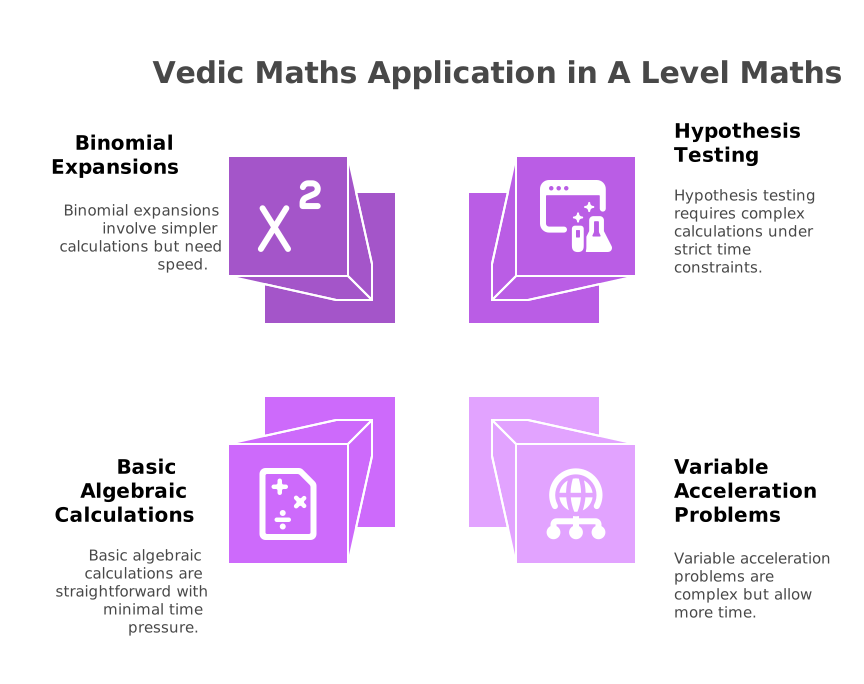
1. Faster Calculations in Pure Mathematics
Pure Maths has heavy calculation-based questions, including:
- Binomial expansions
- Algebraic calculations
- Differentiation & integration
- Functions and transformations
Vedic Maths helps students with faster calculations and smart shortcuts, allowing them to focus more on understanding the logic behind the questions instead of spending time on lengthy steps.
2. Faster Statistics Calculations (Especially in Hypothesis Testing)
Statistics involves:
- Z-scores
- Probability calculations
- Summations
- Standard deviation steps
- Hypothesis testing computations
Vedic Maths is helpful, especially when solving multi-part hypothesis testing questions under time pressure.
3. Faster Mechanics Calculations
Mechanics requires:
- Manipulating formulas
- Calculating forces, acceleration, and momentum
- Working with variable acceleration
- Solving simultaneous equations
Using Vedic Maths techniques, students spend less time calculating and more time understanding the steps.
Read our blog, "Vedic Maths Tricks Including a PDF," to learn smart and interesting Vedic Maths techniques.
Why Vedic Maths is Important to A-Level Students
- Reduces careless errors
- Builds mental flexibility
- Saves time in exams
- Boosts speed in calculations and problem-solving
- Enhances confidence in exam conditions
What are you waiting for?
Learn Vedic Maths in just 40 days by joining our 40-day Live Vedic Maths Class program, taught by Mamta Rupesh, a certified Vedic Maths teacher with over 8 years of experience, who has trained 15,000 students, 5,000 parents, and 5,000 teachers to date and continues to train across the globe.

Live Vedic Maths Classes Best Selling
Its a 40 day live Classes thought only for children from Grade 3 to 12 covers from Basics to Advance.
- 40 Day Live Program
- Get Individual Attention
- Certification & Lifetime Access
If you are not able to attend a live class, learn Vedic Maths with the Vedic Maths bundle kit, which includes 7+1 pre-recorded courses with 25 hours of video content, practice worksheets, suitable for students, parents, and teachers.

Vedic Maths Bundle Kit Best Selling
Perfect program designed for students from grade 3 - 12, teachers & parents aspiring to grow their career & upskill their children.
- Bundle Offer
- Worksheets & Exercise Problems
- Certification & Lifetime Access
The courses provide lifetime access, and you can clear all your doubts with an expert like Mamta Rupesh by joining our Vedic Maths WhatsApp community today. You will also get the latest updates on upcoming classes and courses.
Visit www.thevedicmaths.com or contact us at +91-866-056-2614 or info@thevedicmaths.com to learn more.
What are you waiting for?
Book a free 45-minute personalized demo class today to know more about our Vedic Maths course.
Why choose Mamta Rupesh as your Vedic Maths teacher?
Listen to what our students, parents, and teachers say about why they chose Mamta Rupesh to learn Vedic Maths.


Testimonials from Students
Here are a few reviews from Parents


It has been wonderful experience for my granddaughter. Our brain is nothing but a number crunching machine. Vedic Maths sharpens the brain and improves this number crunching ability.
Madam Mamata has been very good and her teaching was nice. She is sincere and caring towards students.
Please continue the good work and I wish you best luck for the future journey.

Mukund Oke
Happy Grandfather, India
The most interesting and helpful class in the world,
The teacher always clears our doubts until we are clear about the concepts.
Her teaching style is very interactive. she keeps the class more fun also .Thank you mam for giving us a wonderful opportunity to learn with you.

Sengamala Priya
Happy Mother, UAE
I had enrolled my daughter for vedic math class with Miss Mamta and it was a good experience for her to learn the math concepts. Miss Mamta was patiently guiding through the course, helping out in case of doubts and flexible with kids. Thanks for sessions, it was really helpful.
Thivya Nagarajan
Happy Mother, Singapore
Thank you for your wonderful sessions. My daughter really enjoyed throughout this course. No fear of Maths which she had experienced before with abacus.
You will be greatly missed!
Looking for some advanced classes for kids soon!
Geethu Sajad
Happy Mother, UAE
Ms Mamta is very warm and jovial. She made my child feel very comfortable. By sharing her own challenges in math in her early years and how she overcame these challenges she makes everything seem possible. During this short duration of the demo she showed atleast 5 tricks to solving problems there by piquing my daughter’s interest. We are very much looking forward to the classes with Ms Mamta.
Veena Krishnamurthy
Happy Mother, Malaysia
She is an amazing teacher. She has a “no frills, student centered” teaching approach. The personal attention towards every learner in a virtual environment is indeed praiseworthy. The illustrations and practice exercises are perfect to overcome mathematics phobia. As a teacher, I can safely say, she is a wonderful person to teach Maths to the kids of all age groups.
Dr. Manishankar Chakraborty
Happy Father, UAE
12. Conclusion
The Edexcel A Level Maths Specification 2026 is more than just a syllabus — it is the complete roadmap that guides students through what to study, how to prepare, and how to perform confidently in their final exams.
By understanding the official Edexcel A Level Mathematics Specification, students gain clarity on topic weightage, assessment structure, exam expectations, and the exact skills required to score highly in Pure Maths, Mechanics, and Statistics.
A clear understanding of the specification helps students:
- Build a structured and strategic study plan
- Focus on the most important topics from the Edexcel A Level maths syllabus
- Reduce exam anxiety through familiarisation
- Practise with accuracy using past papers and mark schemes
- Improve performance with consistent, specification-aligned revision
For students choosing advanced pathways, the Edexcel A Level Further Maths spec offers deeper mathematical understanding, preparing them for competitive university courses in engineering, physics, computer science, data science, economics, and more.
Incorporating smart tools like Vedic Maths enhances preparation by improving calculation speed, accuracy, and time management—skills that are crucial for tackling multi-step, time-pressured A-Level Maths exam papers.
With the right combination of:
- Pearson’s official materials
- A structured study plan
- Timed past-paper practice
- Vedic Maths speed techniques
- Expert guidance
Students can prepare efficiently, perform confidently, and achieve the grades they aim for in the 2026 Edexcel A Level Maths exams.
Your preparation starts today — stay consistent, follow the specification closely, and use strategic methods to unlock success in one of the most valuable and respected mathematics qualifications in the world.
13. FAQs on the Edexcel A Level Maths Specification 2026
1What is the Edexcel A Level Maths Specification?
The Edexcel A Level Maths Specification is the official syllabus published by Pearson Edexcel. It details all topics, learning objectives, assessment formats, and exam requirements for A Level Maths (9MA0).
Students use it as the primary guide for structured exam preparation.
2Where can I download the official Edexcel A Level Maths Specification 2026?
You can download the latest and official specification from the Pearson Edexcel website under the GCE Mathematics section. Always download directly from Pearson to ensure accuracy.
3What topics are included in the Edexcel A Level Maths syllabus?
The A Level Maths syllabus includes:
- Pure Mathematics (algebra, calculus, trigonometry, functions, vectors, numerical methods)
- Statistics (sampling, probability, distributions, hypothesis testing)
- Mechanics (kinematics, forces, Newton’s laws, moments, variable acceleration)
These are assessed across three written papers.
4Is Further Maths included in the Edexcel A Level Mathematics Specification?
No. Further Maths has its own separate specification called the Edexcel A Level Further Maths spec (9FM0).
It includes Core Pure Mathematics and optional modules such as Further Mechanics, Further Statistics, and Decision Maths.
5How many papers are there in the Edexcel A Level Maths exam?
Edexcel A Level Maths (9MA0) has three papers:
- Paper 1: Pure Mathematics
- Paper 2: Pure Mathematics
- Paper 3: Statistics & Mechanics
Each paper is 2 hours and carries equal weight (33.33%).
6What calculators are allowed for the Edexcel A Level Maths exam?
Pearson requires calculators with:
- Statistical functions
- Iterative and exponent/logarithmic features
- Probability distribution support
Models such as the Casio fx-991EX ClassWiz are permitted.
7How does the Edexcel A Level Further Maths exam work?
Further Maths (9FM0) consists of four papers:
- 2 mandatory Core Pure papers
- 2 optional modules chosen from Further Mechanics, Further Statistics, or Decision Maths
Each paper is 1 hour and 30 minutes.
8How should I study using the Edexcel A Level Maths specification?
Use the specification to:
- Identify all topic requirements
- Create a revision plan based on unit weightage
- Match past-paper practice to the exact specification topics
- Track weaker areas using assessment objectives
A structured study plan ensures exam-focused preparation.
9How does Vedic Maths help with Edexcel A Level Maths preparation?
Vedic Maths improves:
- Calculation speed
- Mental accuracy
- Time efficiency in long Pure and Applied questions
- Faster simplifications in calculus, algebra, statistics, and mechanics
It helps reduce time pressure during 2-hour exam papers.
10Are the Edexcel A Level Maths and Further Maths specifications updated every year?
Yes. Pearson may revise or update the specification annually. Students must always download the latest version to ensure alignment with the exact 2026 exam requirements.

