

One of the most interesting concepts in mathematics is the cube of a number, which helps students understand powers, volume, and multiplication patterns. Whether learning the concept of mathematical cube numbers for school or preparing for competitive exams like Olympiads, understanding how to calculate cubes will save time and boost confidence.
In this blog, let us explore cubes, the math cube formula, and Vedic Math tricks that help students calculate cubes easily and quickly.
Key Takeaways
- Meaning of Cube: The cube of a number is the result of multiplying a number by itself three times (n³ = n x n x n). Example: 5³ = 5 × 5 × 5 = 125.
- Math Cube Formula: The universal cube formula, n³ = n × n × n, applies to integers, decimals, and negative numbers.
- Practical Examples:
Common cube numbers:
5³ = 125, 8³ = 512, 10³ = 1000, (-6)³ = -216.
Remember, odd powers retain the sign of the number.
- Vedic Maths Cube Tricks: Using sutras like Anurupyena, students can calculate cube numbers mentally and quickly.
- Cube Table Reference: Memorizing cubes from 1³ to 20³ helps in fast problem-solving and mental math.
- Learning Patterns:
a) Numbers ending in 1, 4, 5, 6, or 9 have the same last digit in their cubes.
b) Even numbers result in even cubes; odd numbers result in odd cubes.
- Real-Life Applications: Cubes are used in geometry (volume), architecture (3D design), physics (density and volume), and coding (3D arrays and simulations).
- STEM Skill Development: Understanding cubes improves logical reasoning, visualization, and analytical skills — core to STEM learning.
- Practice with Worksheets: Free printable cube worksheets, created by Mamta Rupesh, help students practice cube sums, connect theory to application, and master Vedic Math shortcuts.
1. Introduction: Why Learn About the Cube of a Number
Understanding the cube of a number goes beyond mere math exercises; it builds a strong foundation for concepts such as geometry, algebra, and volume measurement. As students learn what cubes are and how to calculate them, they develop strong visual thinking, logical, and numerical reasoning skills.
Cubes appear in daily math, such as solving algebraic equations and finding the volume of solids. Learning shortcuts for cube number sequences in competitive exams can significantly improve problem-solving speed, accuracy, and overall calculation efficiency.
For example, quickly recalling 8³ = 512 or 5³ = 125 helps students solve problems more quickly and accurately.
According to the NCERT/CBSE curriculum, cubes are introduced in Class 6 to strengthen spatial reasoning and prepare students for advanced math topics like algebraic identities and geometry, thereby making the math learning journey more effective.
2. What Is a Cube in Mathematics? (Definition & Concept)
In mathematics, the cube of a number means "multiplying a number by itself three times," i.e., n³ = n x n x n.
For example, the cube of 5 is calculated as: 5 x 5 x 5 = 125
Thus, 125 is called the cube of 5.
Numerical Meaning
When we say finding the cube of a number, we are calculating the perfect cube of that number, i.e, how many times a number repeats itself to form a three-dimensional structure.
For example,
- Cube of 2 = 2 x 2 x 2 = 8
- Cube of 6 = 6 x 6 x 6 = 216
Mathematical Cube is an essential math topic in algebra and higher-level mathematics to understand the patterns, powers, and exponents.
Geometric Meaning
In geometry, a cube is a 3D solid (three-dimensional shape) geometric figure, with equal sides. Each side represents one of the number's dimensions. Thus, when you cube a number, you are finding the volume of a cube using its side length.
For example,
If each side of a cube measures 3 cm, then:
Volume = 3 x 3 x 3 = 27 cm³, which means the cube can hold 27 cubic centimeters of space.
Visualization Tip:
Imagine a small block (1 cm³). Now, build a larger cube using two blocks on each edge. You'll ultimately use eight blocks—just like 2³ = 8.
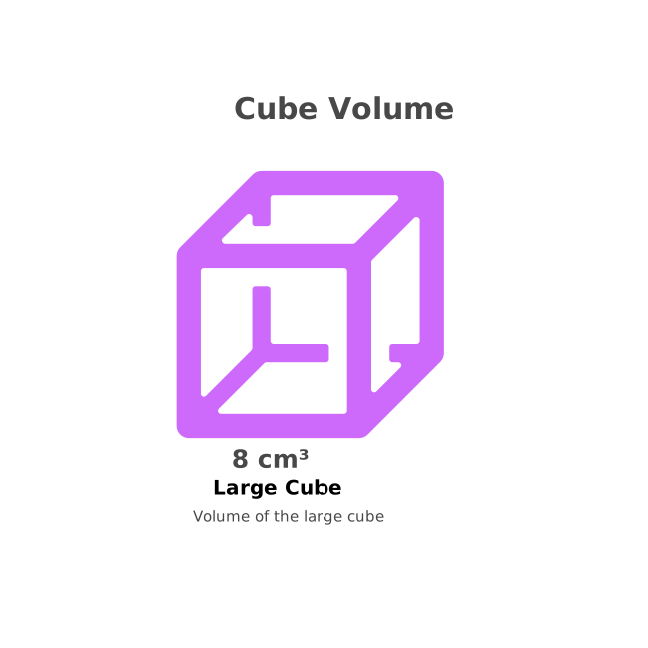
Visualization helps students better understand the connection between arithmetic and geometry, fostering both conceptual and practical understanding of cubes.
3. The Math Cube Formula (With Explanation)
The math cube formula is one of the most important formulas in arithmetic and algebra. It helps students quickly calculate the perfect cube of any number. Cube means multiplying the number three times.
General cube formula: n³ = n x n x n (where n refers to a number).
The number can be an integer, a decimal, or a negative number.
Let us see a few examples of the Cube formula in Maths
1. Calculating the cube of a Positive integer
Example: What is the cube of 5?
5³ = 5 x 5 x 5 = 125
So, the cube of the number 5 is 125.
2. Calculating the cube of a decimal
Example: Calculate the cube of 1.2?
(1.2)³ = 1.2 x 1.2 x 1.2 = 1.728
3. Calculating the cube of a negative integer
Example: Calculate the cube of -4?
(-4)³ = -4 x -4 x -4 = -64
Remember, the cube of a negative number is always negative.
3.1 Application of the Cube Formula in Math
The math cube formula is applied in :
1. Geometry: To find column of a cube -> V= a³, where a is the cube side length.
2. Algebra: Used widely to simplify Polynomial expressions using algebraic identities like
(a+b)³ = a³+ 3a²b + 3ab² + b³.
3. Real Life: Used in finding capacity, density, or measurements of 3D objects.
4. Math Olympiads and Competitive Exams: Quick cube calculation helps answer reasoning questions quickly and saves time.

When students understand that a mathematical cube (perfect cube) involves multiplying the same number three times, it becomes easier to visualize, understand, and quickly solve number and geometry-based problems.
Read our blog, "Vedic Maths for Multiplication," to learn quick multiplication techniques.
4. Examples: What Is the Cube of 5, 8, and More
Here are step-by-step examples of the cube of various number types, shown in a simple table for quick reference and better understanding.
| Number (n) | Calculation ( n x n x n) | Result (n³) |
|---|---|---|
| 5 | 5 x 5 x 5 | 125 |
| 8 | 8 x 8 x 8 | 512 |
| 10 | 10 x 10 x 10 | 1000 |
| -3 | -3 x -3 x -3 | -27 |
| -6 | (-6) x (-6) x (-6) | -216 |
| 1.2 | 1.2 x 1.2 x 1.2 | 1.728 |
| 2.2 | 2.2 x 2.2 x 2.2 | 10.648 |
Conceptual notes:
1. 5³ = 125 - To calculate 5³, first find 5 x 5 = 25 (the square), then multiply 25 by 5 to get 125. Multiplying the square of a number by the same number is the cube of that number.
2. 8³ = 512 - First, multiply 8 x 8 = 64, then 64 x 8 = 512. Visualize 512 as the volume of a 3D block with sides of 8 units (8 x 8 x 8 unit cubes).
3. 10³ = 1000: For powers of ten, cubing simply involves adding three zeros (e.g., 10³ = 1000). This is a quick shortcut for calculating volume.
4. (-6)³ = -216 - With an odd exponent, the sign remains negative because negative x negative x negative = negative. Always remember, the sign is negative if the exponent is odd.
5. (1.2)³ = 1.728 - Cubing decimals works similarly: multiply the decimal three times and place the decimal point correctly, or convert it to a whole number, multiply, and then convert back to a decimal.
Tip: Encourage students to perform the intermediate step of squaring before multiplying once more. For example, 8² = 64, then 64 x 8 = 512. This method helps students learn squares and cubes concurrently, fostering familiarity with the methods and reducing calculation errors.
5. How to Find Cubes Easily – The Vedic Maths Way
Finding the cube of a number (perfect cube) is easy when approached with the right methods and techniques. That's where Vedic Maths plays a crucial role. Learn how to mentally calculate a math cube using Vedic Maths cube tricks in seconds.
Vedic Maths is derived from ancient Indian scriptures called the Vedas, which contain 16 sutras and 13 sub-sutras. Anurupyena is one such powerful sutra that simplifies even larger cube calculations in simple steps.
Let us solve 12³ using the Vedic Maths technique - Anurupyena Sutra.
First, break the number into parts.
12³ = (10 + 2)³
Now, expand this cube equation using the binomial pattern ( a+b )³= a³+ 3a²b+ 3ab²+ b³
-> 12³= ( 10 + 2)³ = 10³ + 3 x 10² x 2 + 3 x 10 x 2² + 2³ = 1000 + 600 + 120 + 8 = 1728
Answer: 12³ = 1728.
Using Vedic Maths Tricks, it can be solved mentally within seconds.
Read our blog, "Vedic Maths Tricks along with PDF", to learn Vedic Maths Tricks that can simplify your math calculations easily.
Why Vedic Maths?
- Boost speed and accuracy in cube calculations.
- Builds confidence not only in academics but also in competitive and Olympiad exams.
- Helps visualize the relation between numbers.
Interesting, right?
Learn Vedic Maths in just 40 days using our 40-day Live Vedic Maths Classes program today. It is taught by Mamta Rupesh, a certified Vedic Maths teacher with over 8 years of experience, who has trained 15,000 students, 5,000 parents, and 5,000 teachers to date and continues to train across the globe.

Live Vedic Maths Classes Best Selling
Its a 40 day live Classes thought only for children from Grade 3 to 12 covers from Basics to Advance.
- 40 Day Live Program
- Get Individual Attention
- Certification & Lifetime Access
You can also learn Vedic Maths at your own pace using our Vedic Maths Bundle Kit—a pre-recorded course with 25 hours of video content suitable for students, parents, and teachers

Vedic Maths Bundle Kit Best Selling
Perfect program designed for students from grade 3 - 12, teachers & parents aspiring to grow their career & upskill their children.
- Bundle Offer
- Worksheets & Exercise Problems
- Certification & Lifetime Access
The courses provide lifetime access, and you can clear all your doubts with an expert like Mamta Rupesh by joining our Vedic Maths WhatsApp community today. You will also get the latest updates on upcoming classes and courses.
Visit www.thevedicmaths.com or contact us at +91-866-056-2614 or info@thevedicmaths.com to learn more.
Don’t wait any longer.
Book a free 45-minute personalized demo class today to know more about our Vedic Maths course.
Why choose Mamta Rupesh?
Listen to what our students, parents, and teachers say about why they chose Mamta Rupesh to learn Vedic Maths.


Testimonials from Students
Here are a few reviews from Parents


It has been wonderful experience for my granddaughter. Our brain is nothing but a number crunching machine. Vedic Maths sharpens the brain and improves this number crunching ability.
Madam Mamata has been very good and her teaching was nice. She is sincere and caring towards students.
Please continue the good work and I wish you best luck for the future journey.

Mukund Oke
Happy Grandfather, India
The most interesting and helpful class in the world,
The teacher always clears our doubts until we are clear about the concepts.
Her teaching style is very interactive. she keeps the class more fun also .Thank you mam for giving us a wonderful opportunity to learn with you.

Sengamala Priya
Happy Mother, UAE
I had enrolled my daughter for vedic math class with Miss Mamta and it was a good experience for her to learn the math concepts. Miss Mamta was patiently guiding through the course, helping out in case of doubts and flexible with kids. Thanks for sessions, it was really helpful.
Thivya Nagarajan
Happy Mother, Singapore
Thank you for your wonderful sessions. My daughter really enjoyed throughout this course. No fear of Maths which she had experienced before with abacus.
You will be greatly missed!
Looking for some advanced classes for kids soon!
Geethu Sajad
Happy Mother, UAE
Ms Mamta is very warm and jovial. She made my child feel very comfortable. By sharing her own challenges in math in her early years and how she overcame these challenges she makes everything seem possible. During this short duration of the demo she showed atleast 5 tricks to solving problems there by piquing my daughter’s interest. We are very much looking forward to the classes with Ms Mamta.
Veena Krishnamurthy
Happy Mother, Malaysia
She is an amazing teacher. She has a “no frills, student centered” teaching approach. The personal attention towards every learner in a virtual environment is indeed praiseworthy. The illustrations and practice exercises are perfect to overcome mathematics phobia. As a teacher, I can safely say, she is a wonderful person to teach Maths to the kids of all age groups.
Dr. Manishankar Chakraborty
Happy Father, UAE
6. Cubes from 1 to 20 – Quick Reference Table
Memorizing cubes is a fundamental math skill to learn early. It helps solve algebra and geometry problems faster, particularly when applying the cube formula: —n³ = n x n x n
Here is a complete cube table from 1³ to 20³, prepared for quick reference and memorization.
| Number (n) | Cube Formula ( n x n x n) | Cube (n³) |
|---|---|---|
| 1 | 1 x 1 x 1 | 1 |
| 2 | 2 x 2 x 2 | 8 |
| 3 | 3 x 3 x 3 | 27 |
| 4 | 4 x 4 x 4 | 64 |
| 5 | 5 x 5 x 5 | 125 |
| 6 | 6 x 6 x 6 | 216 |
| 7 | 7 x 7 x 7 | 343 |
| 8 | 8 x 8 x 8 | 512 |
| 9 | 9 x 9 x 9 | 729 |
| 10 | 10 x 10 x 10 | 1000 |
| 11 | 11 x 11 x 11 | 11 x 11 x 11 |
| 12 | 12 x 12 x 12 | 1728 |
| 13 | 13 x 13 x 13 | 2197 |
| 4 | 14 x 14 x 14 | 2744 |
| 15 | 15 x 15 x 15 | 3375 |
| 17 | 17 x 17 x 17 | 4913 |
| 18 | 18 x 18 x 18 | 5832 |
| 19 | 19 x 19 x 19 | 6859 |
| 20 | 20 x 20 x 20 | 8000 |
This table was created by a certified Vedic Maths educator for accurate and learner-friendly content.
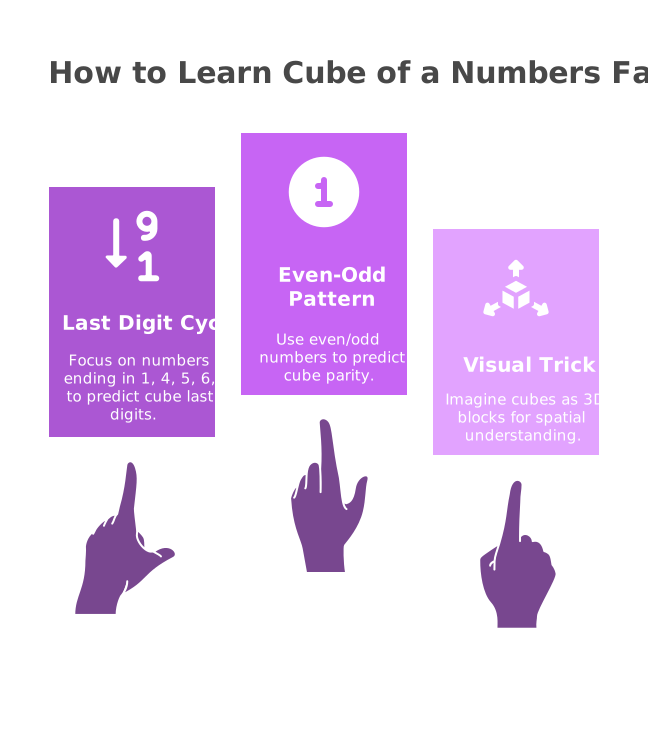
Tips to learn cubes faster
1. Last Digit Cycle
- Numbers ending in 1,4,5,6, or 9 have the same last digit in their cubes.
- Example: 6³= 216 (ends in 6); 14³ = 2744 (ends with 4).
2. Even-Odd Pattern
- Even numbers will result in even cubes, and odd numbers will result in odd cubes.
3. Visual Trick
Imagine cubes as 3D blocks. This makes connecting numbers with their spatial meaning easy.
Download our free math cube worksheet for students to practice quick mental math before exams.
7. Real-Life Applications of the Mathematical Cube
Learning the concept of the mathematical cube (perfect cube) is not just limited to school. It is a lifelong skill required in various tasks. Cubes can be used in engineering, architecture, coding, science, and many other fields.
Understanding the cube of a number strengthens not only the math foundation but also the ability to think spatially, logically, and creatively, all of which are necessary for STEM learning.
Here are a few real-life examples of how the math cube can be used.
a. Geometry and Volume Calculations
In geometry, the cube of a number is used to find the volume of a cube.
- Volume Formula: Volume = side³.
- Example: A cube with a side of 5 cm has a volume of 5³ = 125 cm³.
This simple cube volume formula helps students visualize how space grows in three dimensions.
b. Architecture and 3D Design
Architects often use cube-based measurements to design rooms, furniture, and city layouts.
Understanding cubic measurements ensures structures are built with accurate proportions, leading to efficient and balanced designs.
c. Physics and Engineering Applications
In physics, cubes appear in formulas that involve density, mass, and volume — for example, when calculating the density of materials or designing containers and engines.
- Example: Density = Mass ÷ Volume. Knowing Volume = side³ helps engineers compute object capacities correctly.
d. Coding and Data Structures
Programmers use cube-based logic when dealing with 3D arrays and graphics.
Understanding how numbers grow cubically helps in game development, AI modeling, and data visualization, where real-world behavior is simulated using math-based frameworks.
e. STEM Skill Development
Mastering the mathematical cube helps students develop:
- Logical reasoning.
- Visualization and 3D modeling skills.
- Application-based problem-solving—essential for careers in STEM (Science, Technology, Engineering, and Math).

8. Download Free Cube Worksheets (PDF)
Consistent practice with the math cube helps students master mathematical cubes. To help students strengthen their understanding of cubes and the math cube formula, we have created free printable cube worksheets designed for learners of all levels, from beginner to advanced.
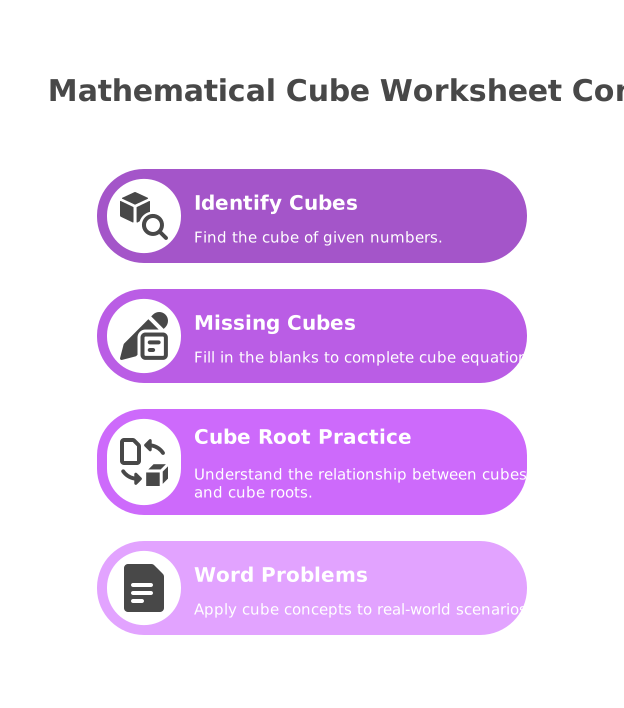
The cube worksheets contain:
- Identify the cube of a number—for example, find 3³, 6³, 9³.
- Find missing cubes—fill in blanks like 4³ = ___, 7³ = ___.
- Cube and Cube Root Practice—connect how cubes grow and how to reverse them.
- Real-Life cube-based word problems—applying cubes in geometry, measurements, and volume.
Each worksheet includes an answer key for self-checking answers, identifying mistakes, and correcting them promptly, which helps build accuracy.
Role of Vedic Maths
Incorporating Vedic Maths techniques with worksheets helps students learn and master cube numbers easily and without stress. Each worksheet is created by certified Vedic Math educator Mamta Rupesh, who has over 8 years of experience in teaching Vedic Maths globally.
Cube worksheets are aligned with NCERT/CBSE learning goals. Use Vedic Math shortcuts for quicker, more accurate, and smarter calculations.
Download our free printable cube worksheets PDFs today and master math cubes in a fun, easy, and screen-free way.
9. Conclusion
Understanding the math cube is more than just a math skill. It acts as a bridge to understanding and mastering the advanced concepts in math, such as geometry, algebra, and physics. When students understand how to calculate the cube and grasp its underlying principles, they develop a deeper understanding of numbers, patterns, and real-world math problems.
From simple exercises like finding the cube of 5 or 8 to applying the math cube formula n³ = n x n x n in real-life situations, Vedic Maths cube tricks help improve speed, accuracy, and confidence. Using Vedic Maths cube tricks, students can solve cube sums mentally in seconds, without using pen and paper.
At Vedic Maths, Mamta Rupesh, with over 8 years of teaching experience and having trained over 15,000 students to date, believes that math should be taught in a fun, clear, and gamified way, rather than through tough and rote learning. That's why she created cube worksheets—aligned with NCERT/CBSE guidelines and containing various question formats such as multiple-choice, fill-in-the-blanks, and word problems—along with answer keys.
What are you waiting for?
Join our Live Classes today or use our Vedic Maths Bundle Kit to learn Vedic Maths tricks and shortcuts for cubes easily.
Download your free cube worksheets PDFs today and master cube easily and more enjoyably.
10. FAQs on Cube of a Number
1What is the cube of a number?
The cube of a number, or perfect cube, is the result of multiplying the number by itself three times. For example, 4³ = 4 × 4 × 4 = 64. It represents the volume of a cube with a side length of 4 cubic units.
2What is the math cube formula?
The math cube formula is n³ = n × n × n, where n is any number (positive, negative, or decimal).
Example: (-3)³ = -27.
3What is the cube of 5?
The cube of 5 is 125 (5 × 5 × 5 = 125).
4What is the cube of 8?
The cube of 8 is 512 because (8 × 8 × 8 = 512).
This also represents the volume of a unit cube with each side of 8 unit cubes.
5How can I calculate cubes quickly?
You can use Vedic Maths cube tricks, such as Anurupyena Sutra, which simplify large cube operations into simple calculations.
Example: 12³ = (10 + 2)³ = 1000 + 600 + 120 + 8 = 1728—solved mentally in seconds.
6Why do we need to learn cubes in Math?
Cube functions are used in many areas of math and real life, such as calculating volume, solving algebraic identities, understanding exponents, and preparing for competitive exams and Olympiads.
7What is the difference between a square and a cube?
A square is when a number is multiplied by itself twice (n² = n × n), whereas a cube is when it’s multiplied three times (n³ = n × n × n).
Example: 3² = 9, 3³ = 27.
8How are cubes used in real life?
Cubes are used in geometry (volume of geometrical shapes), architecture (3D design), physics (density, mass, volume), and even computer science (3D arrays and graphics).
9Are there easy ways to memorize cubes from 1 to 20?
Yes, here are a few easy ways to memorize cubes from 1 to 20:
- Practice with a cube table (1³ to 20³).
- Notice digit sequence patterns—like numbers ending in 1, 4, 5, 6, or 9 have the same last digit in their cubes.
- Use Vedic Maths visualization tricks to recall them faster.
10Where can I download free cube worksheets?
You can download free printable cube worksheets (PDFs) from the Vedic Maths website.
Each worksheet includes practice questions, real-life cube problems, and answer keys, curated by Mamta Rupesh, a certified Vedic Maths educator, with over 8+ years of teaching experience.

