

Preparing for the Edexcel A Level Maths exam becomes easy when students use Edexcel A Level Maths past papers and mark schemes. These papers give you a clear understanding of the exam style, difficulty level, and the type of questions.
Whether you’re searching for Edexcel GCE A Level Maths past papers, A Level Maths past papers, or revision materials, practising with real exam papers is one of the smart ways to boost accuracy and confidence.
Students preparing for advanced modules can use Edexcel A Level Further Maths past papers to gain essential exposure to challenging problem-solving questions, which help you master Core Pure, Further Statistics, Further Mechanics, or Decision Maths.
With the upcoming Edexcel A Level Maths exam dates 2026, it becomes even more important to follow a structured revision strategy using authentic Pearson Edexcel Maths papers.
In this blog, you’ll find everything you need to prepare smarter, such as past paper links, downloadable PDFs, mark schemes, examiner reports, and the full 2026 exam schedule to support your revision plan, and much more.
Key Takeaways
- Edexcel A Level Maths past papers and mark schemes are the most reliable tools to understand real exam style, difficulty level, and question patterns.
- Practising Edexcel GCE A Level Maths past papers regularly helps students build exam fluency, improve reasoning, and target high grades in Pure, Statistics, and Mechanics.
- Edexcel A Level Further Maths past papers are essential for mastering advanced modules like Core Pure, Further Statistics, Further Mechanics, and Decision Maths.
- The Pearson Edexcel Maths papers follow a clear structure: three 2-hour A Level Maths papers (two Pure, one Statistics & Mechanics) and a flexible module-based structure for Further Maths.
- Students should always download A Level Maths past papers PDF from official Pearson Edexcel sources to ensure they’re using up-to-date exam materials.
- The Edexcel A Level Maths exam dates 2026 are expected to fall between mid-May and mid-June, so a structured past-paper-based revision plan is crucial.
- Strategy to excel in exams: Topic-wise practice, timed full papers, error analysis, and spaced repetition make past paper practice far more effective than random solving.
- Combining Edexcel A Level Maths past papers with Vedic Maths speed techniques helps students reduce calculation time, minimise careless errors, and perform with greater confidence under exam pressure.
1. Introduction: Why Edexcel A Level Maths Past Papers Matter
Edexcel A Level Maths past papers are the most essential resources for high-scoring exam preparation. Past papers allow students to practise with real exam-style questions written by the same Pearson Edexcel subject experts who design the official assessments.
A Level Maths is a qualification that combines Pure Mathematics, Statistics, and Mechanics. Exam success depends not only on conceptual understanding but also on mastering the exact exam format, difficulty level, and problem-solving patterns used in Edexcel papers.
Pearson — the official awarding body behind Edexcel develops each A Level Maths paper through a detailed process involving subject specialists, senior examiners, and quality reviewers.
This is why students across the UK and international schools rely on past papers to build exam fluency, identify weak areas, improve their reasoning skills, and develop the speed needed for high exam performance.
Thousands of learners prepare for competitive maths exams. Students who practice Edexcel past papers consistently perform significantly better because they train their minds using the same structure, style, and skills expected in the final 2026 A Level examinations.
2. Edexcel vs Pearson Edexcel (Important Clarification)
One of the biggest confusions students have when searching for Pearson Edexcel Maths papers or past exam resources is distinguishing between Edexcel and Pearson Edexcel.
In simple terms, Edexcel is the qualification brand, established initially as a UK exam board, while Pearson Education is the global education company that owns and operates it.
In 2003, Pearson officially acquired Edexcel, and since then, it has been known as Pearson Edexcel.
This clarification is necessary because all official A Level Maths-related materials, such as specifications, formula booklets, sample assessment materials, and past papers, are now published under the name Pearson Edexcel.

So when you search for Edexcel Maths A-Level past papers, Pearson Edexcel maths papers, or Edexcel GCE materials, you are accessing the same exam board’s resources.
Having this understanding ensures students always download authentic, official resources aligned with the correct exam specification.
3. Edexcel A Level Maths Past Papers: Complete Breakdown
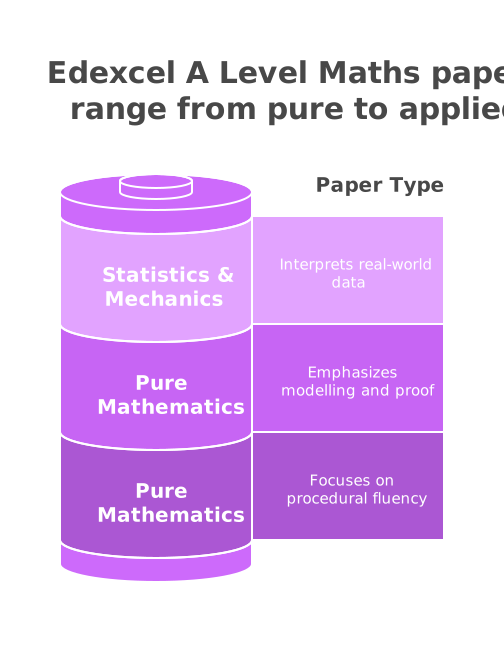
Edexcel A Level Maths past papers are structured into three exam papers, each designed by Pearson’s subject experts and reviewed by senior examiners, which test the conceptual understanding, problem-solving skills, and time management.
Students preparing using A Level Maths past papers PDF get real exam experience and understand the difficulty levels, making them the most reliable tool for high-score preparation.
Here is a breakdown of Edexcel A Level Maths papers:
1. Paper 1: Pure Mathematics
- Marks: 100
- Duration: 2 hours
- Content: Algebra, functions, sequences, trigonometry, calculus, logarithms, vectors, numerical methods
- Difficulty Pattern: Questions gradually increase in complexity, starting from procedural fluency and ending with multi-step reasoning problems.
- Common student mistakes:
a) Not showing enough work will lead to losing method marks
b) Weak algebraic manipulation
c) Misreading multi-step calculus questions
2. Paper 2: Pure Mathematics
- Marks: 100
- Duration: 2 hours
- Content: Remaining Pure topics, deeper calculus, complex algebraic reasoning
- Difficulty Pattern: More abstract questions, with heavy emphasis on modelling and proof-style steps.
- Common student mistakes:
a) Incorrect application of differentiation/integration rules
b) Missing links between multiple concepts in a single question
c) Losing marks due to sign errors or weak simplification
3. Paper 3: Statistics & Mechanics
- Marks: 100
- Duration: 2 hours
- Sections:
i) Section A: Statistics (sampling, probability, distributions, hypothesis testing)
ii) Section B: Mechanics (kinematics, forces, Newton’s laws, moments)
- Difficulty Pattern: Applied questions require interpreting real-world data or motion, not just calculation.
- Common student mistakes:
a) Poor understanding of conditions for binomial/normal distribution
b) Incorrect hypothesis testing notation
c) Mechanics errors like mixing up acceleration vs. velocity
Students who regularly practise Edexcel A Level Maths past papers improve in:
- Exam timing
- Familiarity with question structure
- Method-mark accuracy
- Reducing conceptual errors
Students who practice consistently with structured past papers can score significantly higher because the exam pattern remains stable and predictable year to year.
4. Edexcel GCE A Level Maths Past Papers (Formats + Structure)
Edexcel GCE A Level Math Past Papers follow a standard structure set by Pearson. These past papers are different from IAL (International A Level) papers.
Understanding the differences between these papers helps students choose the right resources as they prepare for the most prestigious exams.
4.1 GCE vs IAL: What are the differences?
a) GCE A Level Maths (UK version):
- Follows the UK curriculum
- Linear qualification (all exams at the end of Year 13)
- 3 compulsory question papers (Pure Mathematics Paper 1, Pure Mathematics Paper 2, Stats + Mechanics)
- Used in UK schools and many international schools
b) IAL (International A Level Maths):
- Modular structure
- Multiple exam windows (Jan, June, Oct)
- Different question styles and difficulty progression
- Designed for global centres outside the UK
For UK-based students, only GCE past papers are relevant.
For international learners, schools may offer either GCE or IAL, so it's important to confirm which version is available before downloading past papers.
4.2 Components of the GCE A Level Maths Past Papers
The GCE (9MA0) A Level Maths exam consists of three papers:
- Paper 1 — Pure Mathematics
- Paper 2 — Pure Mathematics
- Paper 3 — Statistics & Mechanics
Each paper:
- Is 2 hours
- Contains 100 marks
- Follows the strict rules given by the Pearson GCE Mathematics Specification
Past papers reflect the exact structure and difficulty pattern used in real assessments.
4.3 Mark Scheme Design (How Marks Are Allotted)
Pearson examiners use two types of marks in the mark scheme:
M Marks (Method Marks): Awarded for correct mathematical steps, even if the final answer is wrong.
A Marks (Accuracy Marks): For the correct final answer.
B Marks (Independent Marks): For standalone correct statements or definitions.
This means students can score well even if they don't reach the final answer. That's why practising with Edexcel GCE A Level Maths past papers is extremely important.
4.4 Grade Boundaries & How They Are Set
Grade boundaries for GCE Maths are set after each exam series based on:
- National student performance
- Comparative difficulty of the paper
- Statistical moderation
- Historical performance data
This ensures fairness across exam years.
For example:
- A slightly more difficult paper will have lower boundaries
- A simpler paper will have higher boundaries
Pearson publishes grade boundaries for each exam series (June/November), and teachers rely on these to test student performance.
5. Edexcel A Level Further Maths Past Papers (All Modules Explained)
Edexcel A Level Further Maths past papers are more important than standard A Level Maths papers because students can take different combinations of modules.
Unlike the primary Maths qualification (9MA0), which has a fixed structure, Further Maths (9FM0) is flexible, allowing students to specialise based on their interests and goals.
Below is a complete breakdown of every paper students may encounter, based on the Pearson specification.
1. Compulsory Papers: Core Pure Mathematics
a) Core Pure Maths 1 (CP1)
Topics include:
- Complex numbers
- Proof methods
- Polynomial roots
- Matrices
- Series & sequences
- Vectors
- First-order differential equations
CP1 builds the foundation of all Further Maths modules.
b) Core Pure Maths 2 (CP2)
Topics include:
- Hyperbolic functions
- Further complex numbers
- Maclaurin series
- Polar coordinates
- Advanced differential equations
- Advanced matrix algebra
Students who practise CP1 + CP2 past papers repeatedly develop the fluency required for university-level courses in engineering, physics, and mathematics.
These papers require strong conceptual understanding rather than just procedural understanding.
2. Optional Modules (Students Choose 2 Papers)
The optional modules allow students to customise their Further Maths pathway. These are the major categories:
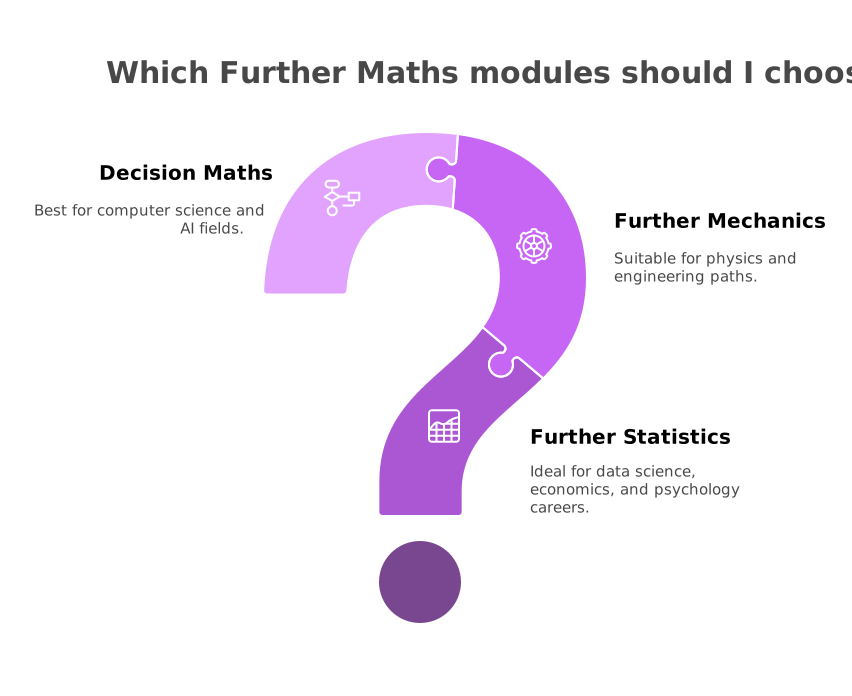
a) Further Statistics (FS1 / FS2)
Topics include:
- Continuous & discrete distributions
- Chi-squared tests
- Hypothesis testing (advanced)
- Correlation & regression
- Probability generating functions
- Statistical modelling
Ideal for those aiming for:
- Data science
- Economics
- Psychology
- Actuarial science
- Business analytics
b) Further Mechanics (FM1 / FM2)
Topics include:
- Work, energy, power
- Momentum & impulse
- Circular motion
- Centres of mass
- Elastic collisions
- Variable acceleration
Ideal for students pursuing:
- Physics
- Mechanical or aerospace engineering
- Robotics
- Architecture
These papers require heavy calculations. Students who combine past papers with strong algebraic fluency and Vedic Maths speed techniques perform far better under exam pressure.
c) Decision Maths (D1 / D2)
Topics include:
- Graph theory
- Algorithms (sorting, searching, pathfinding)
- Linear programming
- Network flows
- Critical path analysis
- Matching algorithms
Decision Maths is foundational for:
- Computer science
- Machine learning
- AI
- Logistics & operations research
Students who love and enjoy logic and algorithmic thinking often find Decision Maths easier than Statistics or Mechanics.
Let's see how the exam combination works
Students must take 4 papers in total for Further Maths:
- Paper 1: Core Pure 1
- Paper 2: Core Pure 2
- Paper 3: Optional module (FS1 / FM1 / D1, etc.)
- Paper 4: Optional module (FS2 / FM2 / D2, etc.)
Each paper:
- Duration: 1 hour 30 minutes
- Equal weighting
- Based on the Pearson Edexcel official 9FM0 spec
Schools choose the available optional pathways, so the combination varies by centre.
6. Where to Download Official Past Papers
When preparing for Edexcel A Level Maths, students must use only official sources to download past papers. While some archives (such as the Edexcel Emporium) are restricted to teachers, Pearson provides a large collection of publicly available PDFs that students can use while preparing for exams.
Below is a complete guide to where you can download Edexcel A Level Maths past papers PDFs.
1. Pearson Edexcel Official Past Paper Archive (Public Access – Free PDFs)
Pearson Edexcel provides an open, legal repository where students can download:
- A Level Maths past papers (9MA0)
- A Level Further Maths past papers (9FM0)
- Mark schemes
- Examiner reports
- Formula booklets
These PDFs are published after each exam series and are completely safe and legal for student use.
Includes exam series:
- 2025
- 2024
- 2023
- 2022
- 2021 & 2020 (COVID-adjusted years)
- Earlier archives
What students can download:
- Paper 1: Pure Mathematics
- Paper 2: Pure Mathematics
- Paper 3: Statistics & Mechanics
- Further Maths: CP1, CP2, FM, FS, D1/D2 modules
Pearson publicly releases these files, aligning with exam guidelines.
2. Pearson Edexcel International A Level (IAL) Past Papers
For international centres, Pearson also releases IAL past papers.
IAL papers include:
- P1, P2, P3, P4 (Pure Maths modules)
- S1, S2, M1, M2 (Stats & Mechanics)
- FP1, FP2 (Further Pure)
These are useful if you want extra practice, as IAL questions follow a similar structure but are presented in a modular format.
3. Sample Assessment Materials (SAMs)
Pearson publishes SAMs whenever a new specification is released.
These include:
- Model papers
- Specimen mark schemes
- Expected exam formats
Schools often use SAMs to prepare students for the first exam cycle, like 2026.
4. What is Not Available to Students (Teacher-Only Archives)
While students can download publicly released PDFs, some resources are restricted and legally inaccessible to learners.
You cannot access:
a) Edexcel Maths Emporium (Restricted)
Contains:
- 10–15 years of extended past papers
- Unreleased sets
- Examiner guidance packs
- Restricted mark schemes
- Teacher-only mock papers
Who can access?
- Verified teachers
- Approved exam officers
- Pearson-registered school staff can log in.
Pre-release "secure" materials
Pearson enforces strict copyright and exam security protocols to protect the integrity of global exams.
Unofficial websites often offer outdated, incorrect, or illegally obtained files, which can mislead students and violate Pearson's copyright laws.
7. Edexcel A Level Maths Exam Dates 2026
The Edexcel A Level Maths exam dates 2026 have been officially released by Pearson. Edexcel follows a very consistent timetable structure for A Level Maths (9MA0), conducting exams across mid-May to mid-June.
7.1 Expected Exam Window for 2026
Based on past Edexcel timetables, students can expect the A Level Maths 2026 exams to fall within this approximate period:
- Paper 1 (Pure Mathematics): Mid–Late May 2026
- Paper 2 (Pure Mathematics): Late May – Early June 2026
- Paper 3 (Statistics & Mechanics): Early–Mid June 2026
This structure aligns with Pearson’s practice of spacing the three A Level Maths papers roughly 5–10 days apart to allow revision time between exams.
Why are these dates important?
Pearson Edexcel historically follows a standard pattern:
- A Level exams begin the second week of May.
- Maths Paper 1 almost always appears in the first 10–12 exam days.
- Paper 2 typically follows within a week.
- Paper 3 (Statistics & Mechanics) is usually placed after half-term or early June.
This pattern has remained stable across:
2019 (pre-pandemic series), 2022, 2023, 2024, and 2025 provisional timetables
This makes the expected structure for edexcel a level maths exam dates 2026 highly predictable.
7.2 When Will Pearson Release the Final 2026 Timetable?
Pearson Edexcel typically publishes the final, confirmed timetable:
- Between October and December of the previous year
- On the official Pearson Qualifications – Exam Timetables page
- As a downloadable PDF for UK and International centres
So the official Edexcel A Level Maths exam dates 2026 will be confirmed by late 2025.
Students, even before the final timetable is announced, you can begin planning your study and revision strategy around the expected exam window, since the schedule rarely shifts significantly.
8. How to Use Past Papers Effectively (Scientifically Proven Strategy)
Using Edexcel A Level Maths past papers effectively will significantly boost exam scores, but only if students follow a scientifically proven study method.
Cognitive science research shows that active recall, spaced repetition, and retrieval practice are the three most effective ways to retain mathematical concepts and improve problem-solving speed.
When combined with time-bound practice and error analysis, they create a powerful learning cycle that is like real exam conditions.
Below is a structured method that can be successfully used for A-Level exam preparation.
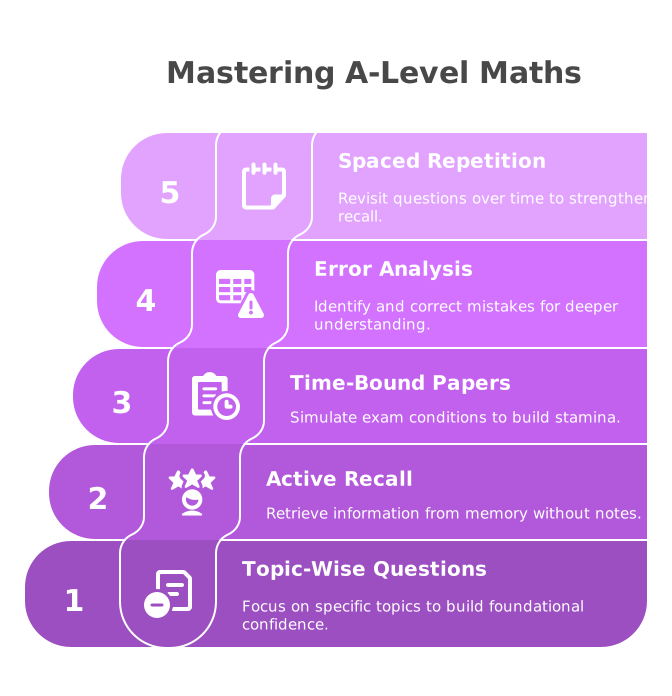
Step 1: Start With Topic-Wise Past Paper Questions (Not Full Papers)
Students often make the mistake of jumping directly into full exam papers.
The correct approach is:
- Start by solving past questions by topic (Pure, Stats, Mechanics).
- This helps build foundational confidence and strengthens weaker topic areas.
- It aligns perfectly with how the brain forms long-term memory—one concept at a time.
This approach boosts retention and improves the ability to apply skills to solve new problems.
Step 2: Apply Active Recall
Active recall means retrieving information from memory, not from notes.
Use these methods:
- Solve questions without looking at formulas.
- Re-derive steps manually.
- Explain your reasoning out loud (Feynman Technique).
- Create flashcards for tricky formulas and proofs.
Step 3: Shift to Time-Bound Full Papers (Simulate Exam Conditions)
Once topic-wise questions are comfortable:
- Attempt full 2-hour A Level papers.
- Use the approved calculator model.
- Sit in a quiet environment without breaks.
- Do not check solutions in between.
This builds exam stamina, improves time management, and reduces time anxiety. These skills are essential for Pure Maths Papers 1 & 2 and the combined Statistics & Mechanics Paper 3.
Step 4: Perform Deep Error Analysis
Error analysis is where real progress happens.
After each paper:
- Mark your work with the official Edexcel mark scheme.
- Identify whether errors were due to:
- Conceptual misunderstanding
- Calculation mistakes
- Skipped steps
- Misreading the question
- Poor time management
- Write every mistake in an error log and re-solve it after 24 hours.
Step 5: Use Spaced Repetition for Maximum Retention
Revisit past questions in a scientifically proven schedule:
- Day 1
- Day 3
- Day 7
- Day 14
- Day 30
Spaced repetition prevents forgetting and strengthens long-term recall for calculus, algebra, probability, distributions, and mechanics modelling.
Step 6: Combine Past Papers With Vedic Maths
In our live Vedic Maths programs, we integrate speed techniques that help students:
- Reduce calculation time in Pure Maths
- Simplify any expressions faster
- Perform calculations efficiently
- Make quick estimations for error checking
Using past papers and Speed Maths consistently helps students save precious time in exams.
9. Vedic Maths for Faster Problem Solving (Speed Advantage)
In Pearson Edexcel Maths exams, whether Pure, Statistics, or Mechanics, speed plays an essential role in determining how many marks a student can actually secure.
Students often know the concepts, but they lose marks because they run out of time or make unnecessary calculation errors under pressure. This is where Vedic Maths becomes a game-changer.
9.1 Why Quick Calculation Improves Marks
A Level Maths papers are structured so that every question builds on the previous step.
Slow calculation delays:
- Multi-step algebra
- Long differentiation/integration
- Probability evaluations
- Mechanics modelling
- When time runs short, students leave high-value questions unanswered.
Fast, accurate calculation ensures you:
- Attempt more questions
- Reduce careless calculation mistakes
- Spend more time on reasoning
- Increase your overall scoring smartly
9.2 Where Students Lose Time in Each Paper
1. Pure Mathematics (Paper 1 & Paper 2)
Students lose time in:
- Expanding/simplifying expressions
- Long multiplications/divisions
- Algebraic manipulation
- Binomial expansions
- Differentiation/integration steps
- Solving equations
2. Statistics (Paper 3 – Section A)
Delays happen during:
- Fraction/percentage calculations
- Standard deviation & variance
- Z-score computations
- Summations
- Hypothesis testing steps
3. Mechanics (Paper 3 – Section B)
Time consumption includes:
- Force resolution
- Simultaneous equations
- Acceleration/velocity calculations
- Moments and modelling
- Integration/differentiation for motion
In all the sections, most of the time is spent on lengthy, slow calculations.
9.3 How Vedic Maths Helps
Vedic Maths techniques drastically cut down calculation time by teaching students to:
- Multiply large numbers in seconds
- Simplify algebra mentally
- Perform quick divisions
- Approximate values instantly (crucial for Stats)
- Solve equations faster
- Reduce multi-step arithmetic to 1–2 steps
Read our blog, "Vedic Maths Tricks along with PDF", to learn easy yet powerful Vedic maths techniques.
These shortcuts help students focus on modelling, reasoning, and solving, rather than struggling with unnecessary calculations.
Vedic Maths consistently helps learners:
- Save exam time
- Reduce careless calculation errors
- Improve confidence under time pressure
- Attempt more 5–7 mark questions at the end of each paper
This helps in improving grades, especially when students have high targets.
Learn Vedic Maths today by joining our 40-day Live Vedic Maths Class program, taught by Mamta Rupesh, a certified Vedic Maths teacher with over 8 years of experience, who has trained 15,000 students, 5,000 parents, and 5,000 teachers to date and continues to train across the globe.

Live Vedic Maths Classes Best Selling
Its a 40 day live Classes thought only for children from Grade 3 to 12 covers from Basics to Advance.
- 40 Day Live Program
- Get Individual Attention
- Certification & Lifetime Access
You can also learn Vedic Maths at your own pace using our Vedic Maths Bundle Kit—a pre-recorded course with 25 hours of video content, seven complete modules, and one bonus module suitable for students, parents, teachers, and competitive exam aspirants.

Vedic Maths Bundle Kit Best Selling
Perfect program designed for students from grade 3 - 12, teachers & parents aspiring to grow their career & upskill their children.
- Bundle Offer
- Worksheets & Exercise Problems
- Certification & Lifetime Access
The courses provide lifetime access and include free downloadable worksheets and PDFs that help learners practice what they learned in the course using different question formats, such as multiple-choice, fill-in-the-blank, true-or-false, and real-world word problems.
Clear all your doubts with an expert like Mamta Rupesh by joining our Vedic Maths WhatsApp community today. You will also get the latest updates on upcoming classes and courses.
Visit www.thevedicmaths.com or contact us at +91-866-056-2614 or info@thevedicmaths.com to learn more.
Don’t wait.
Book a free 45-minute personalized demo class today to know more about our Vedic Maths course.
Why choose Mamta Rupesh as your Vedic Maths teacher?
Listen to what our students, parents, and teachers say about why they chose Mamta Rupesh to learn Vedic Maths.


Testimonials from Students
Here are a few reviews from Parents


It has been wonderful experience for my granddaughter. Our brain is nothing but a number crunching machine. Vedic Maths sharpens the brain and improves this number crunching ability.
Madam Mamata has been very good and her teaching was nice. She is sincere and caring towards students.
Please continue the good work and I wish you best luck for the future journey.

Mukund Oke
Happy Grandfather, India
The most interesting and helpful class in the world,
The teacher always clears our doubts until we are clear about the concepts.
Her teaching style is very interactive. she keeps the class more fun also .Thank you mam for giving us a wonderful opportunity to learn with you.

Sengamala Priya
Happy Mother, UAE
I had enrolled my daughter for vedic math class with Miss Mamta and it was a good experience for her to learn the math concepts. Miss Mamta was patiently guiding through the course, helping out in case of doubts and flexible with kids. Thanks for sessions, it was really helpful.
Thivya Nagarajan
Happy Mother, Singapore
Thank you for your wonderful sessions. My daughter really enjoyed throughout this course. No fear of Maths which she had experienced before with abacus.
You will be greatly missed!
Looking for some advanced classes for kids soon!
Geethu Sajad
Happy Mother, UAE
Ms Mamta is very warm and jovial. She made my child feel very comfortable. By sharing her own challenges in math in her early years and how she overcame these challenges she makes everything seem possible. During this short duration of the demo she showed atleast 5 tricks to solving problems there by piquing my daughter’s interest. We are very much looking forward to the classes with Ms Mamta.
Veena Krishnamurthy
Happy Mother, Malaysia
She is an amazing teacher. She has a “no frills, student centered” teaching approach. The personal attention towards every learner in a virtual environment is indeed praiseworthy. The illustrations and practice exercises are perfect to overcome mathematics phobia. As a teacher, I can safely say, she is a wonderful person to teach Maths to the kids of all age groups.
Dr. Manishankar Chakraborty
Happy Father, UAE
10. Proven Study Strategy Using Past Papers + Vedic Maths
To score well in Edexcel A-level maths, most students rely on past papers, but without speed calculation, they run out of time.
If they practice shortcuts, they might not have practiced under real exam conditions.
To strengthen exam performance, it is recommended to build exam familiarity (through Edexcel A Level Maths Past Papers) and boost speed and accuracy (through Vedic Maths techniques).
Practice both methods regularly as part of a weekly routine.
Here is a proven strategy used in top-performing maths classrooms.
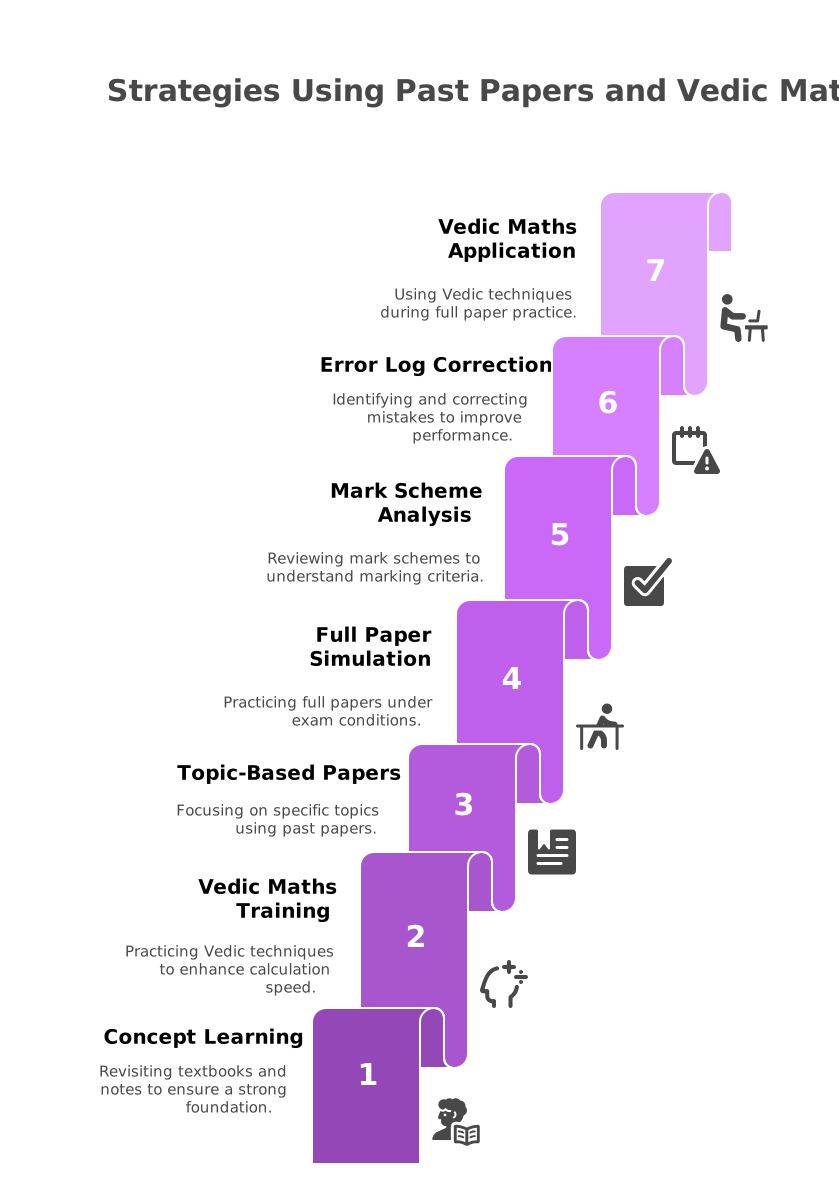
Step-by-Step Weekly Mastery Plan
This plan includes learning methods such as spaced repetition, active recall, retrieval practice, and timed exam simulation.
Step 1: Concept Learning (Daily – 20 to 30 mins)
Before using past papers, revisit:
- Textbook concepts
- Class notes
- Worked examples
This ensures students don’t waste time on past papers without understanding the concepts.
Step 2: Daily Vedic Maths Speed Training (10–15 mins)
Use Vedic Maths techniques to build speed in:
- Multiplication & division
- Fractions, ratios, percentages
- Quick estimation (important for Statistics)
This improves calculation speed in Pure, Stats & Mechanics, preventing long arithmetic delays.
Step 3: Topic-Based Past Papers (3–4 times per week)
Use Edexcel A Level Maths past papers based on the topic:
- Pure: sequences, trig, calculus, vectors
- Statistics: probability, distributions, hypothesis testing
- Mechanics: forces, kinematics, moments
This ensures focused improvement before attempting full papers.
Step 4: Practice the Full Past Paper Under Exam Conditions once a week
Practice one full paper every week:
- Paper 1 (Pure)
- Paper 2 (Pure)
- Paper 3 (Stats + Mechanics)
Exam rules to follow:
- Strict 2-hour timing
- Use only permitted calculators
- No interruptions
- Attempt all questions in sequence
- This builds exam stamina and reduces time pressure.
Step 5: Mark Scheme Analysis
Students must review:
- Method marks (M)
- Accuracy marks (A)
- Reasoning steps required
- Common mistakes identified by examiners
Review it on the same day. Dedicate just 20 minutes.
Step 6: Error Log + Correction cycle
Maintain an error log record and note down:
- Which questions were wrong
- Why were they wrong (concept, calculation, logic)?
- What correction is needed
- Which Vedic Maths technique could help
This creates a personalised improvement roadmap and reduces the likelihood of repeated mistakes.
Step 7: Apply Vedic Maths During Full Papers
Encourage students to use Vedic techniques for:
- Simplifying expressions before differentiation
- Fast expansions
- Quick probability calculations
- Mechanics algebra rearrangements
This bridges the gap between practice paper and real exam paper performance.
Students who follow this method consistently will have:
- Higher accuracy
- Reduced calculation time
- Better management of exam pressure
11. Helpful Links & Resources
To support your A Level Maths preparation, here is a curated list of verified, authoritative, and safe resources.
These include official Pearson Edexcel links, public past papers, qualification pages, and Vedic Maths resources that enhance speed and accuracy, essential for high exam performance.
All external links listed here are publicly accessible and maintained by Pearson, ensuring students follow only authentic, exam-aligned materials.
1. Official Pearson Edexcel Pages (Most Trusted Sources)
Pearson directly maintains these pages, the awarding body responsible for GCSE, IGCSE, GCE, and International A Levels.
a) Pearson Edexcel Home (All Qualifications)
Find official updates, exam policies, and qualification families.
- Syllabus updates
- Exam changes
- Assessment guidelines
b) Pearson Edexcel Mathematics Qualification Pages
Includes everything for:
- GCSE Mathematics (9–1)
- International GCSE Mathematics
- GCE A Level Maths (9MA0)
- GCE A Level Further Maths (9FM0)
These pages contain:
- Specifications
- Formula booklets
- Teaching support documents
- Sample Assessment Materials (SAMs)
- Curriculum guidance
These are the most accurate documents for students following the Pearson/Edexcel syllabus.
2. Official Edexcel Past Papers (Public PDF Access)
These are the legal and public sources where students can download exam papers—unlike restricted teacher-only Emporium archives.
a) Edexcel GCSE Past Papers (Maths)
Includes:
- Past papers
- Mark schemes
- Examiner reports
b) Edexcel GCE A Level Maths Past Papers
Includes complete sets of:
- Paper 1 (Pure Maths)
- Paper 2 (Pure Maths)
- Paper 3 (Stats & Mechanics)
- Mark schemes
- GCE-specific examiner reports
c) Edexcel A Level Further Maths Past Papers
Includes:
- Core Pure
- Further Mechanics
- Further Statistics
- Decision Maths
- Optional modules
d) International A Level (IAL) Maths Papers
Helpful for students following the international curriculum or requiring extra practice.
3. Pearson Emporium (Teacher Access Only)
Although not publicly accessible, the official landing page gives guidance for teachers on:
- Logging in
- Access requirements
- Restrictions
This ensures transparency and helps students understand why some materials are teacher-only.
4. Recommended Edexcel-Aligned Study Tools
These resources help students complement past papers with speed-building strategies and concept clarity.
a) Pearson Edexcel Maths Textbooks
These textbooks match the specification exactly and are widely used in schools.
b) Pearson ActiveLearn (Digital Book Platform)
Offers:
- Interactive textbooks
- Practice questions
- Teacher resources
5. Vedic Maths Resources
To support faster calculations, especially in Pure Maths, Probability, Statistics, and Mechanics, Vedic Maths programs offer students a significant advantage.
a) Live Vedic Maths Classes (Grades 3–12)
Designed for speed-building and exam efficiency.
Perfect for students preparing for GCSE, IGCSE, and A Level Maths.
b) Vedic Maths Bundle Kit (7+1 Pre-Recorded Courses)
Includes:
- 25+ hours of video lessons
- Concept + speed practice
- Worksheets & PDFs
- Lifetime access
Ideal for students, parents, and teachers.
c) Free Vedic Maths Worksheets (PDF Downloads)
Useful for daily warm-up practice or speed drills.
d) Blogs & Learning Guides (The Vedic Maths)
The content is created by Vedic Maths Expert - Mamta Rupesh, with 8+ years of experience and over 15,000 students trained.
These resources support both conceptual understanding and exam strategy, helping students achieve their targeted grade.
12. Conclusion
Edexcel A Level Maths past papers are the most powerful tools for mastering exam structure, question patterns, and time management.
From Pure Mathematics to Statistics and Mechanics and even advanced Further Maths modules, consistent practice with Pearson Edexcel Maths papers builds the exact skills examiners expect.
With the Edexcel A Level Maths exam dates 2026 approaching, using official past paper PDFs, mark schemes, and examiner reports is the smartest way to speed up preparation and target higher grades.
However, past papers alone are not enough without speed and accuracy. This is where Vedic Maths helps students greatly by reducing calculation time, minimizing careless errors, and improving confidence under pressure.
Follow the structured plan, stay consistent, and achieve your target grade in the 2026 Edexcel A Level Maths exam using past papers combined with Vedic Maths speed techniques.
13. FAQs on Edexcel A Level Maths Past Papers
1Where can I download official advanced-level maths past exam papers?
You can download official Edexcel A Level Maths past papers and Edexcel GCE A Level Maths past papers from the Pearson Edexcel Qualifications website.
Under the “Past Papers” or “Exam Materials” section, select your qualification (GCE A Level Maths 9MA0 or Further Maths 9FM0), choose the exam series, and download the past papers as A Level Maths past papers PDF along with mark schemes and examiner reports.
22) What are the most reliable sources for advanced-level maths past papers with mark schemes?
The most reliable and safe sources are always official Pearson Edexcel maths papers from the Pearson website. Here you’ll find:
- Edexcel A Level Maths past papers (9MA0)
- Edexcel A Level Further Maths past papers (9FM0)
- Mark schemes for every paper
- Examiner reports explaining common mistakes
In addition, many schools share these files via their own learning platforms, but the source is always Pearson Edexcel.
3Where can I find timed practice tests using past advanced-level maths questions?
You can create your own timed practice tests by:
- Downloading A Level Maths past papers PDF from the Pearson website
- Setting a strict 2-hour timer (for each paper)
- Attempting the paper under full exam conditions
Some schools also use internal platforms or tools, such as ExamWizard (teacher access), to generate timed tests from past Edexcel GCE A Level exam papers.
If you’re a student, ask your teacher to share timed mock papers based on these question banks.
4What is the difference between Edexcel A Level Maths and Pearson Edexcel Maths?
Edexcel is the qualification brand, and Pearson is the parent company. Together, they are called Pearson Edexcel. So when you see Pearson Edexcel Maths papers or Edexcel A Level Maths past papers, they all refer to the same official exam board.
5Are Edexcel GCE A Level Maths past papers and International A Level (IAL) papers the same?
No. GCE A Level Maths (9MA0) is the UK linear qualification with three fixed papers (two Pure + one Statistics & Mechanics).
IAL Maths is mainly used in international centres. The structure, paper codes, and question style differ.
So always confirm whether your school uses GCE or IAL before choosing past papers.
6How many Edexcel A Level Maths past papers should I solve before the 2026 exam?
As a general guideline, students targeting top grades usually solve:
- At least 8–10 full past papers for A Level Maths (mix of recent series).
- Topic-wise questions from older papers for Pure, Statistics, and Mechanics.
- Additional Edexcel A Level Further Maths past papers if they are taking 9FM0.
Quality and review matter more than just quantity, so constantly analyse your mistakes using mark schemes and examiner reports.
7When will the final Edexcel A Level Maths exam dates 2026 be confirmed?
Pearson Edexcel typically releases the final exam timetable between October and December of the previous academic year. The confirmed Edexcel A Level Maths exam dates for 2026 will be published on the Pearson “Exam Timetables“ page.
8How should I use mark schemes for Edexcel A Level Maths past papers?
After finishing a paper under timed conditions:
- Mark your work using the official mark scheme
- Note where you gained method marks (M) vs accuracy marks (A)
- Rewrite any incomplete or incorrect solutions using the mark scheme steps
- Add repeated errors to an “error log” and reattempt them after a few days
This approach trains you to think like an examiner and helps you earn higher marks on each question.
9How can Vedic Maths help with Edexcel A Level and Further Maths past papers?
Vedic Maths techniques help you:
- Multiply, divide, and simplify expressions much faster
- Reduce careless arithmetic errors in long multi-step problems
- Save time in mechanics questions involving forces, kinematics, and moments
When combined with systematic practice using Pearson Edexcel Maths papers, Vedic Maths gives you a genuine speed advantage in the exam.
10What is the best way to combine past papers and Vedic Maths in my study plan?
A simple weekly structure is:
- Daily: 10–15 minutes of Vedic Maths speed practice
- 3–4 days/week: Topic-based questions from Edexcel A Level Maths past papers
- 1 day/week: One full-time paper (Paper 1, 2, or 3)
- Same day: Mark scheme review + error log update
This builds concept clarity, exam familiarity, and calculation speed together, helping you to prepare for the 2026 Edexcel A Level Mathematics exams strongly, smartly, and confidently.

