

The Edexcel Emporium, often called the Maths Emporium or Edexcel Maths Emporium, is one of the most valuable resource hubs created by Pearson Edexcel Maths experts. Whether you are preparing for GCSE, IGCSE, A Level, or Functional Skills, the Edexcel Emporium Maths platform provides teachers and students with exclusive exam materials, teaching resources, and insider updates, including examiner reports directly from the awarding body, Pearson.
Many learners wonder, “Is Pearson Edexcel the same as Edexcel?”
Yes. Edexcel is the qualification brand, while Pearson is the parent organization. Together, they run the Maths Emporium Pearson site, offering thousands of curated tools to support high-quality maths teaching.
From past papers and mark schemes to topic tests, grade boundaries, and the Edexcel exam emporium archive, this hub has become an excellent resource for anyone preparing for Pearson mathematics qualifications.
In this blog, we break down everything you need to know about accessing, using, and benefiting from the Edexcel resources available inside the Emporium, which transform your maths preparation.
Key Takeaways
- Edexcel Emporium is a teacher-only resource. Pearson Edexcel creates it for teachers and exam officers, not for direct student access.
- Edexcel Emporium contains official exam materials. The Emporium includes past papers, mark schemes, examiner reports, grade boundaries, and assessment guidance written by real Edexcel examiners.
- Pearson and Edexcel are the same system. Pearson is the parent company, and Edexcel is the exam board. All Edexcel Maths resources are under the Pearson Edexcel brand.
- Students cannot log in directly. Learners benefit from the Emporium indirectly through school-provided worksheets, mock papers, and revision material shared by teachers.
- The Emporium is not a learning platform. It supports exam practice only. Students still need textbooks, lessons, and concept-based teaching to understand maths topics.
- Public past papers are the best alternative for students. Students should use Pearson Edexcel’s official past paper archives, textbooks, and Sample Assessment Materials (SAMs).
- Examiner reports are extremely valuable. They show common mistakes and explain exactly how marks are awarded, helping students improve exam technique.
- Using Emporium resources correctly matters. Topic-wise practice, careful mark scheme review, examiner report analysis, and timed papers lead to better results.
- Speed plays a big role in exam success. Strong calculation skills help students manage time, reduce errors, and attempt more questions confidently.
- Vedic Maths helps in Edexcel preparation well. While the Emporium improves exam technique, Vedic Maths builds speed, accuracy, and confidence.
- The best results come from combining both. Concept learning, exam-focused practice, and calculation speed create a balanced and effective study strategy.
- With the proper guidance, maths becomes easier. Structured practice, reliable resources, and consistent effort can turn maths into a strength rather than a struggle.
1. Introduction: What Is the Edexcel Emporium & Why Students Use It
The Edexcel Emporium—also known as the Edexcel Maths Emporium—is an exclusive online resource hub created and maintained by Pearson Edexcel, one of the UK’s most trusted awarding bodies.
Edexcel Emporium, designed primarily for teachers and exam officers, acts as a central archive of essential exam materials, including past papers, mark schemes, examiner reports, grade boundaries, topic booklets, and assessment guidance.
Edexcel Emporium contains official resources written directly by Edexcel examiners, the same experts who design and mark the real GCSE, IGCSE, and A Level mathematics papers. Because of this, teachers rely on it heavily to prepare students with accurate, exam-aligned practice materials.
Many students search for the Edexcel Emporium, although it is restricted to only authorised users such as teachers, because it is widely known as the most complete and up-to-date source for authentic past papers and mathematics resources.
While students cannot log in directly, they can take help from teachers who download Emporium materials and use them for revision sessions, mock papers, and exam preparation.
By understanding what the Emporium is and how it works, learners can rely on it to access high-quality, reliable resources directly from Pearson Edexcel’s official archive.
2. Are Pearson and Edexcel the Same? Clearing the Confusion
One of the most common questions students ask is: "Is Pearson Edexcel the same as Edexcel?"
The answer is Yes — but with an important distinction.
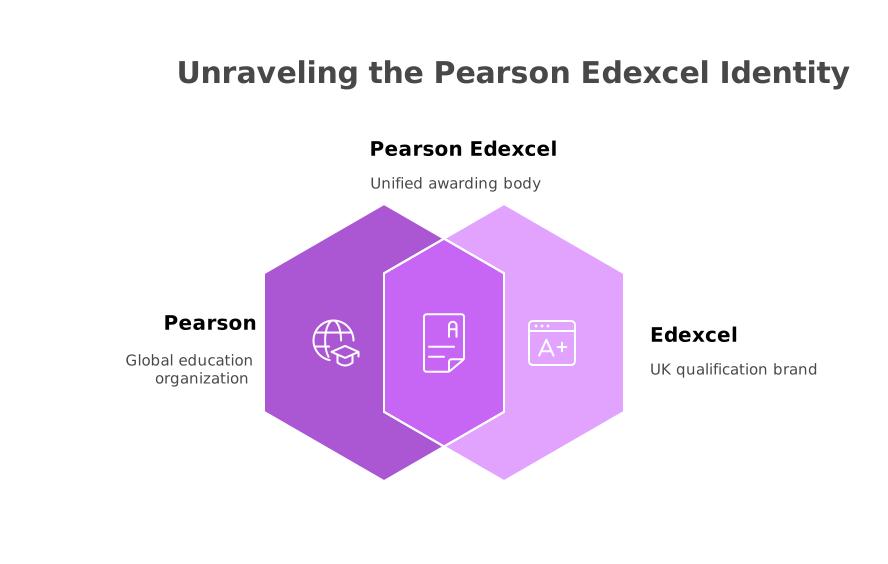
- Pearson — the Company
Pearson is one of the world's largest education organisations, responsible for publishing, assessments, digital learning tools, and global qualifications. It operates across more than 70 countries.
- Edexcel — the Qualification Brand
Edexcel was originally an independent UK exam board formed in 1996.
In 2003, it was officially acquired by Pearson and became part of the Pearson Assessment Division. This made Edexcel the UK's only privately owned exam board at the time.
Pearson Edexcel — the Combined Name
Today, the correct and official name is Pearson Edexcel, which simply means:
Pearson (the organisation) + Edexcel (the exam board/qualification).
So when you see:
- Pearson Edexcel Maths,
- Edexcel Maths Emporium,
- Pearson qualifications, or
- Edexcel exam materials.
All of them refer to the same awarding body under the Pearson universe.
Understanding the terminology is very important to avoid confusion when downloading resources or searching for exam information. Whether a document says "Edexcel" or "Pearson Edexcel," it comes from the same official authority responsible for conducting GCE Advanced Level, IGCSEs, and Mathematics A Levels exams worldwide.
This clarification helps you trust and use authentic resources — especially when accessing materials from the Edexcel Maths Emporium.
3. Edexcel Emporium Maths: The Complete Resource Library
The Edexcel Emporium Maths (often called the Maths Emporium Pearson) is one of the most valuable mathematics resource hubs available for teachers delivering Pearson Edexcel qualifications.
Although access is restricted to educators, it remains the most trusted and most complete repository of official maths exam materials.
What does the Maths Emporium contain?
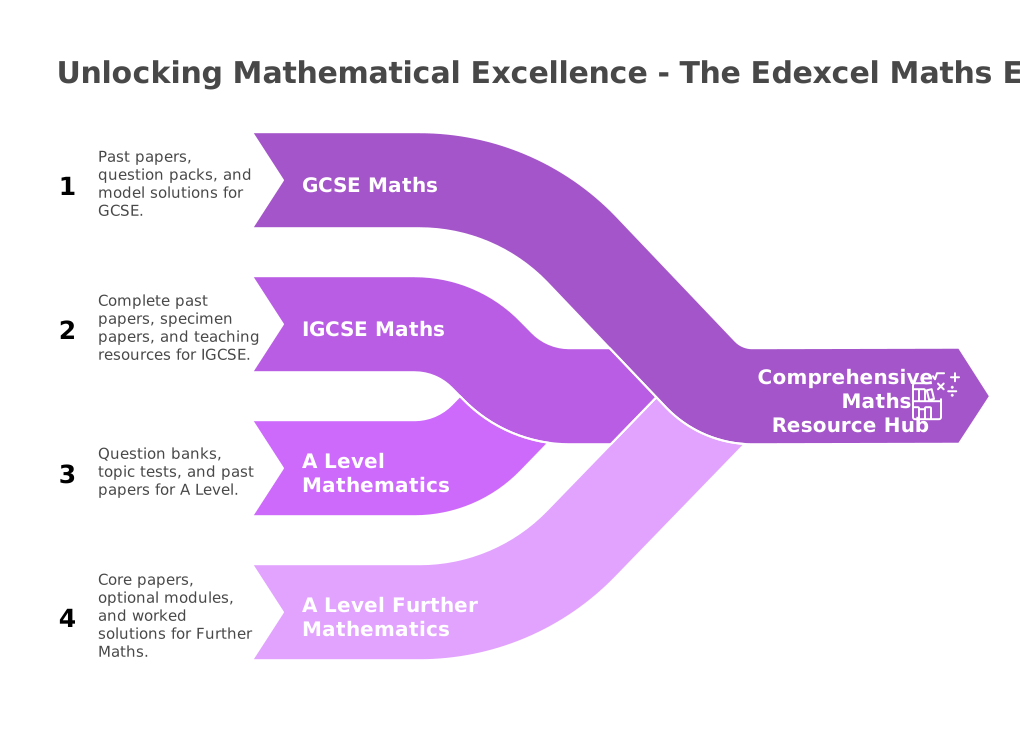
The Emporium covers the full range of Pearson Edexcel mathematics qualifications, including:
1. GCSE Maths (9–1)
- Past papers (both tiers),
- Topic-based question packs,
- Model solutions,
- Examiner-style practice tasks.
2. International GCSE (IGCSE) Maths
- Complete past papers,
- Specimen papers,
- Graded model answers,
- Teaching resources.
3. A Level Mathematics (9MA0)
- Pure Maths question banks,
- Statistics and Mechanics topic tests,
- Past papers with mark schemes,
- Examiner report summaries.
4. A Level Further Mathematics (9FM0)
- Core Pure papers,
- Optional modules (FS, FM, D1/D2),
- Step-by-step worked solutions.
Why Maths Teachers Depend on It?
The Maths Emporium is more than a storage site. It is the official space where Pearson Edexcel releases:
- Examiner-written past papers,
- Topic tests created by senior maths examiners,
- Examiner comments highlighting common mistakes,
- Assessment guidance and teaching notes,
- Unseen practice sets used by international schools preparing for high-stakes exams.
This makes the Emporium the most authoritative resource hub for teachers because the content is curated by the same senior examiners who write and evaluate Edexcel Maths examinations.
Why Students Search for It?
Even though direct access is restricted, students know that the Emporium contains:
- The latest and most accurate maths practice materials,
- High-quality examiner-approved resources,
- Deep-topic question banks that aren’t available elsewhere.
This is why the term “Edexcel Emporium Maths” is one of the most searched phrases among GCSE, IGCSE, and A Level Maths candidates.
4. Edexcel Exam Emporium: Papers, Grade Boundaries, Mark Schemes
The Edexcel Exam Emporium is the central hub where Pearson Edexcel stores all official assessment materials for maths and other subjects.
It is the only place where teachers can access a complete archive of Edexcel assessment-related documents, making it one of the most valuable tools.
Edexcel Exam Emporium contains assessment materials such as:
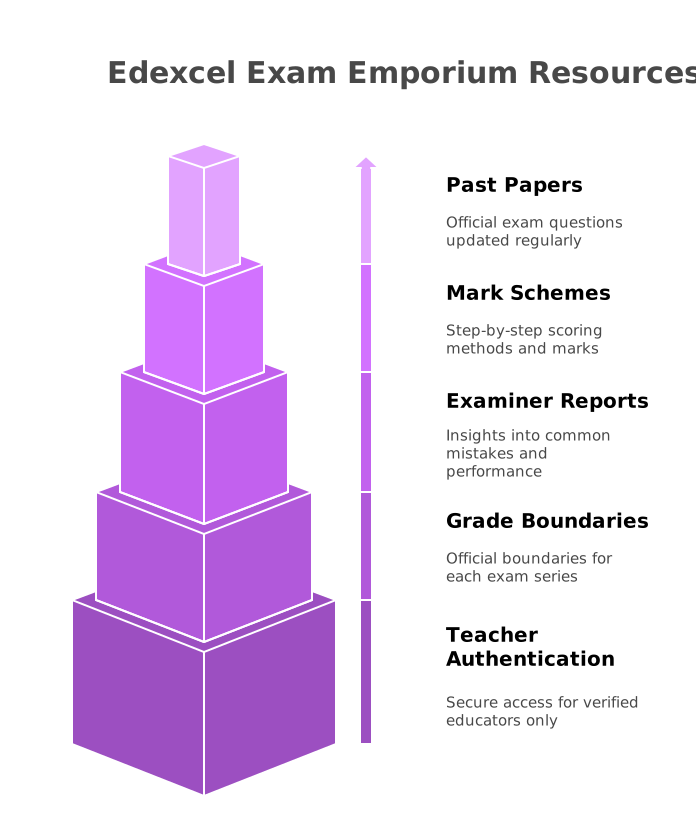
1. 10+ Years of Past Papers (All Levels)
The Emporium contains official past papers for:
- GCSE Maths,
- International GCSE Maths,
- A Level Mathematics,
- A Level Further Mathematics.
These include real exam questions written by Pearson’s senior examiners, updated every exam cycle, and can be used as exam practice papers.
2. Official Mark Schemes
Teachers can download full mark schemes that show:
- Step-by-step scoring methods,
- Accuracy (A) vs. Method (M) marks,
- Reasoning expected by examiners.
These help schools prepare students exactly according to Edexcel’s marking standards.
3. Examiner Reports
One of the most valuable resources in the Edexcel Exam Emporium is the examiner reports, which provide:
- Common student mistakes,
- Misinterpreted questions,
- Advice from senior examiners on how to score full marks,
- Insights into grade performance each year.
These reports are used worldwide to improve teaching quality and lesson planning.
4. Grade Boundaries for All Exams
The Emporium hosts official grade boundaries for every exam series:
- May/June,
- November,
- January (International GCSE & IAL only).
This helps teachers and departments understand performance trends and benchmark student preparedness.
5. Teacher-Only Authentication System
The Edexcel Exam Emporium is not publicly accessible.
To keep exam integrity, access requires:
- Verified teacher credentials,
- A valid school or centre number,
- Authentication through Pearson’s secure login system.
This ensures that only authorised educators can access sensitive exam materials used in Edexcel-affiliated international schools worldwide.
5. How to Access the Edexcel Emporium (2026 Update)
The Edexcel Emporium is a secure resource hub created by Pearson Edexcel for authorised teachers and exam officers.
Because it contains confidential exam materials, Pearson follows strict verification and copyright protocols to protect the integrity of global assessments.
Let's see how to access the Edexcel Maths Emporium.
1. Teacher Login System (Official Route)
Only verified teachers and exam officers can log in.
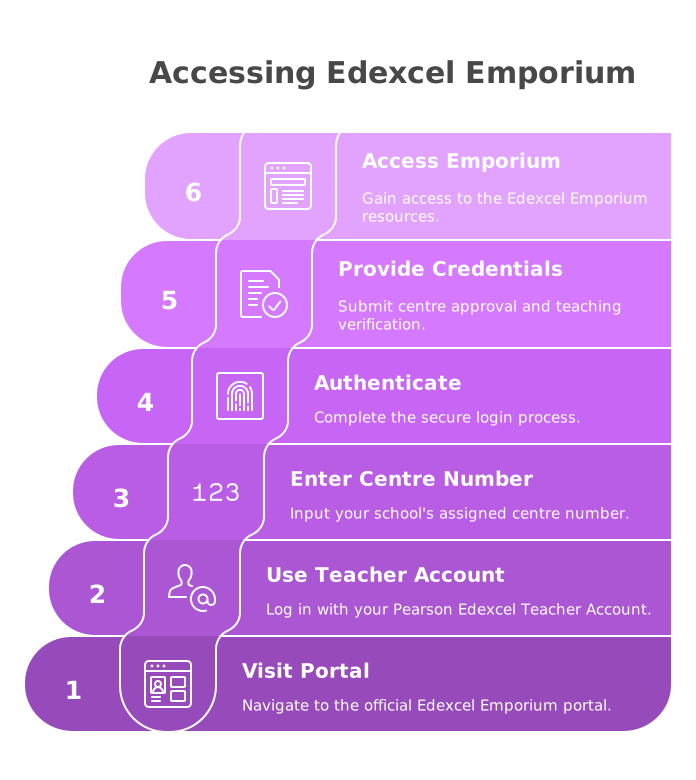
To access the Edexcel Emporium, educators must:
- Visit the official Edexcel Emporium portal.
- Use a Pearson Edexcel Teacher Account.
- Enter their centre number, school/centre email address( assigned to registered schools).
- Authenticate through Pearson's secure login system once the account activation email and confirmation email are sent.
This ensures that only authorised educators at registered Edexcel centres can view sensitive exam resources.
2. School Authentication Requirements
Schools must be officially registered with Pearson.
They must provide:
- Centre approval credentials,
- Teaching verification (teacher ID/staff email address),
- Subject access rights (e.g., Maths department access for Maths Emporium, along with the centre name).
This protects confidential exam materials and ensures compliance with Pearson's global exam security standards.
Let us see who cannot access the Edexcel Emporium.
The following users do not have direct access:
- Students,
- Parents,
- Private tutors not linked to an Edexcel-approved centre,
- Independent learners,
- Coaching centres without Pearson registration.
Students often search for "Edexcel Emporium login," but Pearson does not allow public access to avoid leaks of restricted materials.
Then how can students prepare for the Edexcel Exams?
Are there any alternatives?
Yes. There are alternatives for students
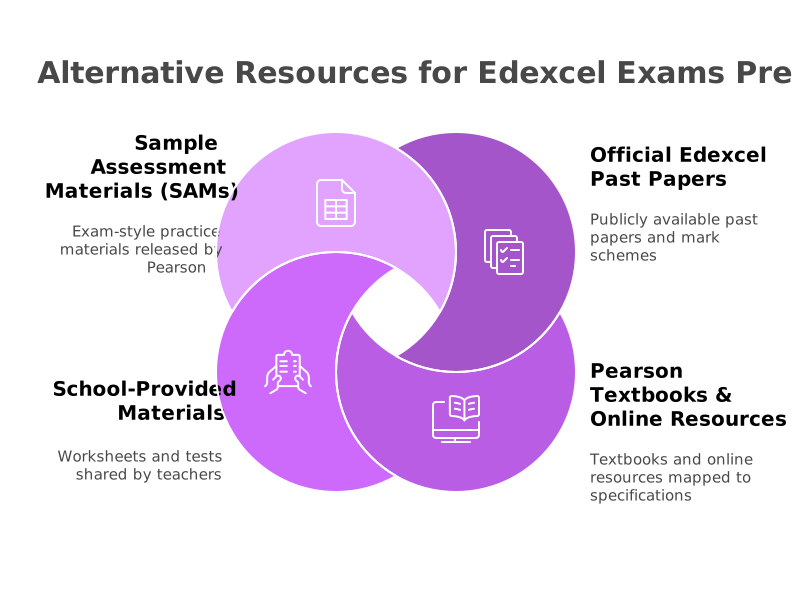
If students cannot access the Edexcel Emporium, they can safely use:
1. Official Edexcel Past Papers (Public Archive)
Available on the Pearson Qualifications website:
- GCSE Maths,
- IGCSE Maths,
- A Level Maths, and
- A Level Further Maths.
These include publicly released past papers, mark schemes, and grade boundaries.
2. Pearson Textbooks & Online Resources
These are mapped directly to the official specifications.
3. School-Provided Materials
Teachers download Emporium resources and share allowed materials through:
- Worksheets,
- Topic tests,
- Revision booklets, and
- Mock papers.
(According to Pearson's copyright rules.)
4. Sample Assessment Materials (SAMs)
Pearson publicly releases SAMs for each specification—perfect for exam-style practice.
6. How Teachers & Tutors Use the Emporium for A Level & GCSE Maths
The Maths Emporium Pearson portal is a strategic teaching tool used by thousands of teachers to teach maths world wide. Because it contains materials created by senior examiners, it helps educators design stronger lessons, accurate mock papers, and targeted revision plans for both GCSE and Mathematics A Level.
Below is how teachers and tutors typically use the Emporium to improve classroom outcomes and exam performance.
1. Creating Accurate Mock Papers Based on Real Exam Trends
Teachers use resources inside the Maths Emporium Pearson to build mock papers that:
- Mirror the real Edexcel Maths exam difficulty,
- Follow the actual question structure and topic distribution,
- Include updated styles aligned with current examiner preferences.
Since Edexcel frequently adjusts the types of problem-solving questions, the Emporium helps teachers keep their mocks aligned with the latest assessment trends.
2. Designing Realistic Modelling & Problem-Solving Questions
The Emporium contains:
- Sample assessment materials,
- Examiner-created modelling questions,
- Themed topic booklets, and
- Problem-solving worksheets.
These materials allow teachers to:
- Create modelling questions for mechanics, statistics, and pure maths.
- Build step-by-step questions similar to real exam ones.
- Train students in multi-step reasoning and application-based questions.
This is especially helpful for Mathematics A-Level Maths and Further Maths, where modelling forms a large part of the mark scheme.
3. Predicting Difficulty Levels for Each Exam Cycle
Teachers analyse:
- Past paper difficulty patterns,
- Question trend shifts,
- Topic frequency,
- Examiner's emphasis on reasoning vs. calculation.
By comparing resources inside the Edexcel Maths Emporium, teachers can predict:
- Which topics may appear more frequently,
- Which question formats may change,
- Likely difficulty levels for upcoming sessions.
This insight helps build accurate revision timetables for both GCSE and A Level students.
4. Using Examiner Reports for Targeted Teaching
One of the most valuable parts of the Edexcel Emporium Maths section is the examiner reports.
These reports highlight:
- Common student errors.
- Misconceptions that cause lost marks.
- What examiners expect in "method marks."
- How to write answers that score full marks.
Teachers use this data to:
- Deliver targeted intervention,
- Clarify tricky topic areas,
- Strengthen students' mathematical explanations,
- Improve exam technique and step-by-step presentation.
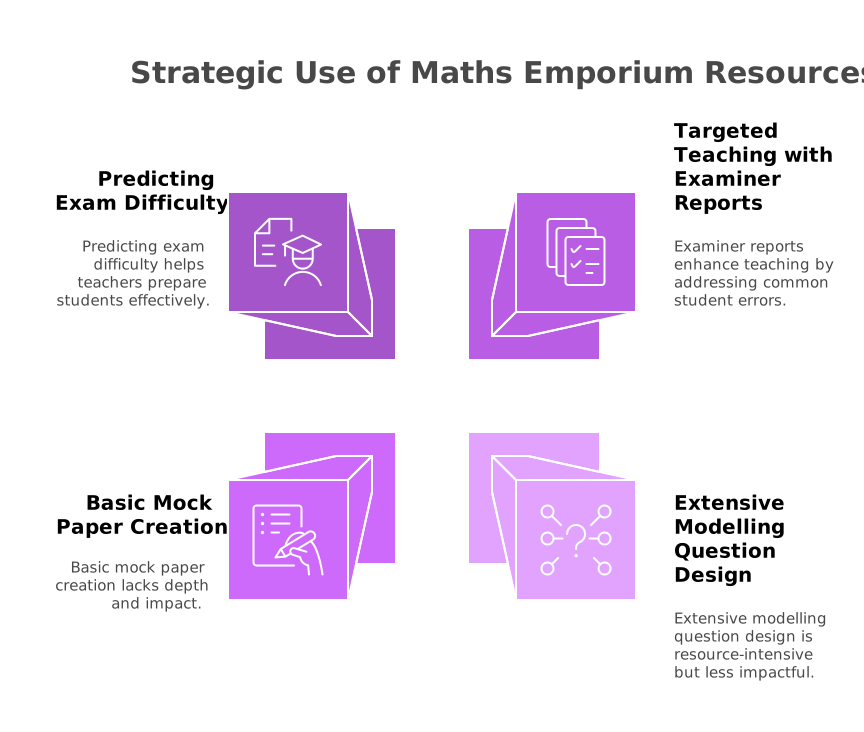
This makes teaching more efficient and ensures students learn exactly what examiners look for.
7. Limitations of the Edexcel Emporium (What Most Students Don’t Know)
Although the Edexcel Exam Emporium is one of the most powerful resource hubs for teachers, it also comes with strict limitations that many students are unaware of. Understanding these limitations helps avoid misinformation, illegal downloads, and confusion in exam preparation.
Here are some limitations that students don't know about
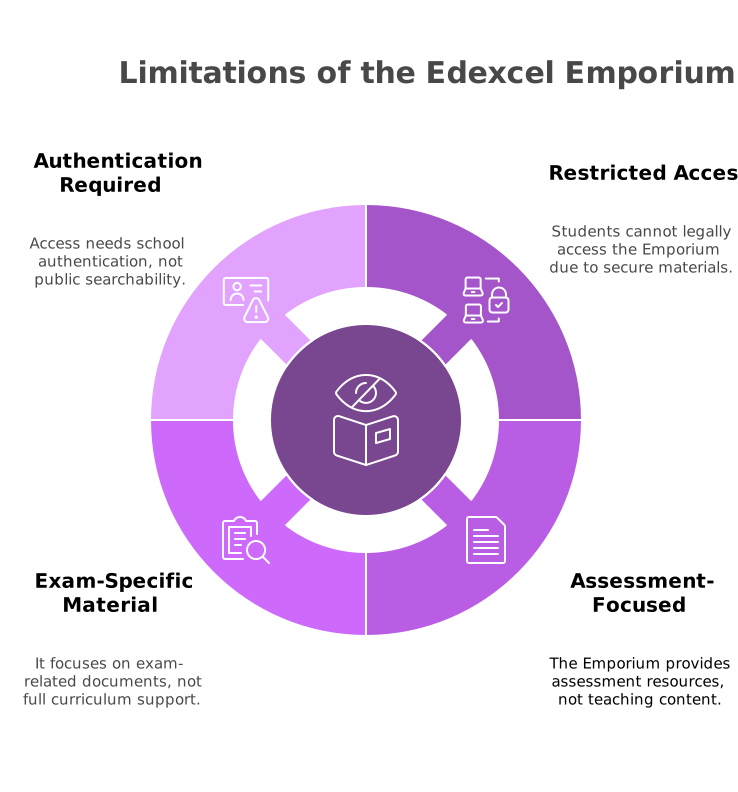
1. Students cannot Directly Access the Emporium
This is one of the most important limitations.
The Edexcel Emporium is strictly restricted to:
- Registered teachers,
- Approved tutors,
- School exam officers,
- Centres offering Pearson Edexcel qualifications.
Students cannot create accounts or log in.
Why?
Because the Emporium contains:
- Secure materials,
- Copyright-protected resources,
- Examiner-only documents,
- Pre-release assessment files.
Pearson has strict access to ensure exam integrity, prevent leaks, and protect officially copyrighted content.
2. It Is Not a Complete Learning Resource
Many students assume the Emporium is a platform to "learn" maths, but that's not true.
The Emporium provides assessment resources, not teaching content.
It does not include:
- Full lessons,
- Topic explanations,
- Step-by-step tutorials,
- Worked-out video solutions,
- Structured learning modules.
It is designed for teachers — not for students learning from scratch.
What it does include:
- Past papers,
- Mark schemes,
- Examiner reports,
- Grade boundaries,
- Topic-based question sets,
- Sample assessments.
These are tools for teachers to teach better, not a replacement for textbooks or structured learning.
3. It Contains Only Exam-Based Material (No Complete Curriculum Support)
Another major limitation is that students think the Emporium covers everything from Edexcel.
In reality, it focuses entirely on:
- GCSE Maths,
- IGCSE Maths,
- A Level Maths, and
- A Level Further Maths.
And even within these subjects, it only provides exam-related documents.
It does not include:
- Course specifications,
- Teaching guides,
- Full lesson plans,
- Classroom resources,
- Pearson textbooks (sold separately).
So while the Edexcel exam emporium is extremely strong for exam preparation, it does not provide academic resources.
4. Access Requires School Authentication (Not Publicly Searchable)
Students often try searching for "Edexcel Emporium login" in the hope of finding an open link — but it doesn't exist.
Access requires:
- An approved school/centre number,
- Teacher verification, and
- Password issued by Pearson.
This protects sensitive examiner-produced documents and ensures only authorised educators use them.
Why does Pearson have These Limitations for students?
Understanding the limitations helps students:
- Avoid illegal downloads.
- Use appropriate alternative resources.
- Know what the Emporium can (and cannot) offer.
- Focus on safe and official study materials.
For complete learning, students should rely on:
- Pearson textbooks.
- School-provided resources.
- Past papers are published on the official website.
- Structured courses.
- Concept-based tutorials.
- Vedic Maths for speed and accuracy in exams.
Read our blog, "Vedic Maths Tricks PDF," to learn quick Vedic Maths tricks.
8. How to Use Emporium Resources Effectively for Exam Success
The Edexcel Emporium Maths library is one of the most powerful tools teachers use to help students succeed — but only when used strategically.
Since the Emporium contains years of past papers, examiner commentary, and mark schemes, using these resources correctly can dramatically improve exam performance for GCSE, IGCSE, A Level Maths, and Further Maths.
Below is a step-by-step strategy designed to boost exam success.
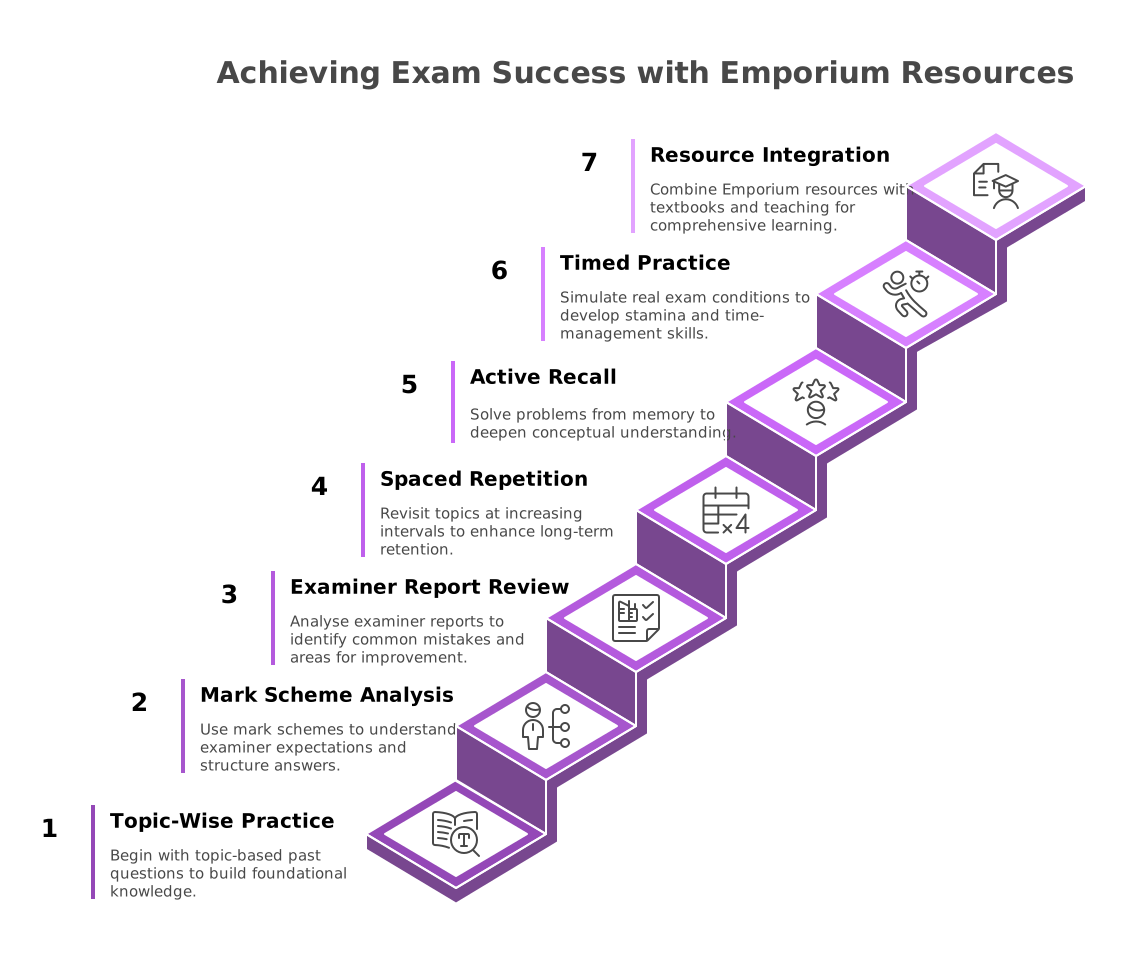
Step 1: Start with Past Papers (Topic-Wise → Year-Wise)
The Emporium contains 10+ years of past papers.
However, students often jump straight into full papers, which leads to low scores.
Correct usage method:
- Begin with topic-based past questions (Pure, Stats, Mechanics).
- Move to mixed-topic papers.
- Finally, solve full past papers under timed conditions.
Step 2: Use Mark Schemes to Learn EXACT Examiner Expectations
Mark schemes from the Edexcel Emporium Maths archive help students understand how answers must be structured.
How to use them effectively:
- Check method marks (M), accuracy marks (A), and independent marks (B).
- Learn standard formats (e.g., hypothesis-testing layouts).
- Practice writing solutions using mathematical reasoning steps.
- Compare your solution to the mark scheme after every attempt.
Step 3: Analyse Examiner Reports for Common Mistakes
One of the most underused yet powerful resources is the examiner report.
These reports highlight:
- The most common student errors.
- Topics students typically misunderstand.
- Steps needed for full marks.
- Misinterpretations of question wording.
- Areas requiring improved mathematical modelling.
Step 4: Apply Spaced Repetition & Active Recall
To make the most of Edexcel Emporium Maths materials, integrate scientifically proven learning techniques:
1. Spaced Repetition
Revisit topics at increasing intervals:
- Day 1,
- Day 3,
- Day 7,
- Day 14,
- Day 30.
This dramatically improves long-term retention, especially for tricky Pure Maths topics like differentiation, integration, sequences, and trigonometry.
2. Active Recall
Instead of rereading solutions, try:
- Solving problems from memory,
- Re-deriving formulas,
- Explaining solutions aloud, and
- Attempting the same problem again after a gap
This builds deeper conceptual understanding.
Step 5: Simulate Real Exam Conditions Using Emporium Papers
Once students are confident with topic practice, they should begin timed practice.
Correct simulation technique:
- Sit for the full 2-hour papers without breaks,
- Use the approved calculator,
- Follow official instructions strictly,
- Avoid checking answers midway, and
- Review systematically after finishing.
This develops exam stamina and time-management skills.
Step 6: Avoid the Most Common Mistakes
Students often misuse Edexcel Emporium resources by:
- Only reading mark schemes without attempting questions,
- Memorising answers instead of learning methods,
- Solving papers without timing,
- Ignoring examiner reports,
- Practising without reviewing mistakes,
- Solving too many papers in a short time.
Correct approach:
Solve → Mark → Analyse → Reattempt → Review
This cycle ensures exponential improvement.
Step 7: Combine Emporium Resources With Concept Learning
Since the Emporium focuses only on exam materials, teachers often combine it with:
- Pearson textbooks,
- Structured classroom teaching,
- Vedic Maths for fast mental calculations,
- Model solutions,
- Question banks, and
- Revision guides.
This ensures both conceptual understanding and the development of exam technique.
Using the Edexcel Emporium Maths archive this way helps students develop:
- Accuracy,
- Speed,
- Strong problem-solving skills,
- Clear mathematical understanding, and
- Confidence for final exams.
9. Boosting Calculation Speed with Vedic Maths (For Faster Exam Performance)
Fast calculations play a crucial role in GCSE, IGCSE, A Level Maths, and Further Maths. Whether it's simplifying algebra, evaluating probabilities, or handling multi-step calculations in solving statistics questions, students who calculate quickly perform significantly better, especially in time-bound exams.
This is why many teachers regularly use Edexcel Emporium resources + Vedic Maths techniques to strengthen students' speed, accuracy, and mental ability to solve maths problems quickly and accurately.
9.1 Why Fast Calculation Matters in A Level & GCSE Maths
Exams such as A Level Maths (9MA0) and GCSE Maths require students to:
- Simplify long algebraic expressions,
- Handle surds, fractions, indices, and binomial expansions,
- Perform multi-step probability and statistics calculations,
- Evaluate functions, logs, and differentiation quickly, and
- Work under timed pressure.
Even a few extra minutes saved on calculations can help students attempt more questions — often improving exam scores.
9.2 How Vedic Maths Supports Core Exam Areas
Vedic Maths helps to master the skills needed for both GCSE and A Level:
1. Algebra (Pure Maths)
Vedic Maths helps with:
- Faster factorisation,
- Squaring & cubing shortcuts,
- Rapid multiplication,
- Mental simplification of large expressions, and
- Solving equations with fewer steps.
This is especially useful for long Pure Maths tasks in Papers 1 & 2.
2. Probability & Statistics
Vedic techniques support:
- Quick fraction operations,
- Percentage conversions mentally,
- Z-score approximations,
- Standard deviation shortcuts, and
- Rapid addition/multiplication is needed in binomial or normal distribution calculations.
This helps students finish Section A of Paper 3 more efficiently.
3. Mechanics
Calculations involving:
- Acceleration,
- Forces,
- Moments, and
- Variable acceleration (calculus-based).
This helps students to calculate faster and reduce careless errors.
9.3 Real Use-Cases Where Vedic Maths Helps
Students preparing with Edexcel Emporium resources often struggle with:
- Long arithmetic steps in integration/differentiation,
- Simplifying algebra before substitution,
- Handling large numbers in probability questions,
- Re-computing values repeatedly under exam stress,
Vedic Maths helps by offering:
- 2–5 second multiplication,
- Fast division methods,
- Rapid ratio analysis, and
- Quick mental estimation (crucial for checking answers)
Read our blog, "Vedic Maths for Multiplication," to learn smart multiplication techniques using Vedic Maths.
Many reports say that students using Vedic methods show improved exam speed, fewer mistakes, and higher problem-solving confidence.
9.4 Learn Vedic Maths with Expert Guidance
Learn Vedic Maths in just 40 days with our Live Vedic Maths Classes Program, designed and taught by Mamta Rupesh, a certified Vedic Maths teacher with over 8 years of experience, who has trained 15,000 students, 5,000 parents, and 5,000 teachers to date, and continues to train across the globe.`

Live Vedic Maths Classes Best Selling
Its a 40 day live Classes thought only for children from Grade 3 to 12 covers from Basics to Advance.
- 40 Day Live Program
- Get Individual Attention
- Certification & Lifetime Access
You can also learn Vedic Maths at your own pace using our Vedic Maths Bundle Kit—a pre-recorded course with 25 hours of video content, seven complete modules, and one bonus module suitable for students, parents, teachers, and competitive exam aspirants.

Vedic Maths Bundle Kit Best Selling
Perfect program designed for students from grade 3 - 12, teachers & parents aspiring to grow their career & upskill their children.
- Bundle Offer
- Worksheets & Exercise Problems
- Certification & Lifetime Access
The courses provide lifetime access and include free downloadable worksheets and PDFs that help learners practice what they learned in the course using different question formats, such as multiple-choice, fill-in-the-blank, true-or-false, and real-world word problems.
You can also clear all your doubts with an expert like Mamta Rupesh by joining our Vedic Maths WhatsApp community today. You will also get the latest updates on upcoming classes and courses.
Visit www.thevedicmaths.com or contact us at +91-866-056-2614 or info@thevedicmaths.com to learn more.
Don’t wait any longer.
Book a free 45-minute personalised demo class today to know more about our Vedic Maths course.
Why learn Vedic Maths from Mamta Rupesh?
Her proven results-driven methods and approach focus on building speed, accuracy, and conceptual clarity — skills essential for high performance in GCSE, IGCSE, and Mathematics A Level. Listen to what our students, parents, and teachers say about why they chose Mamta Rupesh to learn Vedic Maths.


Testimonials from Students
Here are a few reviews from Parents


It has been wonderful experience for my granddaughter. Our brain is nothing but a number crunching machine. Vedic Maths sharpens the brain and improves this number crunching ability.
Madam Mamata has been very good and her teaching was nice. She is sincere and caring towards students.
Please continue the good work and I wish you best luck for the future journey.

Mukund Oke
Happy Grandfather, India
The most interesting and helpful class in the world,
The teacher always clears our doubts until we are clear about the concepts.
Her teaching style is very interactive. she keeps the class more fun also .Thank you mam for giving us a wonderful opportunity to learn with you.

Sengamala Priya
Happy Mother, UAE
I had enrolled my daughter for vedic math class with Miss Mamta and it was a good experience for her to learn the math concepts. Miss Mamta was patiently guiding through the course, helping out in case of doubts and flexible with kids. Thanks for sessions, it was really helpful.
Thivya Nagarajan
Happy Mother, Singapore
Thank you for your wonderful sessions. My daughter really enjoyed throughout this course. No fear of Maths which she had experienced before with abacus.
You will be greatly missed!
Looking for some advanced classes for kids soon!
Geethu Sajad
Happy Mother, UAE
Ms Mamta is very warm and jovial. She made my child feel very comfortable. By sharing her own challenges in math in her early years and how she overcame these challenges she makes everything seem possible. During this short duration of the demo she showed atleast 5 tricks to solving problems there by piquing my daughter’s interest. We are very much looking forward to the classes with Ms Mamta.
Veena Krishnamurthy
Happy Mother, Malaysia
She is an amazing teacher. She has a “no frills, student centered” teaching approach. The personal attention towards every learner in a virtual environment is indeed praiseworthy. The illustrations and practice exercises are perfect to overcome mathematics phobia. As a teacher, I can safely say, she is a wonderful person to teach Maths to the kids of all age groups.
Dr. Manishankar Chakraborty
Happy Father, UAE
10. Recommended Study Strategy Combining Emporium + Vedic Maths
To score higher in GCSE, IGCSE, A Level Maths, and Further Maths, students need two things:
1. Exam-focused practice - using official Edexcel Emporium Maths resources.
2. Fast and accurate calculations - through Vedic Maths methods.
When combined, this approach becomes a powerful study strategy that improves problem-solving speed, accuracy, and exam confidence.
Below is a structured strategy that teachers and high-performing students use worldwide.
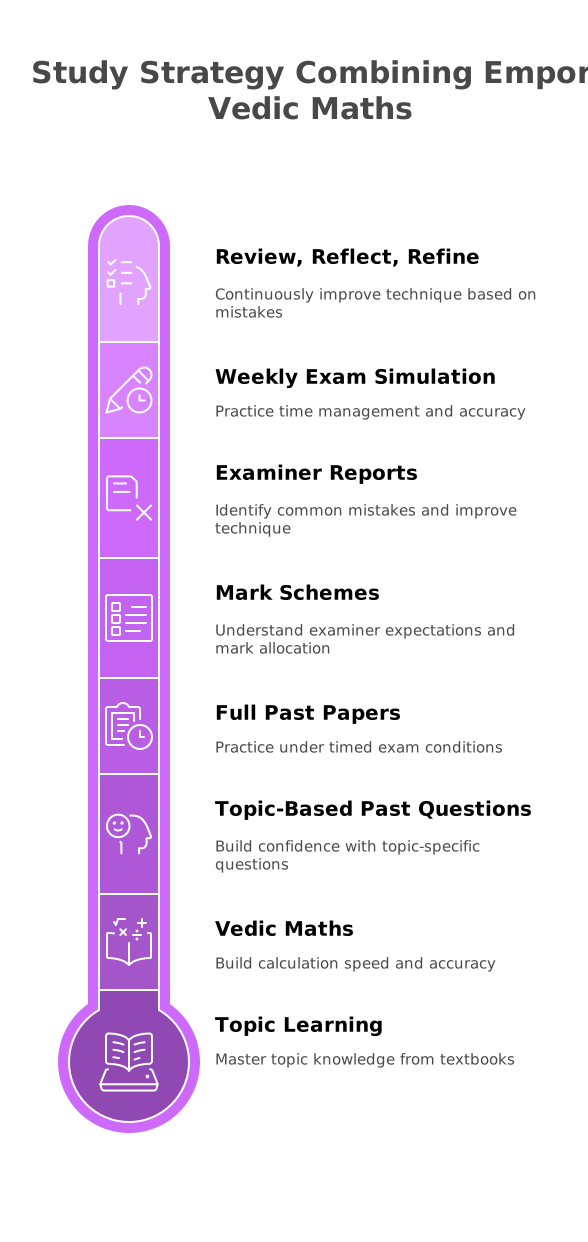
Step 1: Start With Topic Learning (Weeks 1–4 of Any Study Cycle)
Before solving past papers, students should first master the topic knowledge from textbooks or teacher notes.
Use:
- Class notes,
- Pearson Edexcel textbooks, and
- Topic worksheets.
Do not start Emporium papers — past papers are exam-level, meant for later stages of preparation.
Step 2: Introduce Vedic Maths for Calculation Speed (Daily, 10–15 min)
Vedic Maths helps simplify:
- Algebraic equation,
- Multiplication & division,
- Fractions, ratios, percentages,
- Probability & statistics calculations, and
- Simplifications in Mechanics.
Use Vedic Maths daily for:
- Mental maths warm-up,
- Practising shortcuts, and
- Building speed before solving questions.
Vedic Maths plays a crucial role when attempting long Pure Maths questions or multi-step A Level questions under time pressure.
Step 3: Use Edexcel Emporium Maths Resources (After Topic Mastery)
Once a student understands the basics of the topic, they can begin practising with Edexcel Emporium maths materials.
Use in this order:
1. Topic-Based Past Questions
Pick individual topic folders, such as:
- Algebra,
- Differentiation,
- Normal distribution,
- Kinematics, and
- This builds confidence.
2. Full Past Papers
Attempt full papers under timed conditions.
3. Mark Schemes
Check step-by-step working — this shows how examiners award marks.
4. Examiner Reports
Identify common mistakes described by senior examiners.
Past-paper retrieval is the strongest predictor of exam success across UK exam boards.
Step 4: Combine Both Approaches Daily (High-Performance Routine)
Here’s a sample effective daily routine:
| Time | Task | Purpose |
|---|---|---|
| 10 minutes | Vedic Maths speed techniques | Build speed and accuracy |
| 20 minutes | Topic revision | Strengthen conceptual foundation |
| 30 minutes | Emporium past papers questions | Apply concepts in the exam |
| 10 minutes | Mark scheme review | Understand how marks are distributed |
| 5 minutes | List of errors | Identify weak areas |
Using this routine, students improve both exam technique and mathematical fluency.
Step 5: Weekly Exam Simulation (Using Emporium Papers)
Solving one full mock paper per week helps students practice:
- Time management,
- Accuracy under stress, and
- Real exam stamina.
Combine this with Vedic Maths for faster calculations in:
- Binomial expansions,
- Algebraic simplifications,
- Probability fractions, and
- Mechanics numerical steps.
Full-paper practice will reduce exam anxiety and improve time efficiency.
Step 6: Review, Reflect, and Refine (RRR Method)
After every Emporium paper:
1. Review mistakes.
2. Reflect on the topic causing the issue.
3. Refine your technique using Vedic Maths or additional topic practice.
This creates a continuous improvement.
By combining Edexcel Emporium and Vedic Maths, students can create a structured plan, practice it, and perform better in both GCSE and Mathematics A-Level.
11. Helpful Links & Resources
To support students, teachers, and tutors preparing for GCSE, IGCSE, and A Level Maths, here is a list of credible, authoritative, and highly useful resources that ensure learners have access only to reliable, official materials.
These include Pearson Edexcel's official resources and highly valuable resources from The Vedic Maths.
11.1 Official Pearson Edexcel Websites (Most Authoritative Sources)
These pages are maintained directly by Pearson — the awarding body responsible for Edexcel exams — making them the most trusted resources for exam preparation.
1. Pearson Edexcel Main Website
Contains information about all UK and international qualifications.
Use for: syllabus updates, policy changes, exam announcements.
Pearson Official Website (Education & Qualifications)
2. Pearson Edexcel Maths Qualification Pages
Includes everything related to:
- GCSE Maths,
- IGCSE Maths,
- A Level Maths (9MA0), and
- A Level Further Maths (9FM0).
Use for:
- Syllabus,
- Formula booklets,
- Assessment structure, and
- Sample assessment materials (SAMs).
Pearson Edexcel Mathematics Qualification Section
3. Pearson Emporium / Maths Emporium Information
Although access is restricted, the official description explains its purpose.
Use for: teacher login guidance
11.2 Official Past Paper Repositories
These are the legal sources for students (unlike the restricted Emporium).
1. Pearson Past Papers Archive (Public Access)
Offers freely accessible:
- GCSE past papers,
- IGCSE past papers,
- A Level past papers,
- Mark schemes, and
- Examiner reports.
Pearson Edexcel Past Paper Archive
2. International GCSE & GCE Resources
Use for:
- Global exam centres, and
- International variants.
11.3 Additional Study Tools
These are recommended because they closely align with Pearson Edexcel exam patterns and are widely used across schools.
1. Pearson Textbooks & eBooks
Mapped exactly to the specification.
Pearson Edexcel Textbooks Platform (ActiveLearn)
2. Pearson "ExamWizard."
A tool for teachers to generate custom papers using past paper questions.
11.4 High-Authority Vedic Maths Internal Resources
These offer speed-building and conceptual clarity — essential for success in Edexcel exams, especially Paper 1, Paper 2, and applied papers.
1. Live Vedic Maths Classes (Grades 3–12)
Helps students increase calculation speed for algebra, statistics, combinatorics, and mechanics.
2. Vedic Maths Bundle Kit (7+1 Pre-Recorded Courses)
Includes 25+ hours of shortcuts, worksheets, and exam-oriented techniques.
3. Free Vedic Maths Worksheets (Downloadable PDFs)
Perfect for mental maths warm-ups and daily speed practice.
4. Expert-Led Content by Mamta Rupesh
She has:
- 8+ years of global teaching experience.
- 15,000+ students trained.
- 5,000+ parents and 5,000+ teachers trained.
Blogs & Learning Guides by The Vedic Maths
These resources help students access related learning information.
12. Conclusion
The Edexcel Emporium is one of the most reliable and powerful resource hubs created by Pearson Edexcel for mathematics exams.
It contains official past papers, mark schemes, and examiner reports to help teachers accurately prepare students for GCSE, IGCSE, A Level, and Further Maths.
However, it is important to understand that the Edexcel Maths Emporium is designed for teachers, not for direct student access.
Students benefit from it indirectly through school-provided materials and guided practice. It is also not a complete learning platform, and it supports only exam practice, not concept teaching.
To succeed in Edexcel maths exams, students need both exam-aligned practice and strong calculation skills. This is where combining Emporium-based exam resources with Vedic Maths works extremely well.
While the Emporium helps with exam technique, Vedic Maths improves speed, accuracy, and confidence.
When used together in a structured way, these tools help students manage time more effectively, reduce mistakes, and perform more calmly in exams.
With the proper guidance, consistent practice, and clear understanding, students can turn maths from a challenge into a strength and achieve better results in their Edexcel exams.
13. FAQs on Edexcel Emporium
1What is the Edexcel Emporium?
The Edexcel Emporium (also called the Maths Emporium or Edexcel Maths Emporium) is an official resource hub created by Pearson Edexcel for teachers and exam officers.
It contains past papers, mark schemes, examiner reports, grade boundaries, and exam-focused materials.
2Who can access the Edexcel Emporium?
Only authorised teachers, exam officers, and registered Pearson Edexcel centres can access the Emporium. Students, parents, and private candidates cannot log in directly.
3Can students access the Edexcel Maths Emporium directly?
No. Students cannot directly access the Edexcel Emporium. They can only use materials shared by teachers in line with Pearson’s copyright rules.
4Can I get downloadable past papers for UK secondary maths exams on any emporium websites?
No. Emporium websites are not publicly accessible.
However, students can download UK secondary maths past papers (GCSE, IGCSE, A Level) from:
- Pearson Edexcel’s official public past paper archives
These include past papers, mark schemes, and examiner reports released for public use.
5How can I access official Edexcel Maths exam preparation tools?
Students can access official preparation tools through:
- Pearson Edexcel public past paper repositories,
- Pearson Edexcel textbooks and eBooks,
- Sample Assessment Materials (SAMs), and
- School-provided worksheets, mocks, and revision packs.
These are the approved alternatives to the restricted Emporium.
6Which platforms offer revision materials for Edexcel Maths Emporium courses?
While the Emporium itself is teacher-only, students can use:
- Pearson Edexcel Limited textbooks (GCSE, IGCSE, A Level, Further Maths),
- Pearson ActiveLearn and ExamWizard (via schools),
- School-issued revision booklets and mock papers, and
- Concept-based learning platforms aligned with Edexcel specifications.
- Vedic Maths courses for improving calculation speed and accuracy
7How to purchase Edexcel Maths Emporium revision books online?
There are no books sold under the name “Emporium Books.”
Instead, students should purchase:
- Official Pearson Edexcel textbooks, and
- Pearson-endorsed revision guides
These are available through:
- Pearson’s official website,
- Online bookstores (Amazon, educational suppliers), and
- School-recommended vendors.
8Is the Edexcel Emporium a complete learning platform?
No. The Emporium is not designed for teaching concepts. It focuses only on exam and assessment materials. Students still need textbooks, lessons, and guided practice to learn topics properly.
9What is the difference between Edexcel Emporium and Pearson textbooks?
- Edexcel Emporium: Exam-focused materials (past papers, examiner reports) for teachers.
- Pearson textbooks: Structured learning resources for students.
Both are important but serve different purposes.
10How do teachers use the Emporium to help students?
Teachers use Emporium resources to:
- Create realistic mock exams,
- Identify common mistakes in examiner reports,
- Plan targeted revision, and
- Align teaching with real exam standards.
Students benefit indirectly through these teacher-prepared materials.
11Does the Emporium include Functional Skills Maths resources?
Yes. For authorised users, the Emporium also includes assessment-related materials for Functional Skills Maths, alongside GCSE, IGCSE, and A Level Maths.
12How does Vedic Maths support Edexcel exam preparation?
While not part of the Emporium, Vedic Maths helps students:
- Calculate faster,
- Reduce careless errors, and
- Manage time better in exams.
This makes it a strong complement to Emporium-based exam practice.
13What is the biggest takeaway about the Edexcel Emporium?
The Edexcel Emporium is an exam support system for teachers, not a student learning portal.
Students perform best when they combine:
- Official Edexcel online exam materials (publicly available),
- Teacher guidance,
- Strong conceptual learning, and
- Speed and accuracy skills (like Vedic Maths).
This balanced approach leads to better confidence and higher exam performance.

