

Preparing for Further Maths can be difficult, but the right practice papers make it easier. Edexcel Further Maths past papers are among the best ways to understand the real exam difficulty and question style. Whether you’re revising for Edexcel Further Maths past papers A Level or exploring Edexcel Further Maths past papers GCSE, working through real exam questions helps you to solve exam-style problems under time pressure.
In this guide, we will go through the Edexcel Further Maths resources in detail—covering both GCSE and A Level. You will know where to find every Further Maths Edexcel past paper, how to download them, and how to use them effectively with mark schemes and examiner reports. Common student doubts, such as “How many papers are in Edexcel A Level Maths and Further Maths?”, are also addressed so students can plan their revision effectively and confidently.
By the end of this blog, you’ll know exactly which Edexcel Further Maths past papers, such as GCSE and A Level, to focus on at each stage of your preparation and how to achieve your targeted grade using past paper practice.
Key Takeaways
- Edexcel Further Maths past papers are the most effective tools for building exam speed, accuracy, and real-world problem-solving skills — more effective than textbooks alone.
- Both A Level Further Maths (9FM0) and GCSE Further Maths require consistent practice because questions demand multi-step reasoning, proof skills, and fast calculations.
- Students must understand the exam structure:
a) A Level Further Maths → 4 papers (2 Core Pure + 2 Optional modules).
b) GCSE Further Maths → 2 papers, each 1 hour 45 minutes.
- Official and accurate past papers, mark schemes, and examiner reports are available only on Pearson Edexcel’s qualification pages.
- Some resources, such as the Pearson Edexcel Maths Emporium, are teacher-only and not accessible to students without a registered school/centre login.
- The best revision strategy includes active recall, spaced repetition, timed full-paper practice, and error analysis.
- Students score significantly higher when combining past papers + Vedic Maths, as Vedic techniques improve calculation speed, reduce careless errors, and save precious time in exams.
- Understanding how many papers are in Edexcel A Level Maths and Further Maths helps students plan revision blocks and avoid last-minute stress.
- Vedic Maths enhances performance in heavy-calculation areas such as Core Pure Algebra, Further Mechanics Modelling, and Further Statistics Distributions.
- Following a weekly structured plan—concept revision → topic practice → speed drills → solving full timed papers, which maximises exam confidence and accuracy.
1. Introduction: Why Further Maths Past Papers Matter More Than Textbooks
When it comes to mastering Edexcel Further Maths, practising with Edexcel Further Maths past papers builds exam readiness like practicing actual question papers.
While textbooks build conceptual understanding, Further Maths Edexcel past paper practice trains your brain for speed, accuracy, and high-level problem-solving. Past papers expose you to real exam pressure, the actual difficulty level, and the exact way questions are framed.
All Edexcel Further Maths exam papers are created by subject specialists and senior examiners from Pearson Edexcel, ensuring every question is aligned with real marking standards and grade expectations.
Students who begin early paper-based revision consistently show faster improvement, sharper exam technique, and build confidence when solving complex, unfamiliar problems. Past papers don’t just test what you know — they train you how to think like an examiner.
2. Difference Between GCSE Further Maths & A Level Further Maths
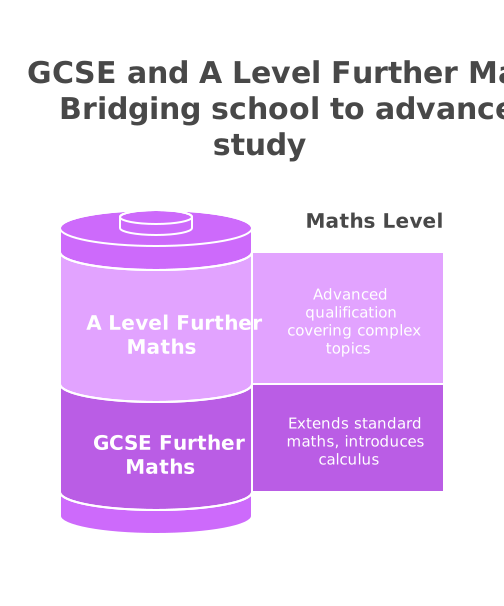
The biggest academic transition students face is choosing GCSE Further Maths and A Level Further Maths. At GCSE Level, Further Maths acts as an extension beyond standard GCSE Maths, focusing on strengthening algebra, introducing basic calculus ideas, and developing greater problem-solving skills. It builds a bridge between school maths and A Level study.
At A Level Further Maths, it is a fully advanced qualification that covers complex topics like Matrices, Complex Numbers, Advanced Calculus, Further Statistics, Mechanics, and Decision Maths.
This is why Edexcel Further Maths past papers GCSE are ideal for building confidence, while A Level past papers require a much higher level of mathematical understanding and fluency.
Both qualifications are designed by Pearson Edexcel, with clearly defined curricula for GCSE and A Level.
GCSE Further Maths is best for high-achieving students who enjoy maths and plan to take it seriously at the next level, i.e., A Level.
A Level Further Maths is strongly recommended for students aiming for careers in engineering, computer science, physics, mathematics, data science, economics, and AI.
The biggest challenge students face during this transition is moving from a procedural comfort zone at GCSE to multi-step, proof-based, and abstract thinking at A Level, which is why early exposure to both GCSE and A Level Edexcel Further Maths past papers makes a powerful difference in long-term success.
3. Edexcel Further Maths Past Papers (A Level — Full Breakdown)
The Edexcel Further Maths A Level (9FM0) is one of the most advanced school-level mathematics qualifications offered by Pearson Edexcel.
Unlike standard A Level Maths, this qualification is advanced and flexible, allowing students to choose optional modules based on their strengths and future career plans. Practising Edexcel Further Maths A Level past papers is essential because each module is aligned with various question styles, difficulty levels, and marking expectations.
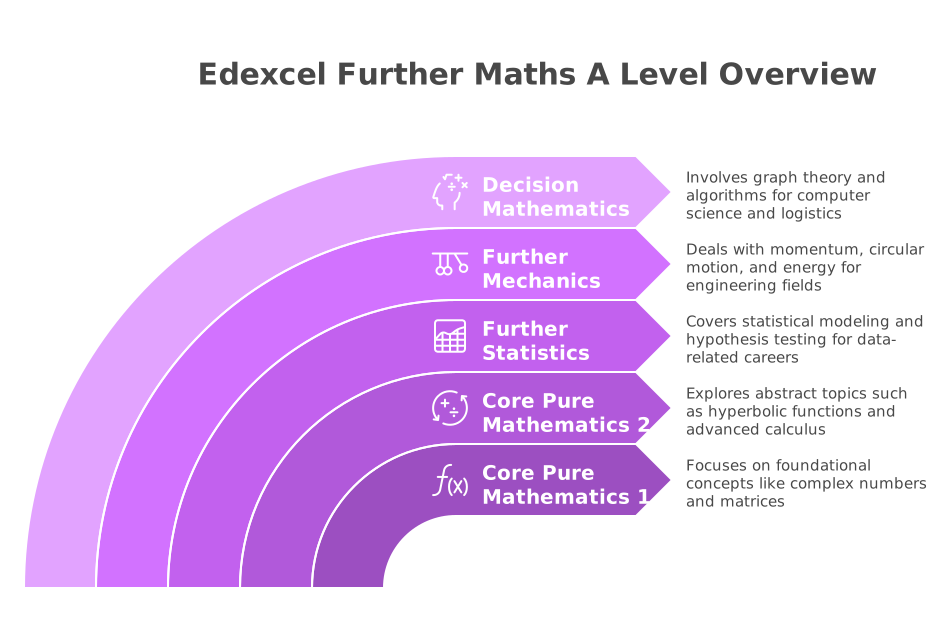
This qualification consists of 4 papers:
- 2 compulsory Core Pure Mathematics papers
- 2 optional module papers( Further Statistics, Further Mechanics or Decision Mathematics)
Each paper is 1 hour and 30 minutes, set for 75 marks, and contributes equally to the final grade.
Let's see each paper in detail:
1. Core Pure Mathematics 1 (CP1)
This paper builds the foundation of all Further Maths learning.
Key Topics Include:
- Complex numbers (advanced operations)
- Proof by contradiction & induction
- Polynomial roots
- Matrices & transformations
- Series & sequences
- Further vectors
- First-order differential equations
Scoring Pattern & Examiner Expectations:
- High weight on proof clarity and logical structure
- Marks are heavily method-based
Examiners expect:
- Full mathematical reasoning
- Correct symbolic manipulation
- Clear explanation of steps (no shortcuts)
Students often lose marks on proof questions for missing justification steps, even when the final result is correct.
2. Core Pure Mathematics 2 (CP2)
This is the most abstract and demanding paper in the entire Further Maths course.
Key Topics Include:
- Hyperbolic functions
- Maclaurin series
- Polar coordinates
- Advanced complex numbers
- Further differential equations
- Advanced matrix algebra
Scoring Pattern & Examiner Expectations:
- Strong focus on multi-step reasoning
- Heavy use of:
- Series expansion
- Coordinate transformation
- Advanced calculus
Examiners expect:
- Structured derivations
- Proper mathematical notation
- Logical linking between steps
Students usually lose marks due to:
- Weak algebraic simplification
- Sign errors in lengthy derivations
- Incorrect setup of Maclaurin or polar equations
3. Further Statistics (FS1 / FS2)
Ideal for students targeting a career in Data Science, Economics, Actuarial Science, Psychology, and Business Analytics.
Key Topics Include:
- Poisson & continuous distributions
- Hypothesis testing (advanced)
- Correlation & regression
- Probability generating functions
- Statistical modelling
Scoring Pattern & Examiner Expectations:
- Correct model selection
- Logical interpretation of results
Examiners strictly evaluate:
- Hypothesis notation
- Probability distribution conditions
- Conclusions in context
Raw marks for top grades often fall between 62–70/75, depending on paper difficulty.
4. Further Mechanics (FM1 / FM2)
Highly preferred by students pursuing a career in Physics, Mechanical Engineering, Aerospace, Robotics, and Architecture.
Key Topics Include:
- Momentum & impulse
- Circular motion
- Centres of mass
- Work-energy-power
- Elastic collisions
- Variable acceleration
Scoring Pattern & Examiner Expectations:
- Strong focus on:
- Diagram accuracy
- Vector resolution
- Correct application of Newton's Laws
Marks are lost mainly due to:
- Algebraic slips
- Incorrect sign conventions
- Poor diagram modelling
Even strong students lose marks here due to calculation mistakes in long mechanics problems—speed and clarity are critical.
5. Decision Mathematics (D1 / D2)
Best suited for Computer Science, AI, Operations Research, and Logistics students.
Key Topics Include:
- Graph theory
- Algorithms (Dijkstra, sorting)
- Linear programming
- Network flows
- Critical path analysis
- Allocation & matching problems
Scoring Pattern & Examiner Expectations:
- Logic accuracy is valued more than heavy calculations
- Examiners focus on:
- Correct algorithm steps
- Logical sequencing
- Conclusion validation
Errors usually occur when students:
- Writing a single wrong step breaks the entire algorithm chain
- skipping justification steps
Students must practise at least 7–10 full past papers per module consistently to:
- Improve accuracy
- Reduce mechanics calculation errors
- Master statistical interpretation
- Build algorithmic confidence in Decision Maths
Most marks are lost not due to lack of knowledge, but due to presentation, speed, and step-skipping.
4. Edexcel Further Maths Past Papers for GCSE
The GCSE Further Maths qualification offered by Pearson Edexcel acts as a bridge between GCSE and A Level Mathematics. Students who practise Edexcel Further Maths past papers GCSE gain early exposure to advanced problem-solving, algebraic reasoning, and structured proof — skills that directly prepare them for A Level Maths and Further Maths.
How Many Papers Are There in Edexcel GCSE Further Maths?
The Edexcel GCSE Further Maths qualification is assessed through:
- 2 written exam papers
- Each paper is 1 hour and 45 minutes
- Each paper carries 80 marks
- 100% exam-based assessment
Both papers are equally weighted and contain a mix of core algebra, calculus foundations, proof, and advanced geometry.
Difficulty Level of GCSE Further Maths
GCSE Further Maths is more challenging than standard GCSE Maths, but still more accessible than full A Level content.
Difficulty comparison:
GCSE Maths → Foundation + Higher core topics
GCSE Further Maths → Higher + pre-A Level extension
A Level Maths → Full calculus, mechanics & statistics depth
This makes Edexcel Further Maths Past papers GCSE ideal for:
- High-ability GCSE students
- Olympiad aspirants (early stage)
Students aiming for A Level Maths, Further Maths, Engineering, or Competitive STEM fields.
GCSE Further Maths Paper Structure (Topic-Wise Breakdown)
Both Paper 1 and Paper 2 typically assess the following high-level areas:
1. Advanced Algebra
- Advanced factorisation
- Algebraic fractions
- Simultaneous equations (including quadratic)
- Functions and inverse functions
This directly prepares students for A Level Pure Maths algebra.
2. Calculus (Foundational Level)
- Differentiation from first principles
- Differentiation of polynomial functions
- Gradient interpretation
- Basic optimisation
3. Mathematical Proof
- Algebraic proof
- Proof by contradiction
- Deductive reasoning using identities
Marks are awarded heavily for logical structure and step-by-step justification, not just final answers.
4. Geometry & Trigonometry (Advanced Level)
- Advanced circle theorems
- Trigonometric identities
- Compound angle style reasoning
- Coordinate geometry
Most students lose marks due to skipped reasoning steps, not incorrect final answers.
Why GCSE Further Maths Is Unique (Pre-A Level Bridge Role)
GCSE Further Maths is not a replacement for A Level, but it acts as:
- A conceptual stepping stone
- A proof-training platform
- A calculus readiness course
- A filter for students ready for Further Maths at A Level
Students who score well in GCSE Further Maths usually:
- Find A Level Maths is not too tough
- Adapt faster to Pure Maths & Further Maths Core Pure
- Have stronger algebra + proof confidence
Where to download the Edexcel GCSE Further Maths Past Papers, which resources are restricted to students, and how to utilize these resources effectively are discussed further in the following sections.
5. How Many Papers are in Edexcel A Level Maths + Further Maths?
Understanding the exact number of papers in Edexcel A Level Maths and A Level Further Maths is essential for building a strong revision timetable. Pearson Edexcel clearly outlines the exam structure in its official specifications (9MA0 for A Level Maths and 9FM0 for A Level Further Maths).
Here is a simple breakdown of how many papers students must take for each qualification.
| Paper | Name | Marks | Duration | Content |
|---|---|---|---|---|
| Paper 1 | Core Pure Mathematics 1 | 75 | 1h 30m | Complex Numbers, Matrices, Differential Equations |
| Paper 2 | Core Pure Mathematics 2 | 75 | 1h 30m | Hyperbolic Functions, Polar Coordinates, Further Complex Numbers |
| Paper 3 | Optional Module 1 | 75 | 1h 30m | Choose any one: Further Mechanics, Further Statistics, or Decision Maths |
| Paper 4 | Optional Module 2 | 75 | 1h 30m | Choose any one: Further Mechanics, Further Statistics, or Decision Maths |
Students must take 4 exam papers, and each paper contributes 25% to the final score. Students can choose optional modules based on their future career goals, such as engineering, data science, or computer science.
Why knowing the paper count helps with time management
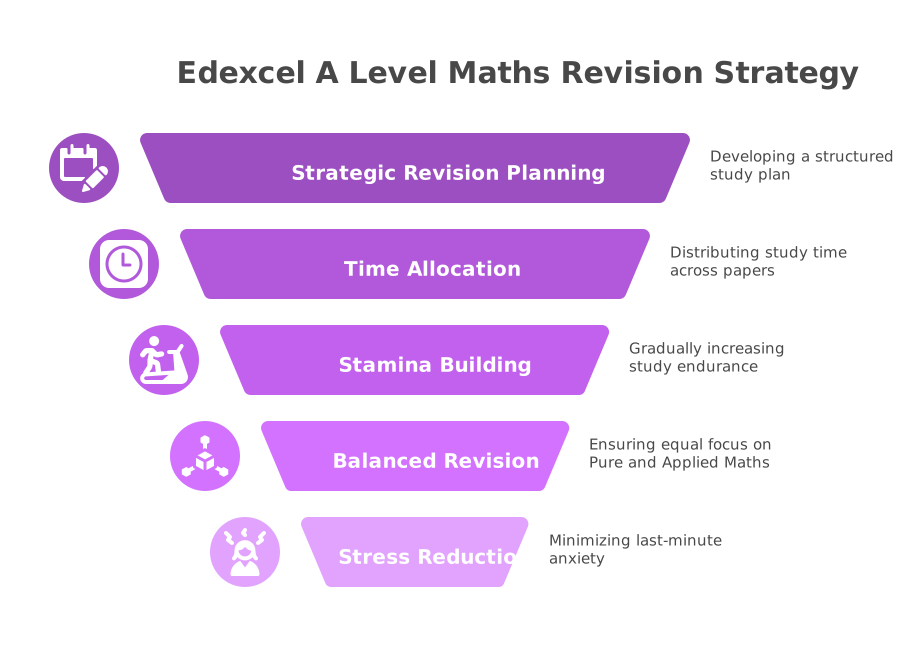
Students who understand the exam structure in detail early will:
- Plan revision more strategically
- Allocate practice time per paper type
- Build exam stamina gradually
- Balance Pure vs Applied Maths revision
- Reduce last-minute stress
For A Level Maths, students can practice weekly on a rotation basis: Pure 1 -> Pure 2 -> Mechanics/Stats.
For Further Maths students, they should practice CP1 and CP2, along with optional modules, each with different difficulty levels.
This clarity prevents students from spending too much time on just one topic while ignoring others that carry equal marks.
6. Where to Access Official Past Papers + Mark Schemes (Legal + Updated)
When preparing for Edexcel Further Maths, using official past papers and mark schemes is crucial. Pearson Edexcel is the only source that provides accurate, updated, and copyright-approved exam materials. Many third-party websites provide outdated, incomplete, or illegally uploaded papers, which can mislead students and violate copyright rules.
Below is a clear guide to where students can legally download Edexcel Further Maths past papers and what materials are restricted.
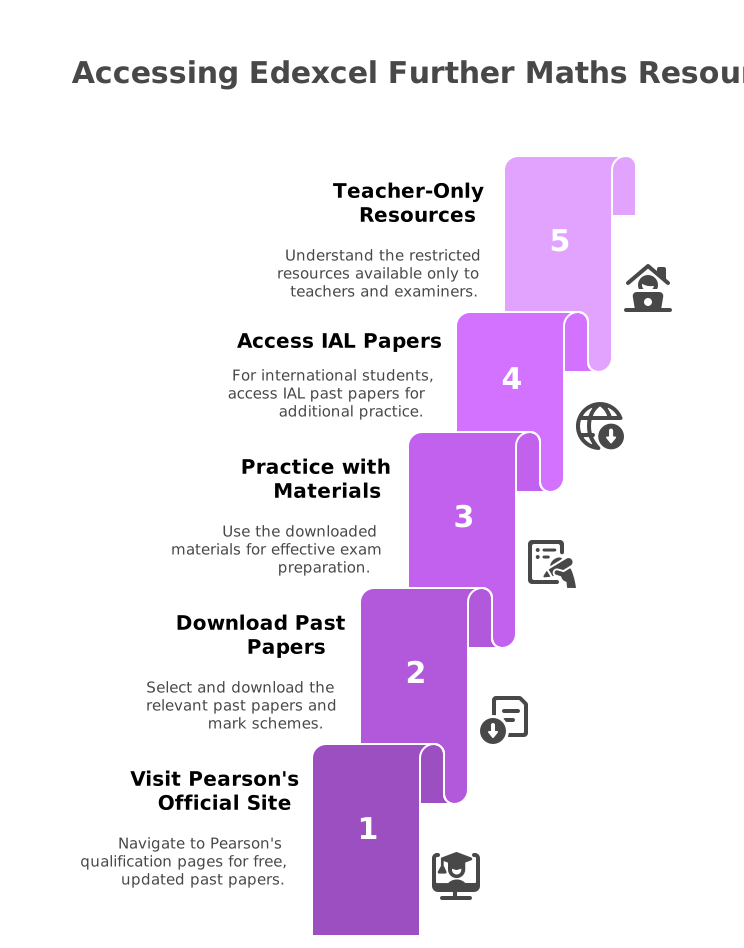
1. Pearson Edexcel Official Past Paper Repository (Public Access – Free & Legal)
Pearson's official qualification pages provide free, safe, and updated downloads for:
- Edexcel Further Maths past papers (A Level – 9FM0)
- Edexcel Further Maths past papers GCSE (Level 2)
- Mark schemes
- Examiner reports
- Sample Assessment Materials (SAMs)
These are released after each exam series (May/June and January for IAL).
All files provided here are copyright-safe, publicly accessible, and aligned with the current specification.
Students can download:
- Core Pure 1 & 2 past papers
- Further Mechanics papers
- Further Statistics papers
- Decision Mathematics papers
- Optional modules
- Examiner commentary on common errors
This is the most reliable source for A Level and GCSE Edexcel Further Maths past papers.
2. International A Level (IAL) Further Maths Past Papers
For students outside the UK, Pearson also provides open access to:
- IAL Further Pure
- IAL Mechanics
- IAL Statistics
These papers follow a slightly different modular structure but are extremely useful for extra practice.
3. What Students Cannot Access
Some high-value resources are not publicly available, require a verified school login, and can be accessed only by teachers and examiners.
These include:
a. Edexcel Maths Emporium (Teacher-Only Zone)
Contains:
- Unreleased mock papers
- Comprehensive question banks
- Extended archives of past papers
- Examiner teaching guidance
- Secure mark schemes
- Topic tests and model solutions
Who can access?
- Qualified teachers
- Exams officers
- Pearson-registered centres can legally access this platform.
Read our blog, "Edexcel Emporium: The Ultimate Guide to Pearson’s Maths Resource Hub," to know more about Edexcel Math Emporium in detail.
Students are NOT permitted to access or download secure materials under Pearson's copyright policy.
Also, students should avoid third-party unofficial websites because they contain:
- Incomplete papers
- Incorrect formats
- Outdated specifications
- Illegally scanned PDF uploads
These can harm exam preparation due to inaccurate content and ethical/legal issues.
7. Best Way to Study Using Past Papers
Practising with a Further Maths Edexcel past paper is one of the highest-impact revision strategies, but only when students follow a structured approach. Cognitive science consistently shows that active recall, spaced repetition, and timed retrieval practice are the most effective ways to strengthen long-term understanding — especially in high-difficulty subjects like Further Maths.
Students who follow the methods below improve accuracy, speed, and exam resilience far more than those who rely solely on textbooks.
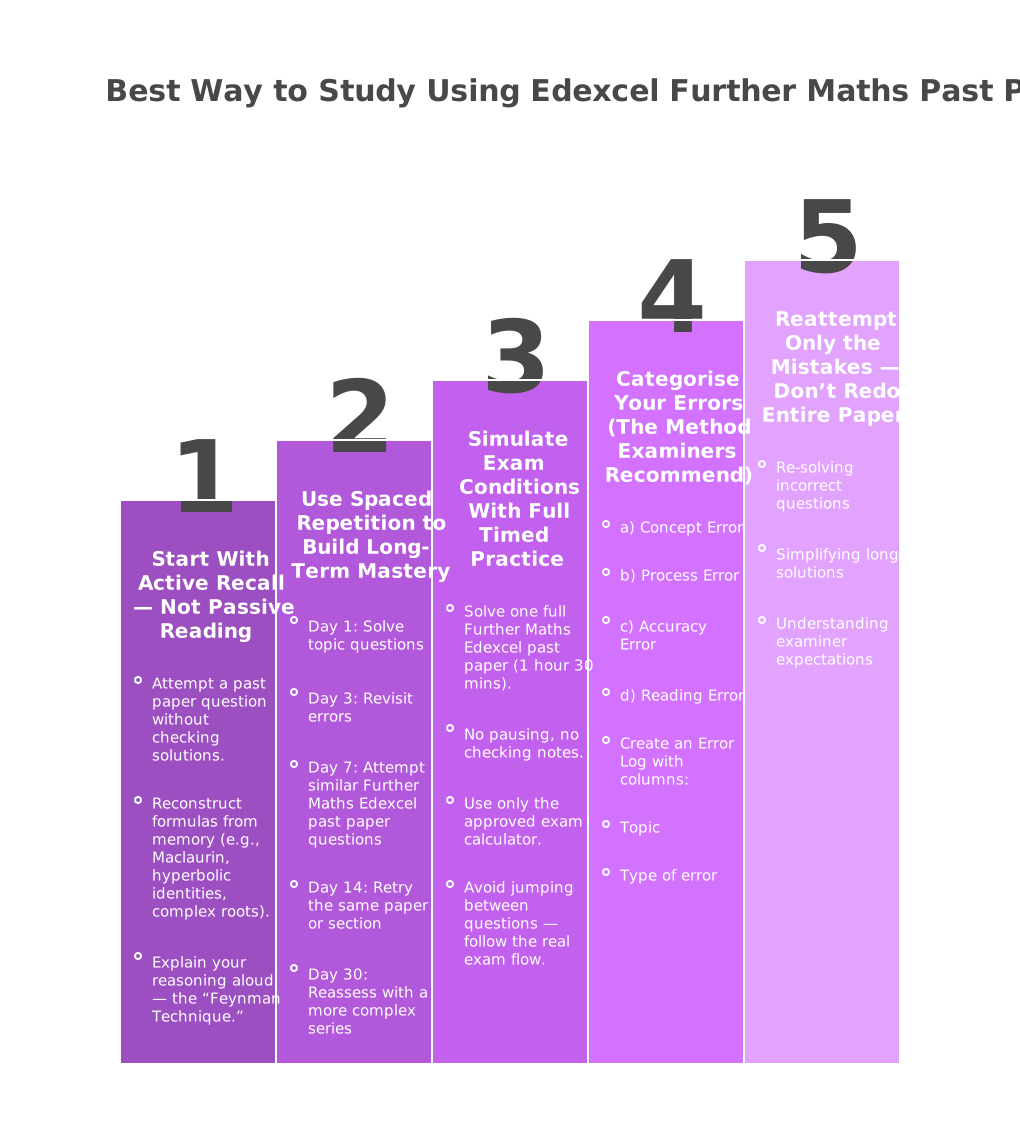
1. Start With Active Recall — Not Passive Reading
Active recall means forcing your brain to retrieve methods, formulas, and strategies without looking at notes.
Use this method for each topic:
- Attempt a past paper question without checking solutions.
- Reconstruct formulas from memory (e.g., Maclaurin, hyperbolic identities, complex roots).
- Explain your reasoning aloud — the “Feynman Technique.”
2. Use Spaced Repetition to Build Long-Term Mastery
Spaced repetition prevents forgetting and strengthens conceptual understanding over time.
A simple schedule:
Day 1: Solve topic questions
Day 3: Revisit errors
Day 7: Attempt similar Further Maths Edexcel past paper questions
Day 14: Retry the same paper or section
Day 30: Reassess with a more complex series
This method is especially effective for high-abstraction content like matrices, polar coordinates, and differential equations.
3. Simulate Exam Conditions With Full Timed Practice
After mastering the topics, students should transition to full, timed papers.
Rules for simulation:
- Solve one full Further Maths Edexcel past paper (1 hour 30 mins).
- No pausing, no checking notes.
- Use only the approved exam calculator.
- Avoid jumping between questions — follow the real exam flow.
Further Maths requires stamina. Many students understand concepts but lose marks due to:
- Time pressure
- Multi-step algebra fatigue
- Slow calculations
- Misreading long questions
Timed practice trains the brain to solve under pressure — precisely what the exam demands.
4. Categorise Your Errors (The Method Examiners Recommend)
After marking your work with an official mark scheme, categorize every mistake into one of these four categories:
a) Concept Error
You didn’t understand the underlying principle (e.g., polar equation conversions, vector proof steps).
b) Process Error
You knew the method but applied it incorrectly.
c) Accuracy Error
Small sign mistakes, arithmetic slips, and rounding errors.
d) Reading Error
Misinterpreting the question — the most common in Mechanics & Decision Maths.
Create an Error Log with columns:
- Topic
- Type of error
- Correct method
- Reattempt date
These methods improve performance more than extra practice.
5. Reattempt Only the Mistakes — Don’t Redo Entire Papers
When revisiting your work, focus on:
- Re-solving incorrect questions
- Simplifying long solutions
- Understanding examiner expectations
By doing so, students maximise improvement with minimal burnout — the exact strategy used by top A Level Further Maths performers.
8. Boosting Problem-Solving Speed Using Vedic Maths Shortcuts
One of the biggest challenges students face when solving Edexcel Further Maths past papers, both GCSE and A Level, is slow calculation speed. Even students who understand the concepts lose precious marks because they spend too much time on long algebraic steps or heavy arithmetic calculations.
Usually, students don't struggle with concepts; they struggle with speed. This is where Vedic Maths becomes a game-changer.
Let's look at where students usually lose the most calculation time:
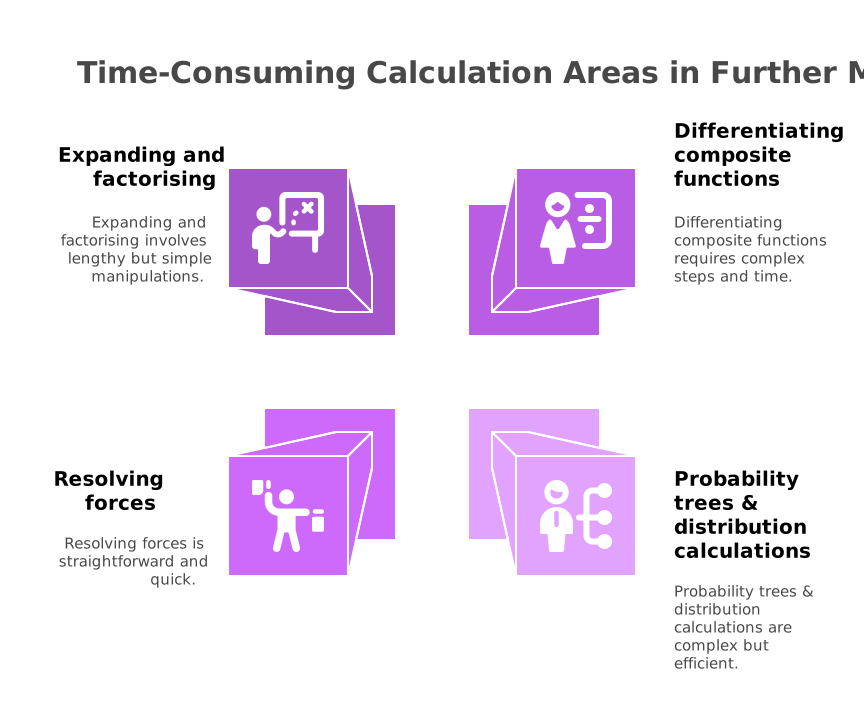
Across Core Pure, Further Mechanics, Further Statistics, and GCSE Further Maths, students usually lose time in:
1. Lengthy Algebraic Manipulations
- Expanding and factorising
- Polynomial multiplication/division
- Simplification steps
2. Trigonometric and Calculus Computations
- Differentiating composite functions
- Integrating expressions with substitutions
- Rearranging trigonometric identities
3. Statistics & Probability Calculations
- Summations
- Variance & standard deviation
- Probability trees & distribution calculations
4. Mechanics Modelling Steps
- Resolving forces
- Eliminating variables
- Multi-step equations
Even a 10–15 second delay per question adds up to 8–12 minutes per paper, which can make a huge difference in achieving the expected grade.
How Vedic Maths Shortcuts Improve Speed?
Vedic Maths techniques help students to:
- Multiply large numbers mentally in seconds
- Perform fractional & ratio calculations instantly
- Estimate values faster (critical for Statistics)
- Reduce multi-step arithmetic into 1–2 steps
- Avoid dependency on a calculator
Read our blog, "Vedic Maths Tricks PDF," to know more about Vedic Maths tricks and shortcuts.
What are you waiting for?
Learn Vedic Maths in just 40 days through our Live Classes, led by Ms. Mamta Rupesh, a certified Vedic Maths teacher with over 8 years of experience. She has successfully trained over 15,000 students, 5,000 parents, and 5,000 teachers globally, and continues to expand her reach. Her proven teaching methodology enables students to grasp even the most challenging math problems with ease and clarity.

Live Vedic Maths Classes Best Selling
Its a 40 day live Classes thought only for children from Grade 3 to 12 covers from Basics to Advance.
- 40 Day Live Program
- Get Individual Attention
- Certification & Lifetime Access
Alternatively, you can learn Vedic Maths at your own pace with the Vedic Maths Bundle Kit. This kit includes 7+1 pre-recorded courses, offering over 25 hours of video tutorials covering division, multiplication, and numerous other math topics.

Vedic Maths Bundle Kit Best Selling
Perfect program designed for students from grade 3 - 12, teachers & parents aspiring to grow their career & upskill their children.
- Bundle Offer
- Worksheets & Exercise Problems
- Certification & Lifetime Access
Also, access free downloadable Vedic Maths worksheets to practice the techniques and shortcuts learned during the course. Download the worksheets today and practice Vedic Maths techniques in different question formats, screen-free.
Book a free 45-minute personalized demo class today to know more about our Vedic Maths course.
Join our Vedic Maths WhatsApp community today for the latest updates on upcoming classes and courses.
For more information, visit www.thevedicmaths.com or contact us at +91-866-056-2614 or info@thevedicmaths.com to learn more.
Why choose Ms. Mamta Rupesh?
Read our real-time reviews from our students, parents, and teachers to see how Mamta Rupesh’s teaching helped them overcome math anxiety and boost their academic performance.


Testimonials from Students
Here are a few reviews from Parents


It has been wonderful experience for my granddaughter. Our brain is nothing but a number crunching machine. Vedic Maths sharpens the brain and improves this number crunching ability.
Madam Mamata has been very good and her teaching was nice. She is sincere and caring towards students.
Please continue the good work and I wish you best luck for the future journey.

Mukund Oke
Happy Grandfather, India
The most interesting and helpful class in the world,
The teacher always clears our doubts until we are clear about the concepts.
Her teaching style is very interactive. she keeps the class more fun also .Thank you mam for giving us a wonderful opportunity to learn with you.

Sengamala Priya
Happy Mother, UAE
I had enrolled my daughter for vedic math class with Miss Mamta and it was a good experience for her to learn the math concepts. Miss Mamta was patiently guiding through the course, helping out in case of doubts and flexible with kids. Thanks for sessions, it was really helpful.
Thivya Nagarajan
Happy Mother, Singapore
Thank you for your wonderful sessions. My daughter really enjoyed throughout this course. No fear of Maths which she had experienced before with abacus.
You will be greatly missed!
Looking for some advanced classes for kids soon!
Geethu Sajad
Happy Mother, UAE
Ms Mamta is very warm and jovial. She made my child feel very comfortable. By sharing her own challenges in math in her early years and how she overcame these challenges she makes everything seem possible. During this short duration of the demo she showed atleast 5 tricks to solving problems there by piquing my daughter’s interest. We are very much looking forward to the classes with Ms Mamta.
Veena Krishnamurthy
Happy Mother, Malaysia
She is an amazing teacher. She has a “no frills, student centered” teaching approach. The personal attention towards every learner in a virtual environment is indeed praiseworthy. The illustrations and practice exercises are perfect to overcome mathematics phobia. As a teacher, I can safely say, she is a wonderful person to teach Maths to the kids of all age groups.
Dr. Manishankar Chakraborty
Happy Father, UAE
9. Combined Study Strategy → Past Papers + Vedic Maths
Solving Edexcel Further Maths past papers is more effective when combined with Vedic Maths speed-building techniques.
Past papers help you master exam style, structure, and difficulty, and Vedic Maths gives you the calculation efficiency and speed needed to finish the paper on time. Students score highest when they combine real exam practice with daily calculation-speed training.
Below is a weekly study plan designed to score the highest grades in the exam.
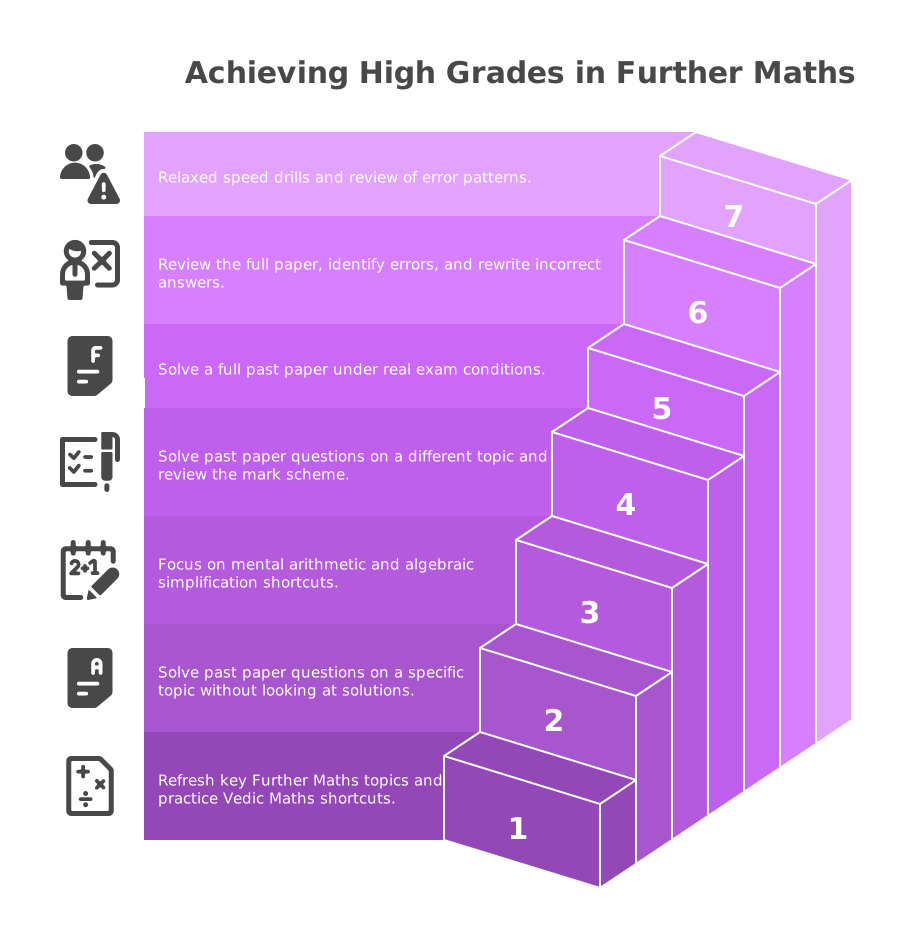
1. Monday — Concept Revision (20–30 mins) + Speed Practice (10 mins)
- Review a key Further Maths topic (e.g., complex numbers, matrices, kinematics).
- Practice 1–2 Vedic Maths speed drills (multiplication, factorisation shortcuts).
Goal: refresh concepts before attempting past paper questions.
2. Tuesday — Topic-Based Practice from Edexcel Further Maths Past Papers
Choose one topic and solve 6–10 real past paper questions.
Examples:
- CP1 → Complex numbers, roots of polynomials
- FS1 → Probability distributions
- FM1 → Impulse, momentum
- Decision Maths → Graph algorithms
Focus: attempt without looking at worked solutions.
3. Wednesday — Vedic Maths Speed Session (15 mins) + Short Timed Quiz
- Practise mental arithmetic, algebraic simplification shortcuts, and quick division.
- Attempt a 15-minute mini-test using questions from older papers.
Goal: build speed while maintaining accuracy.
4. Thursday — Topic-Based Past Papers (Second Topic)
- Solve a different topic to maintain balanced revision coverage.
- Use the official mark scheme afterward to understand the step-by-step reasoning examiners expect.
5. Friday — Full-Length Paper (1 hour 30 minutes)
a) Choose one full paper from:
- Core Pure 1
- Core Pure 2
- Further Statistics / Further Mechanics / Decision Maths
b) Solve under real exam conditions:
- No pausing
- No checking solutions mid-way
- Use only approved calculators
Goal: build exam stamina + time management skills.
6. Saturday — Deep Error Analysis + Speed Correction
This is the MOST important step.
Review your full paper and ask:
- Were the errors conceptual?
- Did I lose time during calculations?
- Could a Vedic Maths method have reduced steps?
Rewrite incorrect answers using the mark scheme logic and add errors to an "Error Log Book".
7. Sunday — Light Revision + Vedic Maths practice
- 10–15 minutes of relaxed speed drills
- Quick review of your week's error patterns
- Don't solve complex problems
When to Solve Past Papers?
Solving past papers is best for:
- Understanding exam format
- Improving reasoning + structure
- Developing confidence with difficult questions
- Applying theory under pressure
When to Practice Speed Maths?
Practicing Vedic Maths is best for:
- Reducing calculation time
- Eliminating silly errors
- Saving precious time in the exam
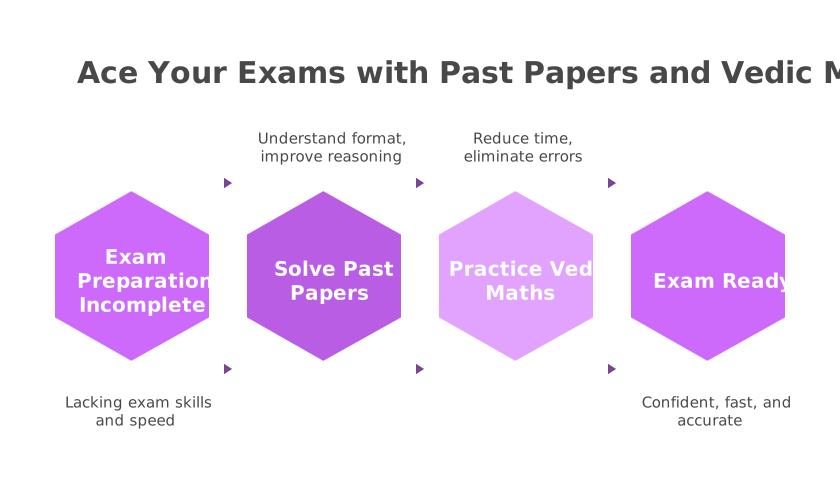
What is the use of combining past papers and Vedic Maths?
Students can:
- Perform 40–60% faster calculations
- Improved completion rates
- Higher accuracy in 4–7 mark questions
- Reduced exam anxiety
When past papers are combined with Vedic Maths speed drills, students can create a perfect high-score preparation plan and strategies.
Time-Efficiency Tracking
Time tracking is essential for achieving A Grades
Track your timings for:
- Q1–5 (easy) should take less than 25 minutes
- The middle section questions should not take more than 40 minutes
- Final long questions - save 20+ minutes
10. Helpful Links & Sources
To prepare effectively for Edexcel Further Maths, students must rely only on official, updated, and legally accessible resources.
Below is a curated list of high-quality links — including Pearson’s official past papers, specifications, mark schemes, and trusted internal learning tools that support speed, accuracy, and long-term mastery.
All sources listed are verified, exam-aligned, and aligned with Pearson copyright requirements.
1. Official Pearson Edexcel Past Paper PDFs (Public Access)
These are the safest and most accurate places to download:
a) Edexcel A Level Further Maths (9FM0) Past Papers Includes:
- Core Pure 1
- Core Pure 2
- Further Mechanics
- Further Statistics
- Decision Mathematics
- Mark schemes + examiner reports
Pearson Qualifications → GCE → Mathematics → Past Papers
Perfect for students searching for a further maths Edexcel past paper collection that is updated every exam series.
b) Edexcel A Level Maths (9MA0) Past Papers
Useful for students taking both Maths + Further Maths.
Includes Pure 1, Pure 2, and Statistics & Mechanics papers.
c) Edexcel GCSE Further Maths Past Papers
Includes:
- Algebra
- Geometry
- Introductory Calculus
- Proof-based questions
Ideal for learners bridging from GCSE to A Level Further Maths.
2. Official Pearson Specifications & Syllabuses
These documents outline exam content, structure, assessment objectives, and required mathematical skills.
a) A Level Further Maths Specification (9FM0)
Includes:
- CP1 + CP2 content
- Optional modules
- Formula booklet
b) A Level Maths Specification (9MA0)
Important for overlap between Maths and Further Maths topics.
c) GCSE Further Maths Specification
Defines pre-A Level advanced concepts and question types.
3. Mark Schemes and Examiner Reports
Pearson releases detailed reports explaining:
- Why do specific answers receive marks
- Common mistakes
- Expected reasoning steps
- Examiner insights on modelling and structure
These documents are essential for improving exam technique.
4. Teacher-Only Resources (Restricted Access)
Some materials are NOT legally accessible to students:
- The Pearson Edexcel Maths Emporium
- Mock exam sets
- Secure mark schemes
- Examiner teaching packs
Students must use only publicly released materials to remain compliant with Pearson’s guidelines.
5. Vedic Maths Resources to Build Speed and Accuracy
These resources complement further maths Edexcel past paper practice by improving:
- Mental calculation
- Algebraic speed
- Probability simplification
- Time management in multi-step problems
a) Live Vedic Maths Classes (Grades 3–12)
Perfect for:
- A Level & Further Maths students
- Competitive exam aspirants
- Learners aiming for speed and conceptual clarity
b) Vedic Maths Bundle Kit (7+1 Complete Modules)
Includes:
- 25+ hours of lessons
- Worksheets
- Lifetime access
- Core arithmetic + algebraic shortcuts
- Ideal for self-paced improvement.
c) Free Vedic Maths Worksheets (Downloadable PDFs)
Useful for daily practice exercises before attempting timed past papers.
These internal resources help students build the speed required to solve tough exam problems under time pressure.
11. Conclusion
Preparing for Edexcel Further Maths—whether at GCSE or A Level—becomes significantly easier and more effective when students rely on the right exam resources. Textbooks help you learn the concepts, but Edexcel Further Maths past papers train you to apply those concepts under real exam pressure. These papers reveal the exact question style, level of difficulty, logic-based reasoning, and marking expectations used by Pearson examiners.
By using Edexcel Further Maths past papers A Level, students gain mastery over Core Pure, Further Statistics, Further Mechanics, and Decision Maths. Meanwhile, Edexcel Further Maths past papers GCSE help younger learners build early confidence, strengthen algebraic foundations, and prepare smoothly for advanced study. Understanding how many papers are in Edexcel A Level Maths and Further Maths also allows students to plan their revision efficiently and avoid last-minute stress.
However, the highest exam performance comes when past paper practice is combined with calculation speed. This is why learners who train with Vedic Maths techniques alongside past papers make faster progress—they reduce calculation time, avoid arithmetic errors, and finish the exam with confidence.
12. FAQs on Edexcel Further Maths Past Papers
1How do I access past Further Maths exam papers with mark schemes?
Download official past papers and mark schemes from the Pearson Edexcel website (Qualifications → Mathematics → Past papers). Search for the A Level Further Maths (9FM0) or GCSE Further Maths section and choose the exam series you need. Mark schemes and examiner reports are published alongside papers.
2Where can I find official Further Maths past papers online?
The most reliable source is Pearson Edexcel’s official past papers repository and qualification pages. These public PDFs include papers, mark schemes, formula booklets, and examiner reports for both A Level (9FM0) and GCSE Further Maths.
3How to access Edexcel Maths Emporium resources (teacher-only)?
The Pearson Edexcel Maths Emporium is restricted to verified teachers and exam officers. Schools with Pearson registration can log in using centre credentials. Students should ask their teacher or exam officer for Emporium downloads; do not attempt to log in as an unauthorised user.
4Where can I get past papers for Further Maths exams from UK exam boards?
For Edexcel, use Pearson’s website. Always prefer official board sites — third-party archives may be incomplete or outdated.
5How to use past Further Maths papers effectively for revision?
Use a staged approach: topic-wise practice → timed full papers → mark with official mark schemes → deep error analysis → spaced repetition. Keep an error log, reattempt mistakes, and simulate exam conditions regularly.
6How many past papers should I solve for A Level Further Maths?
Quality is more important than quantity: Aim for 7–10 full papers per module (CP1, CP2, optional modules) across the year, plus topic-wise questions. Regular timed practice plus mark-scheme review is essential.
7Where can I find Edexcel Further Maths exam timetables?
Edexcel exam timetables are published on the Pearson Qualifications > Exam Timetables page. Schools and registered centres also receive official timetable PDFs—ask your exams officer for the confirmed dates for your centre.
8How to register for Edexcel Further Maths exams?
Students must register through an approved Pearson centre (school, college, or authorised exam centre). Contact your school exams officer to register and provide your details and centre number. Private candidates should contact a local Pearson-registered centre for entry.
9What is the difference between Edexcel IAL and GCE Further Maths?
IAL (international) papers have different session windows; GCE is the UK linear A Level. Both are useful practices, but always check which specification (GCE vs IAL) your centre uses before practising.
10Can private tutors access Emporium resources for students?
Only if the tutor is registered with an approved Pearson centre and has teacher access, otherwise tutors should use public Pearson past papers, SAMs, and official mark schemes to design mocks.
11What are examiner reports, and how should I use them?
Examiner reports explain common student mistakes and what examiners expect for full marks. After marking a paper, read the relevant examiner report to learn wording, method expectations, and common mistakes—then reattempt problem types highlighted.
12How do I create timed practice tests from past papers?
Pick a past paper PDF (or sections), set the official duration (1h30 for Further Maths papers), use only permitted calculators, and sit uninterrupted. Afterwards, mark with the official mark scheme and log errors.
13Is it recommended to download all past papers from unofficial sites?
No — avoid unofficial or pirated repositories. Use Pearson Edexcel’s official downloads to stay copyright-compliant and ensure papers match the current specification.
14How can Vedic Maths help with Further Maths past paper practice?
Vedic Maths speeds up routine calculations (Division, multiplication, fractions) so you spend more time on reasoning and modelling. Use speed drills daily alongside past-paper practice for best results.
For example, in Further Statistics, mental estimation checks prevent calculation errors in Poisson distributions.
15Who should I contact if a paper or mark scheme seems different from my syllabus?
Ask your teacher/exams officer first. If uncertainty remains, check the Pearson Edexcel qualification page for the correct specification code (9FM0 for Further Maths) or contact Pearson customer support via their official site.

